Facts
The appellant was convicted by the Special Court (POCSO), Palakkad, for the aggravated sexual assault of an 11-year-old neighbor in April-May 2017
Source reference: p. 3The prosecution alleged the appellant lured the victim to his house with candy and committed penetrative sexual assault
Source reference: p. 2-3The incident came to light during school counseling on July 10, 2017
Source reference: p. 14The appellant challenged the judgment on grounds of an unsigned First Information Statement (FIS), lack of age proof, and discrepancies in the description of the crime scene
Source reference: p. 4-5Issues
1. Whether the trial court was correct in holding the accused committed offenses under Section 5(m) r/w 6 of the POCSO Act and Section 376(2)(n) (erroneously cited as 376(2)(1) in parts of the text) of the IPC?
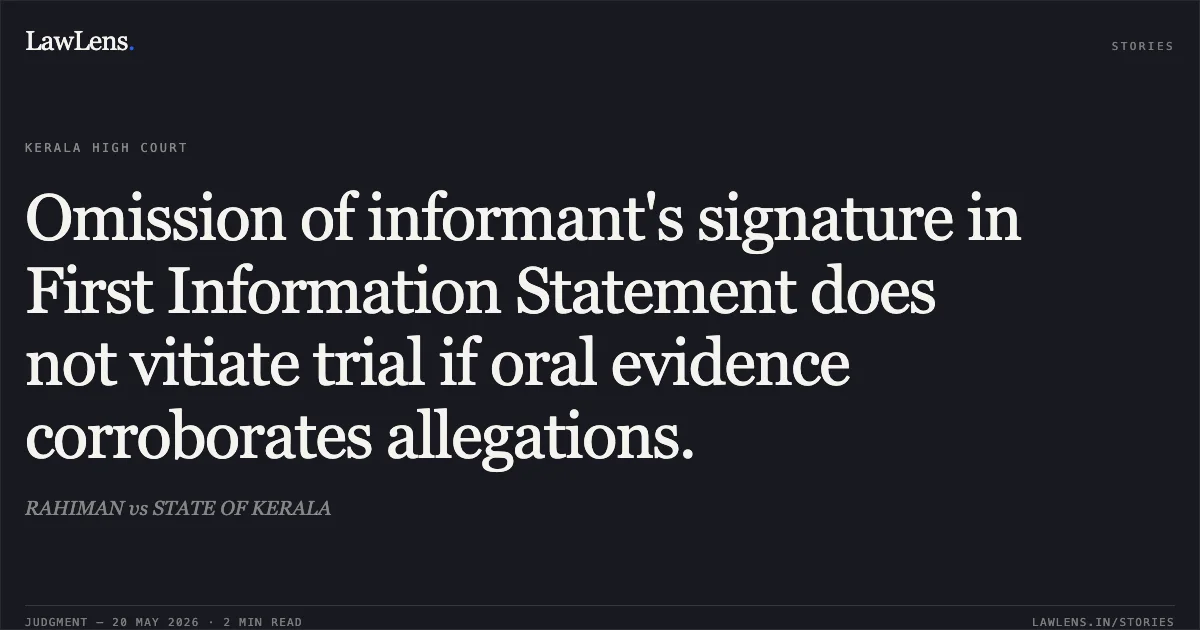
Source reference: p. 6, para. 82. Whether the omission of the informant's signature on the First Information Statement (FIS/Ext.P8) renders it inadmissible or fatal to the prosecution?
Source reference: p. 12, para. 153. Whether the prosecution successfully established the victim’s age below 18 years to invoke POCSO provisions?
Source reference: p. 10, para. 13Law Applied
The Court applied Section 5(m) read with Section 6 of the Protection of Children from Sexual Offences (POCSO) Act, which defines and penalizes aggravated penetrative sexual assault, and Section 376(2) of the Indian Penal Code (IPC) regarding rape
Source reference: p. 2-3Regarding procedural law, it interpreted Section 154 of the Cr.P.C. concerning the First Information Report, establishing that the mere absence of a signature on the FIS does not invalidate a case if the informant’s testimony in court is consistent and credible
Source reference: p. 12It also applied principles of age determination using school admission registers as per the Juvenile Justice rules
Source reference: p. 10, 13Reasoning
The Court found the victim’s (PW13) testimony "candid" and consistent with her prior statements under Section 164 Cr.P.C.
Source reference: p. 12The Court dismissed the challenge to the FIS (Ext.P8), reasoning that while signatures are standard, their omission is a procedural irregularity that does not override substantive, credible oral evidence provided under oath
Source reference: p. 12Regarding age, the Court relied on the school admission register (Ext.P10) and testimony from the teacher (PW3), confirming the victim was 11 years old at the time of the offense
Source reference: p. 10, 13The Court also highlighted the corroborative value of the counselor's testimony (PW18), which explained that the delay in reporting was due to threats made by the accused
Source reference: p. 15The potency of the accused was confirmed via medical examination (PW14), and physical evidence (M.O1-3) recovered from the scene corroborated the victim's account
Source reference: p. 10-11, 13Holding
The High Court affirmed the conviction, holding that the prosecution proved its case beyond a reasonable doubt. It ruled that a lack of signature on the FIS is not a ground for acquittal when the victim’s testimony is reliable
The Court sustained the sentence of 15 years of rigorous imprisonment and a fine of ₹25,000, noting that the punishment was proportionate to the gravity of the offense. The appeal was dismissed.
Source reference: p. 17Acts & Sections Cited
6 provisions across 3 statutes referred to in this judgment. Each provision opens on LawLens.
Protection of Children from Sexual Offences Act, 20124
Indian Penal Code, 18601
Code of Criminal Procedure, 19731
Original Court PDF
RAHIMANvsSTATE OF KERALA
Click to open original judgment
Original judgment, available to read, download and summarize on LawLens.in