Facts
The petitioner was arrested on 06.10.2025 following a police intercept near Nilambazar based on intelligence reports
Source reference: p.2A search of the scooty driven by the petitioner allegedly led to the recovery of 20,000 Yaba tablets weighing 2123.16 grams, classified as a commercial quantity under the NDPS Act
Source reference: p.3The petitioner sought regular bail under Section 483 of the BNSS, 2023, primarily challenging the legality of his arrest on the grounds that the arrest memo lacked the signature of a family member or a respectable locality member
Source reference: p.3Procedurally, the case was pending as Special (NDPS) Case No. 22/2026
Source reference: p.2Issues
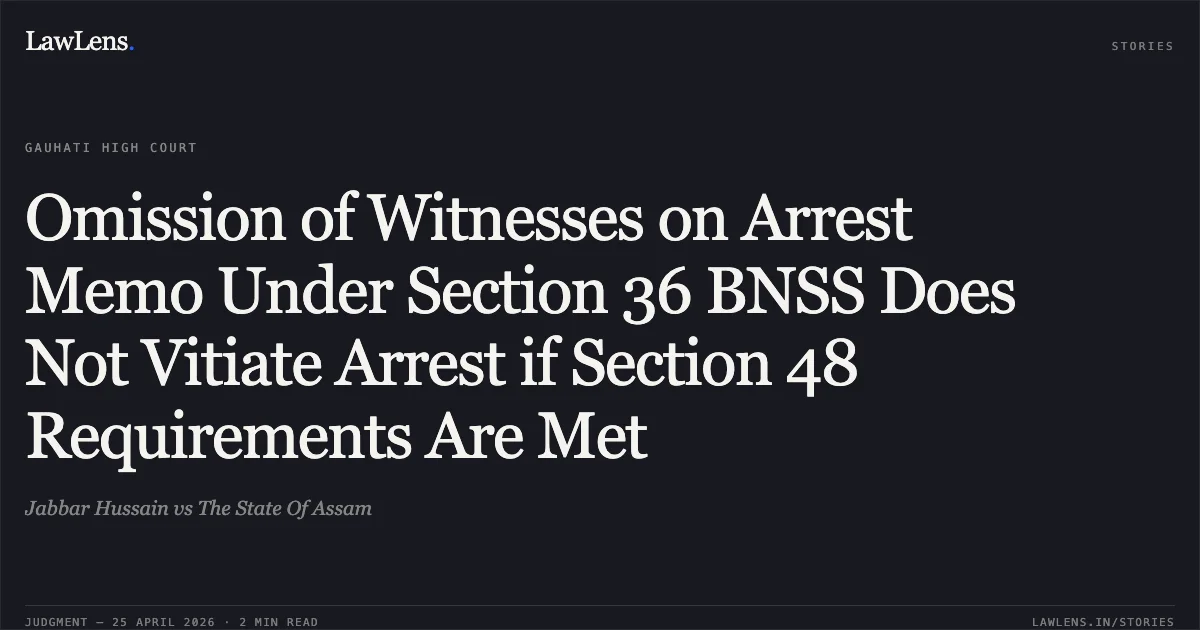
1. Whether the absence of a signature from a family member or a respectable person of the locality on the arrest memo vitiates the arrest or renders it illegal under the BNSS
Source reference: p.3, para. 52. Whether the petitioner is entitled to bail despite the recovery of a commercial quantity of contraband
Source reference: p.8, para. 16Law Applied
Section 36 of the Bharatiya Nagarik Suraksha Sanhita (BNSS), 2023, which prescribes the procedure for arrest, requiring attestation of the memo by a witness unless the arrestee is informed of their right to have a relative notified.
Source reference: p.5-6Section 48 of the BNSS regarding the duty to inform relatives of the arrest and Section 62 regarding strict adherence to the Sanhita.
Source reference: p.6-7; p.5-6D.K. Basu v. State of West Bengal (1997) 1 SCC 416, which established mandatory safeguards for arrestees.
Source reference: p.4Section 37 of the NDPS Act, which imposes a rigorous two-prong test for offenses involving commercial quantities.
Source reference: p.8Reasoning
The court reasoned that while Section 36(b)(i) of the BNSS requires attestation by a family member or local respectable person, this requirement is read in conjunction with Section 36(c), which provides an alternative: informing the arrestee of their right to notify a friend or relative.
Source reference: p.6The court found that since the police had serves a notice under Section 48 of the BNSS to the petitioner’s wife—containing details of the time, date, and place of arrest—the underlying purpose of the arrest memo (legal accountability and notification) was satisfied.
Source reference: p.7-8The court rejected the State's argument that a signature on an inspection memo (prepared under Section 54 CrPC/BNSS equivalent) could substitute an arrest memo signature, noting doctors cannot testify to arrest details.
Source reference: p.8Because a commercial quantity was recovered, the court found the rigors of Section 37 NDPS Act applicable. There were no reasonable grounds to believe the petitioner was not guilty.
Source reference: p.8Holding
The court held that the absence of a witness's signature on the arrest memo does not ipso facto vitiate the arrest if the notification requirements under Section 48 BNSS are otherwise met.
The court further held that the petitioner failed to overcome the statutory hurdles of Section 37 of the NDPS Act. Consequently, the bail application was rejected and the petition dismissed.
Source reference: p.8, para. 17Acts & Sections Cited
10 provisions across 3 statutes referred to in this judgment. Each provision opens on LawLens.
Bharatiya Nagarik Suraksha Sanhita, 20235
Narcotic Drugs and Psychotropic Substances Act, 19854
Code of Criminal Procedure, 19731
Original Court PDF
Jabbar HussainvsThe State Of Assam
Click to open original judgment
Original judgment, available to read, download and summarize on LawLens.in