Facts
The appellant was accused of kidnapping a minor girl (PW1), aged 11, on 03.03.2019 under the pretext of attending his daughter's birthday.
Source reference: p. 10He allegedly took her to a secluded jungle near Khera Dabar Village, committed penetrative sexual assault, and attempted to strangulate her when she resisted.
Source reference: p. 11After regaining consciousness, PW1 was dropped home by an unidentified motorcyclist.
Source reference: p. 11The Trial Court, vide judgment dated 28.11.2024, convicted the appellant under Sections 363, 366, 307 of the IPC and Section 6 read with 5(m) of the POCSO Act.
Source reference: p. 1-2The appellant challenged the conviction, citing material inconsistencies, failure to examine the motorcyclist, a financial dispute with the victim's family, and lack of proof regarding the victim's age.
Source reference: p. 7-8Issues
1. Whether there is any infirmity in the Trial Court’s judgment regarding the conviction under Sections 363, 366 IPC and Section 6 POCSO Act.
Source reference: p. 92. Whether the prosecution satisfactorily established the age of the victim to attract Section 5(m) of the POCSO Act.
Source reference: p. 8 / p. 213. Whether the ingredients of Section 307 IPC (Attempt to Murder) were proven beyond reasonable doubt.
Source reference: p. 26Law Applied
The Court applied Sections 361 and 363 IPC for kidnapping from lawful guardianship and Section 366 IPC for kidnapping with intent to compel illicit intercourse.
Source reference: p. 17Regarding the age of the victim, the Court applied Section 34 of the POCSO Act and the principles established in Sasi v. State of Kerala, holding that certificates prepared by school principals for the IO are hit by Section 162 CrPC and are inadmissible, whereas original admission registers carry evidentiary weight.
Source reference: p. 22For the charge of attempt to murder, the Court relied on Om Parkash v. State of Punjab and Hari Mohan Mandal v. State of Jharkhand, which emphasize that the "intention or knowledge" to cause death is the sine qua non for Section 307 IPC.
Source reference: p. 27-28Reasoning
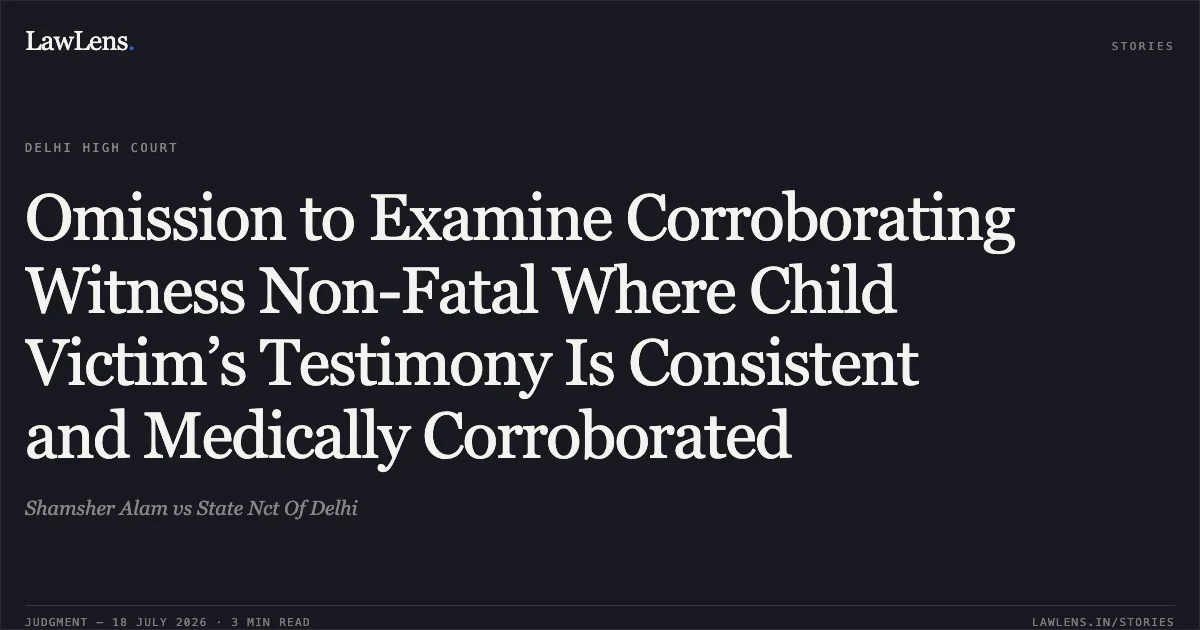
The Court found the testimony of the child victim (PW1) to be "substantially consistent" across her FIS/FIR, Section 164 statement, and Court deposition.
Source reference: p. 20This testimony was corroborated by his brother (PW6) and medical evidence (Ext. PW5/A) showing a torn hymen and neck abrasions.
Source reference: p. 20-21Regarding the victim's age, the Court accepted the school admission register (Ext. PW2/A) recording her birth date as 13.08.2008, rendering her 11 years old at the time of the incident.
Source reference: p. 23The Court dismissed the defense of financial animosity as "unsubstantiated" and ruled that the failure to examine the motorcyclist was not fatal since he was not an eyewitness to the crime itself.
Source reference: p. 24, p. 25-26Regarding Section 307 IPC, the Court observed that while neck injuries existed, the prosecution failed to prove a specific "intention or knowledge" to cause death, noting that choking during a sexual assault does not automatically equate to an intent to murder.
Source reference: p. 29Holding
The High Court partly allowed the appeal, confirming the conviction under Sections 363 and 366 of the IPC and Section 6 of the POCSO Act, while acquitting the appellant of the charge under Section 307 IPC.
The Court modified the sentence for the POCSO Act conviction, reducing it from 14 years to 12 years of rigorous imprisonment, while maintaining the other sentences to run concurrently.
Source reference: p. 31Acts & Sections Cited
17 provisions across 4 statutes referred to in this judgment. Each provision opens on LawLens.
Bharatiya Nagarik Suraksha Sanhita, 20231
Indian Penal Code, 18606
Code of Criminal Procedure, 19737
Original Court PDF
Shamsher AlamvsState Nct Of Delhi
Click to open original judgment
Original judgment, available to read, download and summarize on LawLens.in