01Facts
The deceased, Jyoti Bala, died on 16.05.2007 due to a snake bite sustained while staying at the house of the respondent, her brother-in-law
¶ 2The prosecution alleged that after the bite, the respondent negligently took the deceased to a sorcerer (PW5) instead of a hospital, leading to her death
¶ 2, 7The sorcerer advised the respondent to seek medical help
¶ 19The Trial Court acquitted the respondent of charges under Section 304A IPC, holding that the snake bite, not the respondent's conduct, was the proximate cause of death
¶ 6The State appealed this acquittal
¶ 702Issues
i.1. Whether the failure of the respondent to provide immediate medical treatment constitutes a "rash or negligent act" under Section 304A of the IPC
¶ 9, 17ii.2. Whether the omission to take the deceased to a hospital was the proximate and efficient cause of death
¶ 19, 2103Law Applied
Section 304A of the Indian Penal Code (IPC) regarding causing death by negligence.
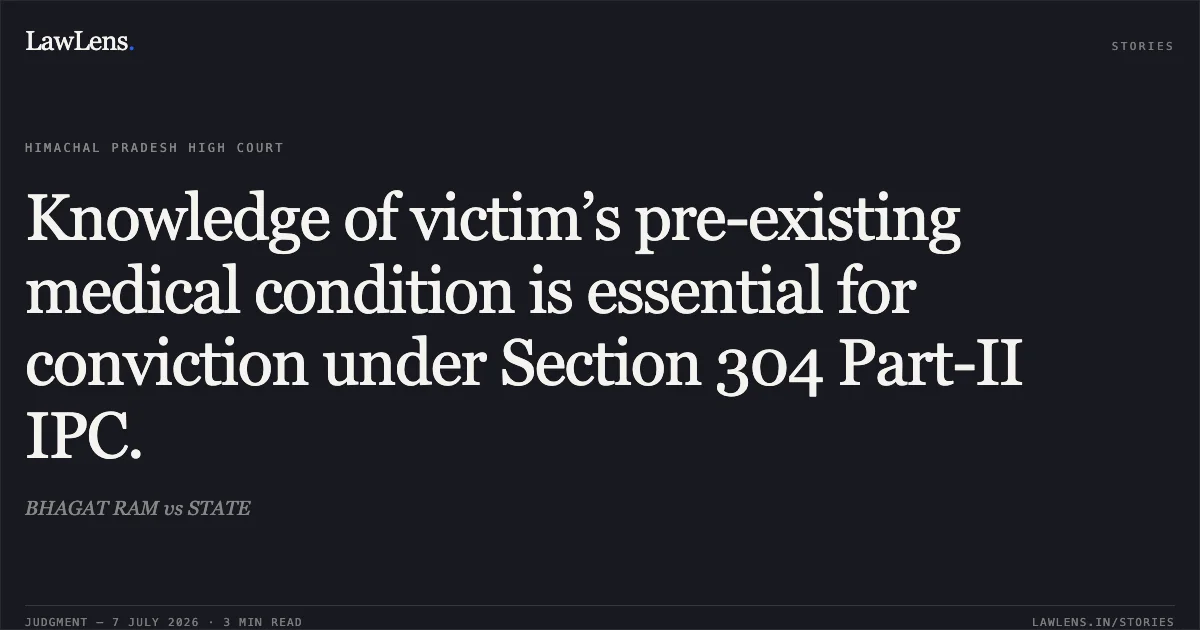
The fundamental principle that for an "omission" to be punishable, it must be "illegal," meaning a breach of a specific direction of law or a ground for civil action
¶ 17High threshold for interfering with acquittals established in Surendra Singh v. State of Uttarakhand (2025) and Tulasareddi v. State of Karnataka (2026)
¶ 12, 14Ratios from Queen v. Morby [L.R. 8 Q.B.D. 571] and Regina v. Broughton [2021], which mandate that the prosecution prove the neglect was a "significant contributory cause" that actually shortened life, rather than a mere possibility of saving it
¶ 19, 21Provisions in the judgment · 4 · Linked ones open on LawLens
Indian Penal Code, 1860 Section 336
Code of Criminal Procedure, 1973 Section 313Section 437
Bharatiya Nagarik Suraksha Sanhita, 2023 Section 481
04Reasoning
The court reasoned that the prosecution failed to establish a legal duty of care whose breach (omission) would be considered "illegal" under the IPC
¶ 18The court noted the absence of expert medical testimony from the autopsy surgeon (PW6) suggesting that the deceased’s life could definitely have been saved had she been hospitalized sooner
¶ 19, 22Following Queen v. Morby, the court held that a mere "possibility" of survival is insufficient for a criminal conviction
¶ 19-20The court considered the socio-economic context: the respondent was of humble means (a hairdresser living in a kaccha house) and behaved as a reasonable person in his community might by visiting a locally renowned healer (PW5)
¶ 23-28The respondent's actions did not meet the standard of "gross negligence" required to overturn an acquittal
¶ 2905Holding
The snake bite was the proximate cause of death and the prosecution failed to prove that the respondent's delay in seeking medical aid was the "proximate and efficient" cause of the fatality
¶ 6, 29The High Court dismissed the appeal and upheld the Trial Court's judgment of acquittal. The respondents were directed to furnish bail bonds as per Section 437-A of the Cr.P.C.
¶ 30, 31Original Court PDF
STATE OF HPvsDEV RAJ
Click to open original judgment
Original judgment, available to read, download and summarize on LawLens.in