Facts
The revisionists—Asha Sah (mother-in-law), Bhup Narayan (father-in-law), and Ashish Anand (husband)—challenged the order dated 19 February 2026 by which the Vth Civil Judge, Senior Division, Ratlam framed charges against them under Sections 74, 85, 351(3) and 3(5) of the Bharatiya Nyaya Sanhita, 2023, and Sections 3 and 4 of the Dowry Prohibition Act, 1961, arising from Crime No. 610/2025 registered at Police Station Station Road, Ratlam
Source reference: paras. 1–2The complainant married Petitioner No. 3 on 2 March 2019 and alleged that, after marriage, he forced her to leave her employment, physically and mentally abused her, and threatened her when she complained of sexual harassment allegedly committed by Petitioner No. 2. She further alleged that Petitioners Nos. 1 and 2 harassed her for dowry
Source reference: paras. 3–6The FIR was registered on 25 July 2025 after the complainant left the matrimonial home on 22 May 2025, and a charge-sheet was thereafter filed against all three petitioners
Source reference: paras. 6–7The petitioners sought discharge, contending that the allegations against the in-laws were vague, delayed, improbable, and omnibus, while the allegations against the husband were disputed questions of fact
Source reference: paras. 8–10Issues
Whether the allegations and material on record disclosed a prima facie case sufficient to sustain the charges against Petitioners Nos. 1 and 2, particularly where the allegations of dowry harassment were general and lacked specific particulars
Source reference: paras. 15–17Whether the allegation that Petitioner No. 2 sexually harassed the complainant while teaching her to drive disclosed the ingredients of an offence under Section 74 of the BNS, 2023, in light of the complainant’s existing driving licence and the surrounding circumstances
Source reference: paras. 16–17Whether the direct allegations of physical assault, mental cruelty, coercion, and criminal intimidation against Petitioner No. 3 warranted interference with the order framing charges at the revisional stage
Source reference: paras. 18–21Whether the revisional court could assess the defence documents and disputed factual explanations at the stage of framing charges
Source reference: paras. 19–21Law Applied
The Court considered Sections 74, 85, 351(3) and 3(5) of the Bharatiya Nyaya Sanhita, 2023, and Sections 3 and 4 of the Dowry Prohibition Act, 1961, which respectively concern sexual harassment, cruelty by the husband or his relatives, criminal intimidation, common intention, and dowry-related offences
Source reference: paras. 1–2, 17At the stage of framing charges, the court is not required to conduct a mini-trial but must determine whether the material raises a grave suspicion or discloses a prima facie case
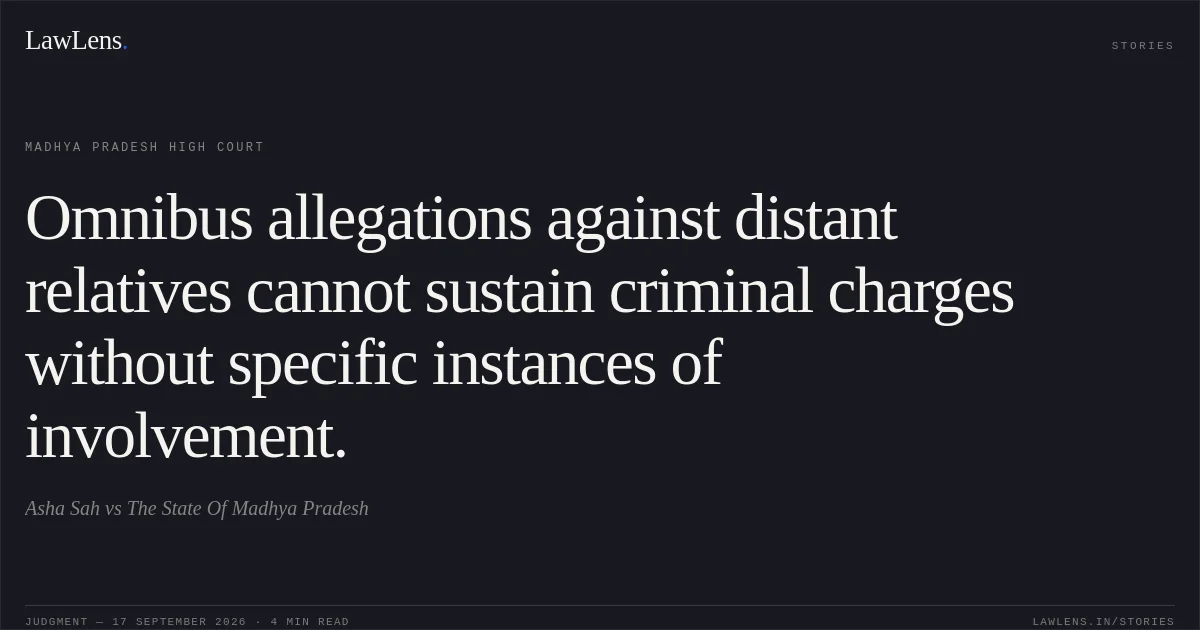
Source reference: paras. 12, 20However, in matrimonial prosecutions, distant relatives should not be prosecuted merely on the basis of omnibus allegations without specific instances of involvement. This principle was drawn from K. Subba Rao v. State of Telangana, (2018) 14 SCC 452, and the Court also considered the caution expressed in Preeti Gupta v. State of Jharkhand, (2010) 7 SCC 667, regarding the tendency to implicate the husband’s relatives in matrimonial disputes
Source reference: para. 10Defence materials and disputed factual matters ordinarily cannot be conclusively evaluated at the charge stage
Source reference: paras. 19–21Reasoning
The Court found that the allegations against Petitioners Nos. 1 and 2 were general allegations of dowry harassment unsupported by specific dates, times, demands, or acts of participation
Source reference: para. 15Applying the principle in K. Subba Rao, it held that such omnibus allegations did not establish their specific involvement.
Source reference: para. 15With respect to the sexual-harassment allegation against Petitioner No. 2, the Court considered the complainant’s valid driving licence and the alleged circumstances of the incident during the COVID-19 lockdown as rendering the prosecution version inherently improbable and self-contradictory
Source reference: paras. 16–17It therefore concluded that the ingredients of the charged offences were not prima facie satisfied against Petitioners Nos. 1 and 2
Source reference: para. 17In contrast, the allegations against Petitioner No. 3 were direct and particularized: he allegedly forced the complainant to resign, assaulted her while intoxicated, subjected her to mental cruelty, and threatened her after she disclosed the alleged conduct of his father
Source reference: para. 18The Court held that the husband’s reliance on photographs, employment records, train tickets, the HMA petition, and other documents raised disputed factual questions which could not be adjudicated in revision at the charge stage
Source reference: paras. 19–21Those allegations were sufficient to create grave suspicion and sustain the charges against him
Source reference: para. 20Holding
The revision was partly allowed.
The order dated 19 February 2026 was set aside as against Petitioners Nos. 1 and 2, Asha Sah and Bhup Narayan, who were discharged from the offences under Sections 74, 85, 351(3) and 3(5) of the BNS, 2023, and Sections 3 and 4 of the Dowry Prohibition Act, 1961; their bail bonds, if any, were discharged
Source reference: para. 23The order framing charges was upheld against Petitioner No. 3, Ashish Anand, and the trial court was directed to proceed against him in accordance with law, uninfluenced by the observations made in the revision order
Source reference: para. 24Acts & Sections Cited
8 provisions across 4 statutes referred to in this judgment. Each provision opens on LawLens.
Bharatiya Nagarik Suraksha Sanhita, 20231
Bharatiya Nyaya Sanhita, 20234
Hindu Marriage Act, 19551
Original Court PDF
Asha SahvsThe State Of Madhya Pradesh
Click to open original judgment
Original judgment, available to read, download and summarize on LawLens.in