Facts
The case arose from Khagaria P.S. Case No. 319 of 2015, registered on the basis of a complaint filed by the father of the deceased, Shweta Kumari, and referred for investigation under Section 156(3) Cr.P.C.
Source reference: p. 2Shweta Kumari had married petitioner no. 2, Gopal Kumar, on 2 May 2008. The prosecution alleged that her husband and other family members subjected her to cruelty, demanded dowry, forcibly administered medicines resulting in miscarriage, and failed to provide financial or medical assistance when she developed serious health complications.
Source reference: p. 2–3She was treated at hospitals in Begusarai, Patna and SGPGIMS, Lucknow, and died during treatment on 25 May 2015.
Source reference: p. 3After investigation, the police submitted a charge-sheet against the petitioners for offences under Sections 498-A, 328, 313, 323 and 34 IPC and Section 4 of the Dowry Prohibition Act.
Source reference: p. 2The petitioners sought discharge under Sections 227 and 228 Cr.P.C.; however, the Additional Sessions Judge-III, Khagaria, rejected their application on 5 March 2018 in Sessions Trial No. 314 of 2016.
Source reference: p. 2They consequently approached the High Court seeking quashing of that order and the consequential proceedings.
Source reference: p. 2Issues
1. Whether the order rejecting the petitioners’ applications for discharge under Sections 227 and 228 Cr.P.C. disclosed sufficient material to justify continuation of the criminal proceedings against petitioner nos. 1, 3, 4 and 5?
Source reference: p. 2, 62. Whether the allegations and materials collected during investigation constituted a legally sufficient basis for proceeding against the family members other than the husband, particularly in view of the deceased’s statement under Section 164 Cr.P.C. and the post-mortem findings?
Source reference: p. 3–5, 63. Whether the proceedings against petitioner nos. 1, 3, 4 and 5 were liable to be quashed as vexatious or malicious in the circumstances recognised in State of Haryana v. Bhajan Lal?
Source reference: p. 5–6Law Applied
The Court considered Sections 227 and 228 Cr.P.C., which govern discharge of an accused and framing of charge in a sessions case, respectively.
Source reference: no citationIt also considered the substantive allegations under Sections 498-A, 328, 313, 323 and 34 IPC and Section 4 of the Dowry Prohibition Act.
Source reference: no citationThe Court applied the principle that criminal proceedings may be quashed where the allegations and materials, even if accepted on their face, do not disclose sufficient grounds to proceed against the accused, or where the prosecution is vexatious or malicious, as recognised in State of Haryana v. Bhajan Lal, 1992 Supp (1) SCC 335.
Source reference: p. 5At the stage of discharge, the court must assess whether the materials disclose sufficient ground for proceeding against the accused; however, the present decision turned on the absence of specific and substantive allegations against the petitioners other than the husband.
Source reference: p. 6Reasoning
The Court found that although the deceased had been treated at several hospitals, no complaint had been made against petitioner nos. 1, 3, 4 or 5 during that period.
Source reference: p. 6The post-mortem report attributed the death to severe anaemia, septicaemia and renal failure resulting in shock and cardio-respiratory failure, rather than specifically linking the death to acts committed by those petitioners.
Source reference: p. 4, 6Most importantly, the deceased’s statement under Section 164 Cr.P.C. primarily alleged that her husband demanded dowry, administered medicines to terminate her pregnancy and assaulted her.
Source reference: p. 4, 6The allegations against the remaining family members were general in nature, principally relating to their failure to arrange or finance treatment, and did not specifically allege dowry demand or torture on account of non-fulfilment of dowry demands.
Source reference: p. 4, 6On this material, the Court concluded that the prosecution case substantially implicated the husband alone and did not disclose sufficient specific grounds for continuing proceedings against the other family members.
Source reference: p. 5–6The Court therefore exercised its quashing jurisdiction consistently with the principles in Bhajan Lal.
Source reference: p. 5–6Holding
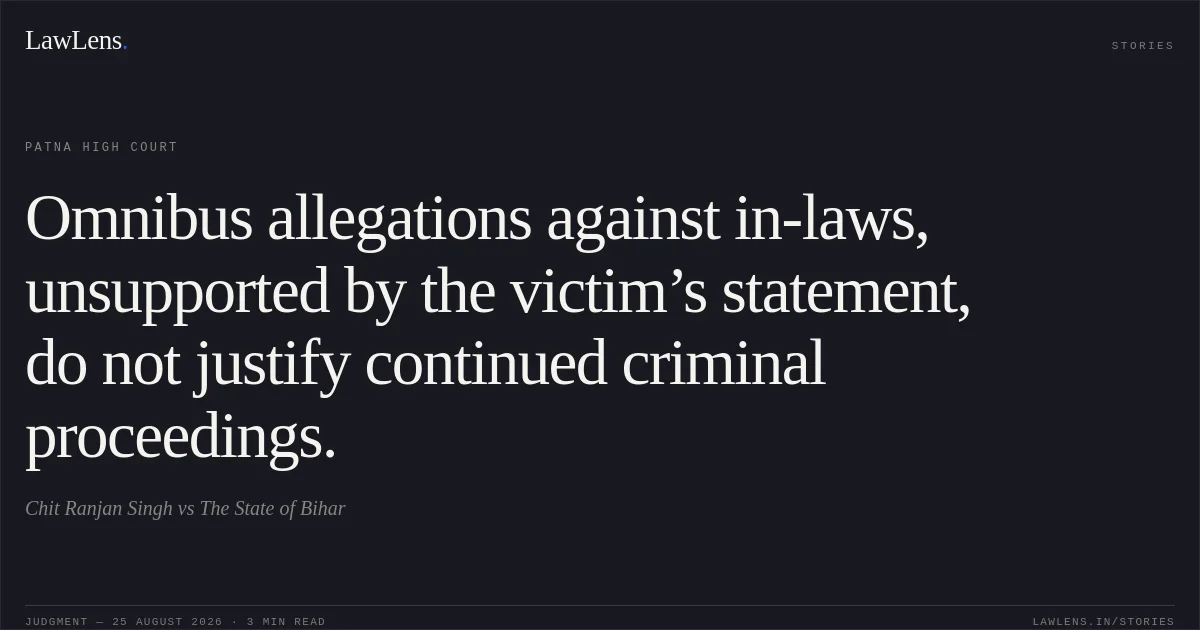
The High Court allowed the application and quashed the order dated 5 March 2018 rejecting the discharge application, together with all consequential proceedings, only insofar as petitioner nos. 1, 3, 4 and 5 were concerned.
The proceedings against petitioner no. 2, Gopal Kumar, the husband of the deceased, were permitted to continue.
Source reference: p. 6The application was accordingly allowed.
Source reference: p. 6Acts & Sections Cited
10 provisions across 3 statutes referred to in this judgment. Linked provisions open on LawLens.
Code of Criminal Procedure, 19734
Indian Penal Code, 18605
Dowry Prohibition Act, 19611
Original Court PDF
Chit Ranjan SinghvsThe State of Bihar
Click to open original judgment
Original judgment, available to read, download and summarize on LawLens.in
![Courts will not interfere with transfers absent mala fides or violation of statutory rules.. M Ramya vs EMPLOYEES STATE INSURANCE CORPORATION (ESIC). CAT - ['Chennai']. LawLens](/stories/thumbnails/courts-will-not-interfere-with-transfers-absent-mala-fides-or-violation-of-statutory-rules-a6845e9ca6f548fca284c51c8351957f.webp)
![Courts cannot direct one-time recruitment age relaxation absent authority in the governing rules or advertisement.. UT OF PUDUCHERRY vs M ANDAL. CAT - ['Chennai']. LawLens](/stories/thumbnails/courts-cannot-direct-one-time-recruitment-age-relaxation-absent-authority-in-the-governing-895d78fde47143e2a8ed0207c4b6a44f.webp)
![A review cannot correct an allegedly erroneous decision absent an error apparent on the record.. Ajit Kumar Jha vs RAILWAY BOARD. CAT - ['Delhi']. LawLens](/stories/thumbnails/a-review-cannot-correct-an-allegedly-erroneous-decision-absent-an-error-apparent-on-the-re-8ac952fd4eba470c92f7da20af72a220.webp)