01Facts
Respondent No. 2 (wife) lodged a complaint on 08.10.2022 alleging that her marriage to accused No. 1 (husband), solemnised in 2019 in Andhra Pradesh, was accompanied by a dowry of Rs. 7,00,000 cash and 30 grams of gold.
¶ 5She alleged that after the birth of a female child, the petitioners, colluding with accused No. 1, harassed her physically and mentally, and that accused persons later visited her parental home and quarrelled with her and her parents.
¶ 5Crime No. 103/2022 was registered at Gangammanagudi P.S., the police filed a charge sheet for offences under Section 498A IPC and Sections 3 and 4 of the Dowry Prohibition Act, and the I Additional CMM, Bengaluru took cognizance in C.C. No. 3872/2023.
¶ 5The petitioners are accused No. 2 (brother-in-law, Petitioner No. 1), accused No. 3 (mother-in-law, Petitioner No. 2), and accused No. 4 (father-in-law, Petitioner No. 3).
¶ 3–4Accused No. 4 has since died, and the petition stands abated against him.
¶ 1–2The petitioners contended that the wife lived with her husband in Bengaluru, not with them, that they are permanent residents of Andhra Pradesh, and that the spot mahazar records this, so the allegations are vindictive, bald and omnibus.
¶ 7The State and respondent No. 2 opposed, relying on completed investigation and witness statements.
¶ 802Issues
i.1. Whether criminal proceedings under Section 498A IPC and Sections 3 and 4 of the Dowry Prohibition Act can continue against the in-laws (brother-in-law and mother-in-law) where the charge sheet contains only general, omnibus and hearsay allegations and no specific overt act, and where they did not reside with the complainant.
¶ 3, 10ii.2. Whether continuation of such proceedings amounts to abuse of the process of Court, warranting quashing under Section 482 Cr.P.C.
¶ 12, 1403Law Applied
The Court relied on Section 482 Cr.P.C. as the source of its inherent power to quash proceedings.
¶ 3The Court applied the principle from K. Subba Rao v. State of Telangana (2024 INSC 960) that courts must be cautious when proceeding against distant relatives in matrimonial and dowry-related cases, and that relatives of the husband should not be roped in on omnibus allegations unless specific instances of their involvement are made out.
¶ 11The Court applied the settled principle that subjecting a person to a criminal trial on general and sweeping allegations, without specific instances of criminal conduct, is an abuse of process, and that courts must scrutinise whether allegations are genuine or made merely to implicate individuals.
¶ 12The Court relied on Dara Lakshmi Narayan v. State of Telangana (2025 3 SCC 735), which holds that mere reference to family members' names in a matrimonial case, without specific allegations of active involvement, must be nipped in the bud, and that prosecution of family members living elsewhere and not residing in the matrimonial house is an abuse of process absent particularised allegations against each.
¶ 13, quoting paras. 25 and 28Section 498A IPC is recognised as intended to curb cruelty by husband and family, but as liable to misuse as a tool of vendetta.
¶ 13, quoting para. 28Provisions in the judgment · 3 · Linked ones open on LawLens
Code of Criminal Procedure, 1973 Section 482
04Reasoning
The Court examined the entire charge sheet material and found that, apart from general, omnibus and hearsay allegations, no specific allegation, incident, date or overt act was attributed to the petitioners, and that the witness statements did not substantiate the allegations.
¶ 10The spot mahazar recorded that after marriage the wife lived with accused No. 1 in Bengaluru, that the couple had a female child there, and that the wife later moved to her parental home due to a matrimonial dispute with her husband.
¶ 10Since the petitioners were admittedly permanent residents of Andhra Pradesh, the Court held there was no occasion for them to harass the complainant.
¶ 10Applying K. Subba Rao and Dara Lakshmi Narayan, the Court found that the petitioners were distant relatives who did not share a household with the complainant and against whom no particularised allegations existed.
¶ 11, 13The Court therefore concluded that the prosecution against them was a misuse of process rather than a genuine criminal grievance.
¶ 12The order does not separately analyse the Dowry Prohibition Act offences; the quashing covers the charge sheet as a whole.
¶ 1405Holding
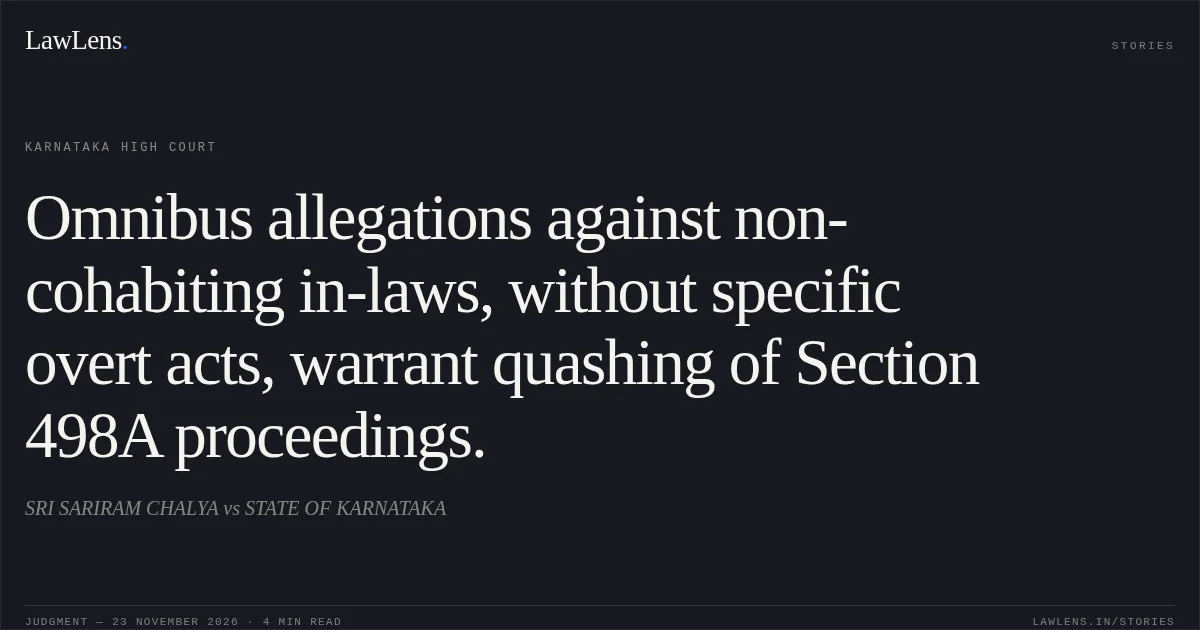
The continuation of C.C. No. 3872/2023 against accused Nos. 2 and 3 (the petitioners) on general and omnibus allegations, without specific overt acts and where they did not reside with the complainant, amounts to abuse of process of Court.
¶ 14The petition is allowed. Proceedings in C.C. No. 3872/2023 arising out of Crime No. 103/2022 at Gangammanagudi P.S., for offences under Section 498A IPC and Sections 3 and 4 of the Dowry Prohibition Act, pending before the I Additional CMM, Bengaluru, are quashed as against the petitioners. The petition stands abated against accused No. 4, who has died.
¶ 14 · ¶ 1–2Original Court PDF
SRI SARIRAM CHALYAvsSTATE OF KARNATAKA
Click to open original judgment
Original judgment, available to read, download and summarize on LawLens.in



