Facts
The appellant (complainant) challenged the acquittal of 31 accused persons for offences under Sections 148, 149, 324, 379, and 506 of the IPC.
Source reference: p. 1The prosecution alleged that on 18.06.1994, the accused persons assaulted the complainant’s husband (who later died) in the afternoon and subsequently, at 10:30 p.m., unlawfully assembled at her pond to steal three quintals of fish worth Rs. 6,500/- while armed with deadly weapons and firearms.
Source reference: p. 1-2The defense contended that the case was concocted due to a pre-existing land dispute and that a civil court had previously ordered status quo on the pond.
Source reference: p. 10The Trial Court acquitted the accused on 25.05.2007, citing lack of proof of exclusive possession and material contradictions in witness testimonies.
Source reference: p. 10-11Issues
1. Whether the prosecution proved the charges of unlawful assembly, rioting, and criminal intimidation beyond a reasonable doubt given the history of factional rivalry.
Source reference: p. 17-182. Whether the essential elements of theft under Section 379 IPC were satisfied regarding the exclusive possession of the pond.
Source reference: p. 193. Whether there are sufficient grounds for an appellate court to interfere with an order of acquittal.
Source reference: p. 20Law Applied
The Court applied the principles of vicarious liability under Section 149 IPC, requiring proof of a common object and specific overt acts rather than mere presence in a crowd.
Source reference: p. 17-18For Section 379 IPC (theft), the court required proof of dishonest removal from the de facto possession of the complainant.
Source reference: p. 19Regarding Section 324 IPC, the court emphasized the necessity of cogent medical evidence to prove hurt caused by dangerous weapons.
Source reference: p. 18The court followed the established appellate doctrine that an order of acquittal reinforces the presumption of innocence and should not be disturbed unless the Trial Court's findings are "manifestly unreasonable" or "perverse".
Source reference: p. 20Reasoning
The Court found the prosecution's narrative "wavering" because the complainant failed to report the alleged theft to the police for several days despite police presence in the village for a related murder investigation.
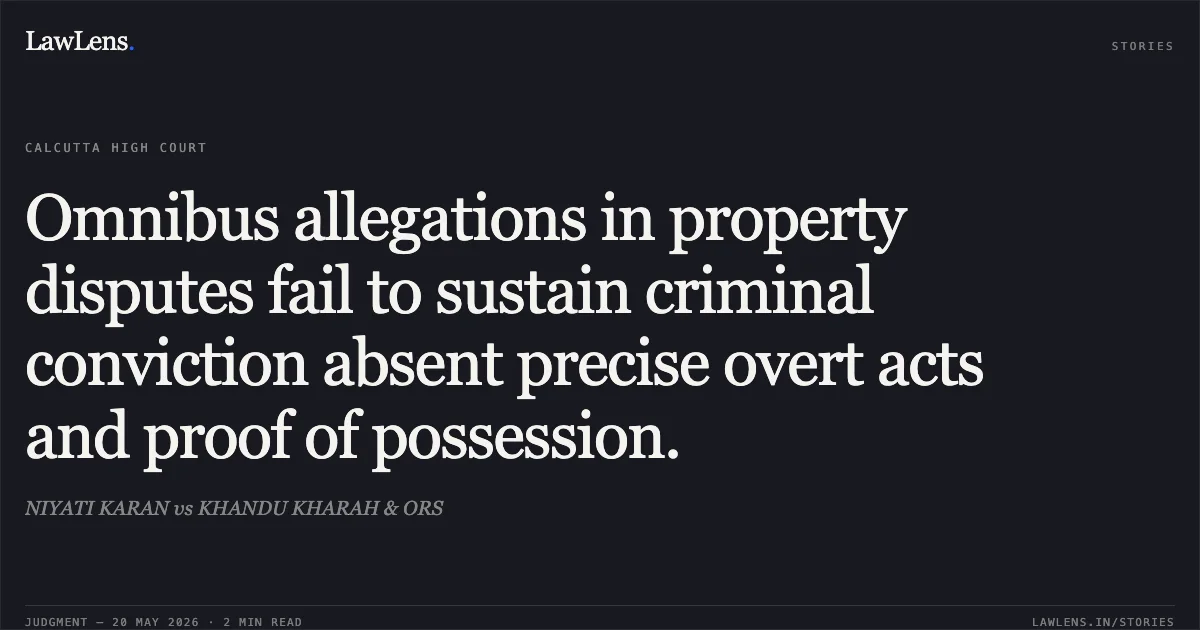
Source reference: p. 15, 17Regarding the unlawful assembly, the Court noted that the witnesses (PW-1 to PW-8) provided "omnibus allegations" without specifying individual roles, which is insufficient to attract Section 149 IPC, especially amid "entrenched animosity" between the parties.
Source reference: p. 17-18The theft charge failed because PW-5 admitted the pond was used by all villagers, and PW-6 was unsure of the complainant's ownership, creating doubt regarding exclusive possession.
Source reference: p. 15, 19The Court further observed that most witnesses were "interested" parties (relatives or political associates) and no independent local witnesses were examined despite the alleged scale of the incident.
Source reference: p. 19-20Holding
The High Court held that the prosecution failed to establish the common object for Sections 148/149, failed to provide medical corroboration for Section 324, and failed to prove exclusive possession for Section 379.
The High Court dismissed the appeal and upheld the acquittal, concluding that the Trial Court’s view was a "plausible and reasoned appreciation of the evidence" and therefore did not warrant interference.
Source reference: p. 20All 31 respondents (including those deceased during the pendency of the appeal) remain acquitted.
Source reference: p. 11, 20Acts & Sections Cited
7 provisions across 2 statutes referred to in this judgment. Each provision opens on LawLens.
Indian Penal Code, 18605
Code of Criminal Procedure, 19732
Original Court PDF
NIYATI KARANvsKHANDU KHARAH & ORS
Click to open original judgment
Original judgment, available to read, download and summarize on LawLens.in