Facts
On 13 December 2001, Tehsildar Jitender Singh Saggu, Naib Tehsildar Jai Chand Parinda, and other officials went to the court premises to inspect deed-writers’ records.
Source reference: paras. 2, 4, 6A quarrel allegedly ensued with the appellants and others, during which the officials were assaulted, their official work was obstructed, the office door and furniture were damaged, records were allegedly torn or removed, and threats were issued.
Source reference: paras. 2, 4, 6Caste-based expressions were also allegedly used against Jitender Singh Saggu and Jai Chand Parinda, the latter being a member of a Scheduled Caste.
Source reference: paras. 2, 4, 6Jai Chand Parinda suffered five injuries, including a grievous fracture, while Jitender Singh suffered three simple injuries.
Source reference: paras. 2, 4, 6The trial Court convicted the appellants under Sections 147, 353/149, 427/149, 452/149, 333/149, 332/149 and 506/149 IPC, and Section 3 of the Scheduled Castes and Scheduled Tribes (Prevention of Atrocities) Act, 1989 read with Section 149 IPC.
Source reference: paras. 1, 8–9The appellants challenged their conviction and sentences in the present appeal.
Source reference: paras. 1, 8–9One co-accused, Piara Lal, died during the pendency of his separate appeal, which consequently abated.
Source reference: paras. 1, 8–9Issues
Whether the non-examination of the complainant, Jitender Singh Saggu, and the Investigating Officer who conducted the further investigation, together with the hostility of certain prosecution witnesses, rendered the prosecution case unreliable?
Source reference: paras. 11–17Whether the medical and X-ray evidence regarding the grievous injury suffered by Jai Chand Parinda was sufficiently reliable to sustain the conviction under Section 333 IPC?
Source reference: paras. 18–20Whether the defence evidence concerning prior disputes and complaints created a reasonable doubt regarding the appellants’ participation in the occurrence?
Source reference: paras. 21–22Whether the evidence established the appellants’ individual liability for the caste-based offence under Section 3 of the SC/ST Act read with Section 149 IPC, despite the absence of specific attribution of the alleged caste-based utterances to any particular appellant?
Source reference: paras. 23–30Whether, having regard to the lapse of almost 25 years, the appellants were entitled to probation or reduction/modification of their substantive sentences?
Source reference: paras. 33–39Law Applied
The Court applied Sections 147, 149, 332, 333, 353, 427, 452 and 506 IPC concerning rioting, vicarious liability of members of an unlawful assembly, causing hurt or grievous hurt to deter public servants from duty, obstruction of public servants, mischief, house-trespass, and criminal intimidation.
Source reference: paras. 1, 31–32It held that the testimony of a solitary witness may sustain a conviction if it is cogent, reliable and trustworthy, and that the evidence of an injured witness carries particular evidentiary weight.
Source reference: paras. 13, 16Non-examination of a complainant or Investigating Officer is not by itself fatal unless demonstrable prejudice is caused to the accused.
Source reference: para. 17For the SC/ST Act offence, the prosecution was required to prove the caste-based insult with sufficient specificity and beyond reasonable doubt against the accused facing trial; Section 149 IPC could not automatically substitute for proof of the essential ingredients of the substantive caste-based offence.
Source reference: paras. 25–30On sentencing, the Court relied on Section 4 of the Probation of Offenders Act, 1958, and on Buta Singh v. State of Punjab, 2004(3) RCR (Criminal) 605, read with Rakesh Kumar v. State of Haryana, 1998(4) RCR (Criminal) 436, to hold that extraordinary delay, absence of previous conviction and the hardship of incarceration after a long interval may justify release on probation.
Source reference: para. 35Reasoning
The Court found PW-9 Jai Chand Parinda to be an injured eyewitness whose presence was corroborated by the medical evidence.
Source reference: paras. 13–17His testimony remained substantially consistent despite cross-examination, and therefore the non-examination of the complainant and the hostility of other witnesses did not create a reasonable doubt.
Source reference: paras. 13–17The X-ray doctor produced the original register and confirmed the fracture detected on the day after the occurrence; the absence of police papers or a referral slip did not establish fabrication.
Source reference: paras. 18–20The prior complaints and disputes relied upon by the defence showed possible animosity but did not discredit the injured witness or negate the occurrence.
Source reference: paras. 21–22However, the caste-based expressions were specifically attributed at the initial stage to Jaspal Goel and Vijay Kumar Singla, neither of whom was facing trial.
Source reference: paras. 25–30Against the present appellants, the allegation that “all of them” repeated the expressions was general and omnibus, without identifying which appellant uttered which words.
Source reference: paras. 25–30The Court held that common participation in the occurrence or liability under Section 149 IPC could not, without specific proof, establish the individual commission of the caste-based offence.
Source reference: paras. 25–30Since the occurrence was nearly 25 years old, the appellants had remained on bail, and no previous convictions were shown, the Court considered immediate incarceration disproportionate and substituted the substantive sentences with probation under Section 4 of the Probation of Offenders Act.
Source reference: paras. 33–38Holding
The appeal was partly allowed.
The convictions under Sections 147, 353/149, 427/149, 452/149, 333/149, 332/149 and 506/149 IPC were upheld.
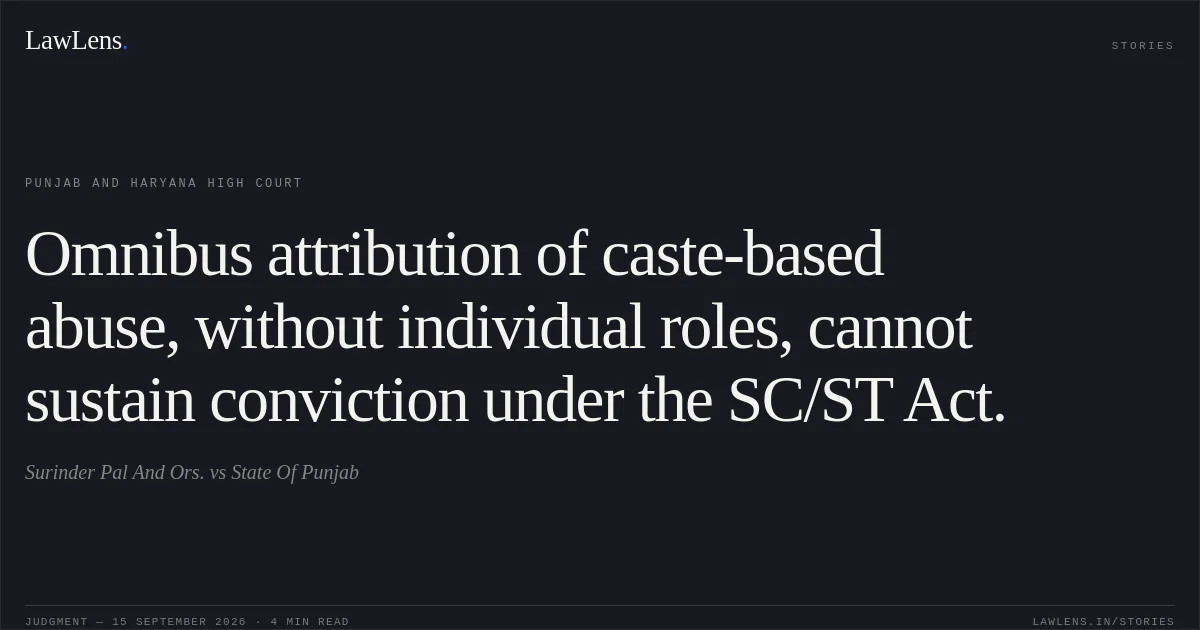
Source reference: paras. 30–32, 39The conviction under Section 3 of the SC/ST Act read with Section 149 IPC was set aside for want of specific and reliable attribution of the caste-based utterances to the appellants.
Source reference: paras. 30–32, 39Instead of requiring the appellants to undergo the substantive imprisonment imposed by the trial Court, the High Court directed their release on probation of good conduct for one year under Section 4 of the Probation of Offenders Act, 1958.
Source reference: paras. 37–39The appellants were directed to furnish a bond of ₹20,000 with one surety in the like amount, undertaking to keep peace and maintain good behaviour, and appearing to receive sentence if called upon.
Source reference: paras. 37–39Failure to furnish the bonds or comply with the conditions would attract action in accordance with law.
Source reference: paras. 37–39Acts & Sections Cited
16 provisions across 4 statutes referred to in this judgment. Each provision opens on LawLens.
Indian Penal Code, 1860
Code of Criminal Procedure, 19732
Probation of Offenders Act, 19581
Original Court PDF
Surinder Pal And Ors.vsState Of Punjab
Click to open original judgment
Original judgment, available to read, download and summarize on LawLens.in