01Facts
The petition was filed under Section 528 of the Bharatiya Nagarik Suraksha Sanhita, 2023, seeking quashing of FIR dated 06.02.2026 registered at Police Station Kevlari, District Seoni, as Crime No. 29/2026, for offences under Sections 85 and 115(2) of the Bharatiya Nyaya Sanhita, 2023, and Sections 3 and 4 of the Dowry Prohibition Act, 1961, along with consequential proceedings.
¶ 1The complainant’s marriage with applicant No.1, Neeraj Dahariya, had taken place approximately four years before registration of the FIR. She alleged that after one year of cordial matrimonial relations, the husband and his relatives subjected her to physical and mental cruelty, used abusive language, and made dowry-related demands.
¶ 2Applicant No.1 contended that the FIR was a counterblast to divorce proceedings instituted by him under Section 13 of the Hindu Marriage Act, 1955, and that the allegations against applicants Nos. 2 to 4—Canchal Dahariya, Vijay Dahariya and Janki Bai Dahariya—were general and omnibus.
¶ 3The State and the complainant opposed quashing, asserting that the FIR disclosed prima facie offences and that the counterblast plea involved disputed questions of fact.
¶ 402Issues
i.1. Whether the FIR and consequential criminal proceedings against applicant No.1/husband disclosed a prima facie case warranting continuation, notwithstanding his contention that the FIR was a counterblast to divorce proceedings.
¶ 6–7ii.2. Whether the FIR disclosed specific and individual acts against applicants Nos. 2 to 4, or whether their prosecution was liable to be quashed because it was based only on general and omnibus allegations.
¶ 8–1303Law Applied
The Court applied Section 528 of the BNSS, 2023, which permits the High Court to exercise inherent jurisdiction to prevent abuse of process and secure the ends of justice.
¶ 1, 13At the quashing stage, the Court ordinarily does not adjudicate disputed defence versions or assess the truth of allegations; however, interference is permissible where the FIR, even if accepted in its entirety, fails to disclose a prima facie case against particular accused persons.
¶ 13The Court relied on Kahkashan Kausar @ Sonam v. State of Bihar, 2022 SCC OnLine SC 162, along with Preeti Gupta v. State of Jharkhand, (2010) 7 SCC 667, and Geeta Mehrotra v. State of Uttar Pradesh, (2012) 10 SCC 741, for the principle that relatives should not be prosecuted on the basis of vague, general or omnibus allegations without specific roles.
¶ 9It also relied on Neelu Chopra v. Bharti, (2009) 10 SCC 184, holding that merely citing statutory provisions is insufficient and that the complaint must disclose the particulars of the offence and the role of each accused.
¶ 10Provisions in the judgment · 6 · Linked ones open on LawLens
Bharatiya Nagarik Suraksha Sanhita, 2023 Section 528
Bharatiya Nyaya Sanhita, 2023 Section 85Section 115
Dowry Prohibition Act, 1961 Section 3Section 4
Hindu Marriage Act, 1955 Section 13
04Reasoning
The Court found that the FIR contained direct allegations that applicant No.1/husband participated in physical and mental harassment and made dowry-related demands. These allegations were neither wholly vague nor inherently improbable, and their truth or evidentiary support was a matter for trial.
¶ 6The prior institution of divorce proceedings could constitute a defence circumstance, but did not conclusively establish that the FIR was false or a counterblast; that issue involved disputed questions of fact unsuitable for determination under Section 528 BNSS.
¶ 7In contrast, the allegations against applicants Nos. 2 to 4 were collective and omnibus, without any specific date, incident, dowry demand, assault, intimidation, or other distinct overt act attributable to any individual relative.
¶ 8, 11Applying the Supreme Court’s caution against continuing matrimonial prosecutions founded solely on familial relationship and generalized allegations, the Court held that their prosecution lacked a sufficient prima facie foundation.
¶ 9–13The divorce proceedings assumed additional significance in the case of the relatives when considered alongside the absence of specific allegations against them, though that circumstance was insufficient to quash the case against the husband.
¶ 1205Holding
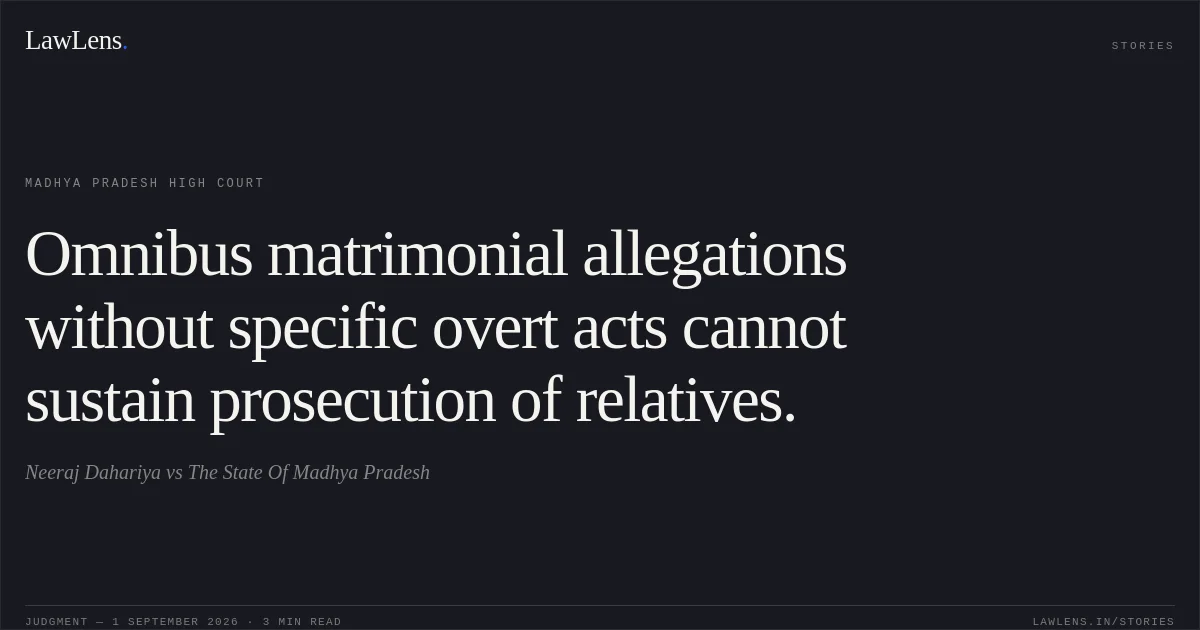
The petition was partly allowed. The proceedings arising from Crime No. 29/2026, including the consequential charge-sheet and criminal proceedings, were quashed insofar as applicants Nos. 2 to 4—Canchal Dahariya, Vijay Dahariya and Janki Bai Dahariya—were concerned, because the FIR contained only general and omnibus allegations against them.
¶ 14The petition was dismissed as against applicant No.1, Neeraj Dahariya, since the FIR contained specific allegations of cruelty and dowry-related conduct against him. The criminal proceedings against him were directed to continue in accordance with law.
¶ 15Original Court PDF
Neeraj DahariyavsThe State Of Madhya Pradesh
Click to open original judgment
Original judgment, available to read, download and summarize on LawLens.in