Facts
The petitioners were inducted into the Himachal Pradesh Forest Service (“HPFS”) in 1990 and completed eight years of service in 1998, following which they were granted the applicable time-scale benefits.
Source reference: para. 2The State introduced a four-tier pay-scale structure for certain categories through instructions dated 23.06.2000, but HPFS was not initially included.
Source reference: para. 2By instructions dated 09.08.2012, the four-tier structure was restored for eight specified services with notional effect from 27.08.2009 and actual effect from 09.08.2012; HPFS was again excluded.
Source reference: para. 3Subsequently, by instructions dated 26.08.2013, HPFS was granted the four-tier pay scale with actual effect from 01.09.2013, including a higher grade pay after completion of 14 years of regular service.
Source reference: para. 3The petitioners had completed 14 years of service in 2004 and claimed that they were entitled to the benefit from 01.01.2006, or at least notionally from 27.08.2009, on parity with HPAS officers and the other services covered by the 09.08.2012 instructions.
Source reference: paras. 4–5Their representation was rejected by communication dated 26.11.2014, which they challenged in the present petition.
Source reference: para. 4Issues
Whether the petitioners, having subsequently been granted the four-tier pay structure as members of HPFS, were entitled to its notional benefit from 27.08.2009, when the State had extended the benefit to other specified services?
Source reference: paras. 9–12Whether denial of the notional benefit to HPFS, while granting it to HPAS and other similarly situated services, was arbitrary and violative of Articles 14 and 16 of the Constitution?
Source reference: paras. 13–17Whether the petitioners were entitled to the four-tier pay-scale benefit from 01.01.2006 on the basis of completion of 14 years’ service in 2004 and the revised pay structure?
Source reference: para. 10Law Applied
The Court applied the constitutional guarantees of equality and non-discrimination under Articles 14 and 16, including the principle that similarly situated government employees cannot be subjected to arbitrary differential treatment.
Source reference: paras. 13–14, 17It relied on Union of India v. Dineshan K.K., (2008) 1 SCC 586, which holds that although equation of posts and determination of pay scales ordinarily lie within the executive and expert bodies’ domain, judicial intervention is permissible where employees holding identical or substantially similar posts are treated differently on an irrational, arbitrary or unjust basis.
Source reference: para. 13The Court also relied on Union of India v. DGOF Employees Association, (2023) 15 Scale 293, reaffirming that courts should not themselves undertake complex pay fixation but may correct discriminatory or irrational denial of an otherwise applicable benefit.
Source reference: para. 15Union of India v. Satya Brata Chowdhury, (2008) 16 SCC 383, was relied upon for the principle that the State cannot give differential treatment to its employees without justification.
Source reference: para. 17The respondents’ reliance on P.U. Joshi v. Accountant General, Ahmedabad and Union of India v. Basudeba Dora, (2003) 2 SCC 632, concerning executive primacy in pay-scale determination, was qualified by the Court’s power to examine arbitrary State action.
Source reference: para. 6; paras. 12–14Reasoning
The Court accepted that the State ordinarily possesses discretion to determine pay structures and that HPFS and HPAS were not identical in every respect.
Source reference: paras. 6, 12However, the State had itself extended the four-tier pay structure to HPFS from 01.09.2013, thereby recognising the category’s entitlement to that structure.
Source reference: paras. 9, 17Since other specified services, including HPAS, had received the same benefit notionally from 27.08.2009, the Court found no rational justification for denying HPFS the corresponding notional benefit, particularly when the record showed that HPFS officers were posted against positions ordinarily occupied by HPAS officers and performed comparable functions in relevant contexts.
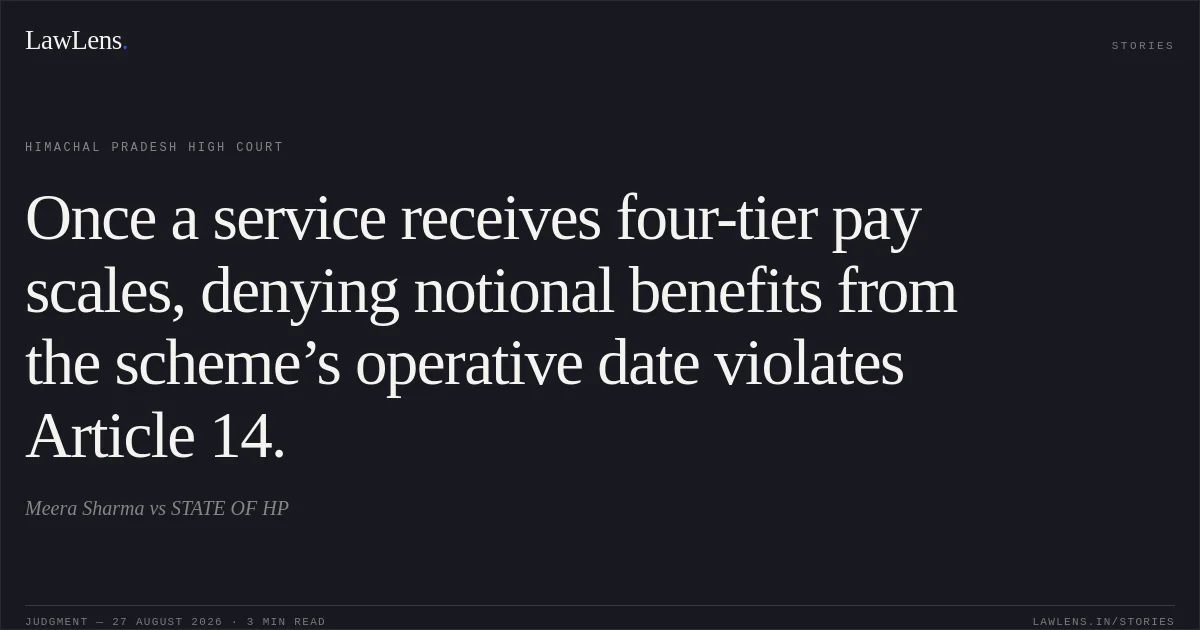
Source reference: paras. 14, 16The Court therefore treated the differential treatment as arbitrary and violative of Articles 14 and 16.
Source reference: paras. 14, 16It rejected the claim for retrospective benefit from 01.01.2006, reasoning that the State had consciously introduced or restored the relevant scheme only from 27.08.2009.
Source reference: para. 10Thus, the permissible relief was notional application from 27.08.2009, followed by actual monetary benefit from 01.09.2013 under the 26.08.2013 instructions.
Source reference: paras. 10–12, 17Holding
The petition was allowed.
The communication dated 26.11.2014 rejecting the petitioners’ representation was quashed.
Source reference: para. 18The respondents were directed to grant the petitioners the four-tier pay-scale benefit notionally from 27.08.2009 and actually from 01.09.2013, in accordance with the instructions dated 26.08.2013.
Source reference: para. 18The claim for entitlement from 01.01.2006 was not accepted.
Source reference: para. 10Arrears were directed to be released within three months; failing such payment, the petitioners would be entitled to interest at 6% per annum from the date of judgment until actual payment.
Source reference: para. 18Original Court PDF
Meera SharmavsSTATE OF HP
Click to open original judgment
Original judgment, available to read, download and summarize on LawLens.in
![Courts will not interfere with transfers absent mala fides or violation of statutory rules.. M Ramya vs EMPLOYEES STATE INSURANCE CORPORATION (ESIC). CAT - ['Chennai']. LawLens](/stories/thumbnails/courts-will-not-interfere-with-transfers-absent-mala-fides-or-violation-of-statutory-rules-a6845e9ca6f548fca284c51c8351957f.webp)
![Courts cannot direct one-time recruitment age relaxation absent authority in the governing rules or advertisement.. UT OF PUDUCHERRY vs M ANDAL. CAT - ['Chennai']. LawLens](/stories/thumbnails/courts-cannot-direct-one-time-recruitment-age-relaxation-absent-authority-in-the-governing-895d78fde47143e2a8ed0207c4b6a44f.webp)
![A review cannot correct an allegedly erroneous decision absent an error apparent on the record.. Ajit Kumar Jha vs RAILWAY BOARD. CAT - ['Delhi']. LawLens](/stories/thumbnails/a-review-cannot-correct-an-allegedly-erroneous-decision-absent-an-error-apparent-on-the-re-8ac952fd4eba470c92f7da20af72a220.webp)