01Facts
The petitioners claim ownership of different portions of Survey No. 8, Mavallipura village, Hesaraghatta Hobli, Yelahanka Taluk, and seek protection against interference with their possession by the State and Panchayat authorities
¶ 1 · p. 6The land was earlier proposed for acquisition under Sections 4 and 17 of the erstwhile Land Acquisition Act, 1881
¶ 2 · p. 6The Taluka Panchayath relied on revenue entries made under orders passed under Section 136 of the Karnataka Land Revenue Act, 1964
¶ 2 · p. 7In W.P. No. 23353/2005 and connected matters, filed by the petitioners and others, the High Court quashed the notifications and Section 136 orders, while granting the State liberty to issue fresh notifications after affording the petitioners an opportunity
¶ 2 · p. 7A Division Bench dismissed W.A. No. 876 of 2010 and connected appeals filed by the Bengaluru Mahanagara Palike, confirming that order
¶ 2 · p. 7 · ¶ 2 · p. 8The petitioners state that no fresh acquisition or title-perfecting steps followed, but that incursions into the land continue
¶ 3 · p. 8The learned Standing Counsel for the Panchayat and the HCGP did not dispute that the acquisition proceedings had come to naught
¶ 4 · pp. 8–902Issues
i.1. Whether the State and Panchayath authorities may interfere with the petitioners' possession of the land in Survey No. 8, Mavallipura, where the acquisition proceedings have terminated and no subsequent lawful proceedings are shown
¶ 4 · pp. 8–9 · ¶ 5 · p. 9ii.2. Whether the petitioners are entitled to a direction restraining dispossession unless due process of law is followed
¶ 5 · p. 903Law Applied
The court relied on Articles 226 and 227 of the Constitution of India as the basis for the writ jurisdiction invoked
pp. 2–3It drew on the proceedings under Sections 4 and 17 of the Land Acquisition Act, 1881, which were the source of the acquisition process, and treated their termination as determinative
¶ 2 · p. 6 · ¶ 4 · p. 8It also relied on Section 136 of the Karnataka Land Revenue Act, 1964, the basis of the revenue entries, whose orders were quashed
¶ 2 · p. 7The court relied on the judgment in W.P. No. 23353/2005, which quashed the notifications and Section 136 orders and permitted only fresh proceedings after notice to the petitioners, and on the Division Bench's dismissal of W.A. No. 876 of 2010 confirming it
¶ 2 · pp. 7–8 · ¶ 4 · pp. 8–9The core principle, stated but not supported by cited authority in the order, is that where no subsisting proceedings exist, possession cannot be disturbed by the authorities except through due process of law
¶ 5 · p. 9 · no citationProvisions in the judgment · 3
Land Acquisition Act, 1881 Section 4Section 17
Karnataka Land Revenue Act, 1964 Section 136
04Reasoning
The court accepted the petitioners' submission that the acquisition and Section 136 proceedings had been quashed and that the quashing was confirmed on appeal
¶ 2 · pp. 6–8It treated the respondents' failure to dispute this as decisive, noting that the Standing Counsel and HCGP "cannot dispute" that the acquisition had come to naught
¶ 4 · pp. 8–9Applying the principle that a terminated proceeding cannot support continuing executive action, the court reasoned that no subsisting statutory basis remained for interference with possession, and therefore any interference by the Village Panchayath or State without fresh due process would be impermissible
¶ 5 · p. 9The court did not adjudicate title or the validity of the revenue entries. It rested its decision on the procedural posture and the absence of any shown subsequent lawful steps, and granted protective relief limited to possession pending lawful action
¶ 5 · p. 905Holding
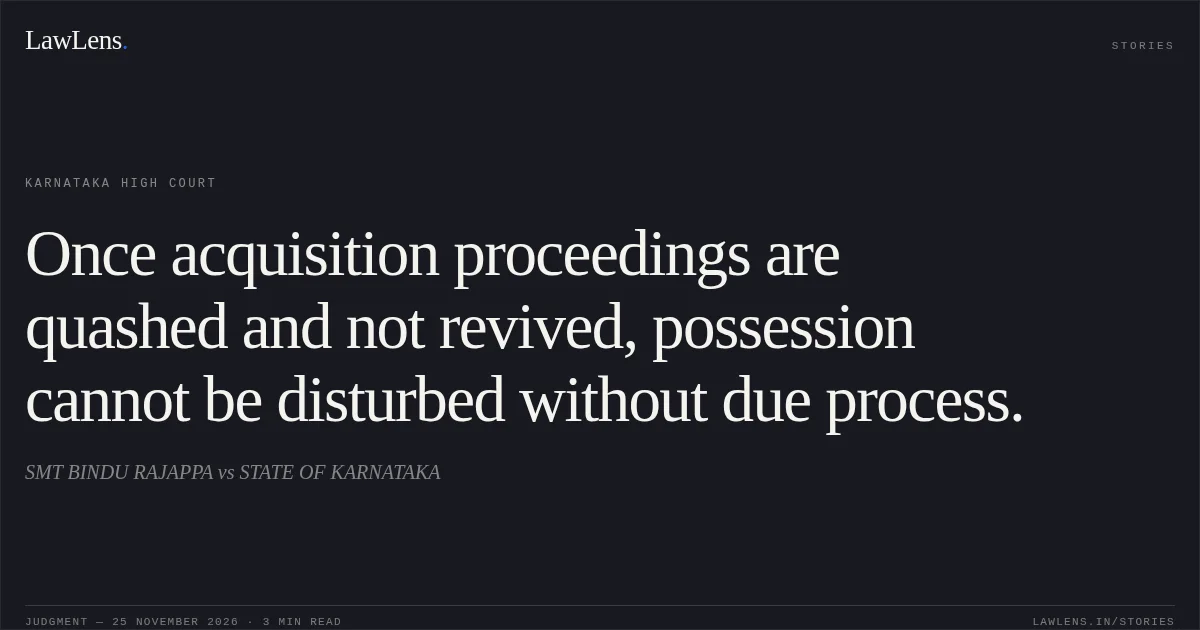
The court held that, because the acquisition proceedings in Survey No. 8, Mavallipura, had come to an end following the quashing in W.P. No. 23353/2005 as confirmed in W.A. No. 876 of 2010, the authorities cannot interfere with the petitioners' possession without due process of law
¶ 4–5 · pp. 8–9Both writ petitions were allowed. The respondents were directed not to dispossess the petitioners from the land in Survey No. 8, Mavallipura, Hesaraghatta Hobli, Yelahanka Taluk, unless and until due proceedings are conducted in accordance with law. The order does not decide ownership or title and does not address any fresh acquisition that the State may initiate in future
¶ 5 · p. 9Original Court PDF
SMT BINDU RAJAPPAvsSTATE OF KARNATAKA
Click to open original judgment
Original judgment, available to read, download and summarize on LawLens.in