01Facts
The petitioners, candidates for teaching posts, challenged Bidhannagar North P.S. Case No. 175 of 2021, registered after a protest concerning alleged recruitment irregularities. The case alleged offences under Sections 143, 188, 341, 269 and 270 of the Indian Penal Code, 1860, read with Section 51 of the Disaster Management Act, 2005.
¶ 1–6After investigation, a charge-sheet was filed against the petitioners and other accused; the Magistrate took cognizance while the writ petition was pending.
¶ 1–6The petitioners sought, under Article 226, to be struck off the police case records, alleging mala fide prosecution and constitutional violations.
¶ 2–302Issues
i.1. Whether a petition under Article 226 seeking to quash a criminal proceeding can be entertained after a charge-sheet has been filed and the competent Magistrate has taken cognizance
¶ 7, 10ii.2. Whether the Article 226 petition could be treated as one under Article 227 or as an application invoking the High Court’s inherent jurisdiction
¶ 13–1503Law Applied
Article 226 is not the appropriate jurisdiction to challenge a judicial order of a subordinate criminal court; such orders are subject to the proper appellate, revisional or supervisory remedies, including Article 227 where applicable (*Radhey Shyam v. Chhabi Nath*, (2015) 5 SCC 423).
¶ 12Under *Neeta Singh v. State of U.P.*, (2026) 6 SCC 817, where cognizance intervenes during the pendency of an Article 226 petition challenging an FIR, the High Court is disabled from proceeding with that petition.
¶ 11The jurisdiction invoked and the assignment of the Judge matter: an Article 226 petition cannot simply be treated as an Article 227 petition unless the Judge has the relevant assignment (*State of Rajasthan v. Prakash Chand*, (1998) 1 SCC 1; *Sohan Lal Baid v. State of West Bengal*, AIR 1990 Cal 168).
¶ 13*Pradnya Pranjal Kulkarni v. State of Maharashtra*, (2026) 6 SCC 813, and *Rajendra Bihari Lal v. State of U.P.*, 2025 INSC 1249, distinguish Article 226 relief from the High Court’s inherent power: after cognizance, an accused may seek quashing under Section 528 of the Bharatiya Nagarik Suraksha Sanhita, 2023, or, as applicable, Section 482 of the Code of Criminal Procedure, 1973.
¶ 14–15Provisions in the judgment · 8 · Linked ones open on LawLens
Indian Penal Code, 1860 Section 143Section 188Section 341Section 269Section 270
Disaster Management Act, 2005 Section 51
Code of Criminal Procedure, 1973 Section 482
Bharatiya Nagarik Suraksha Sanhita, 2023 Section 528
04Reasoning
Because the Magistrate had taken cognizance before the writ petition was disposed of, the petition fell within the rule that Article 226 could not be used to proceed against a criminal matter after a judicial order had intervened.
¶ 11, 15–16The Court did not convert the petition into one under Article 227 or invoke inherent jurisdiction; it treated the matter as the Article 226 petition that had been filed.
¶ 13–16The petitioners’ arguments that the protest was peaceful, the allegations disclosed no offence, and the prosecution was mala fide concerned the merits and were left open for an appropriate proceeding.
¶ 1705Holding
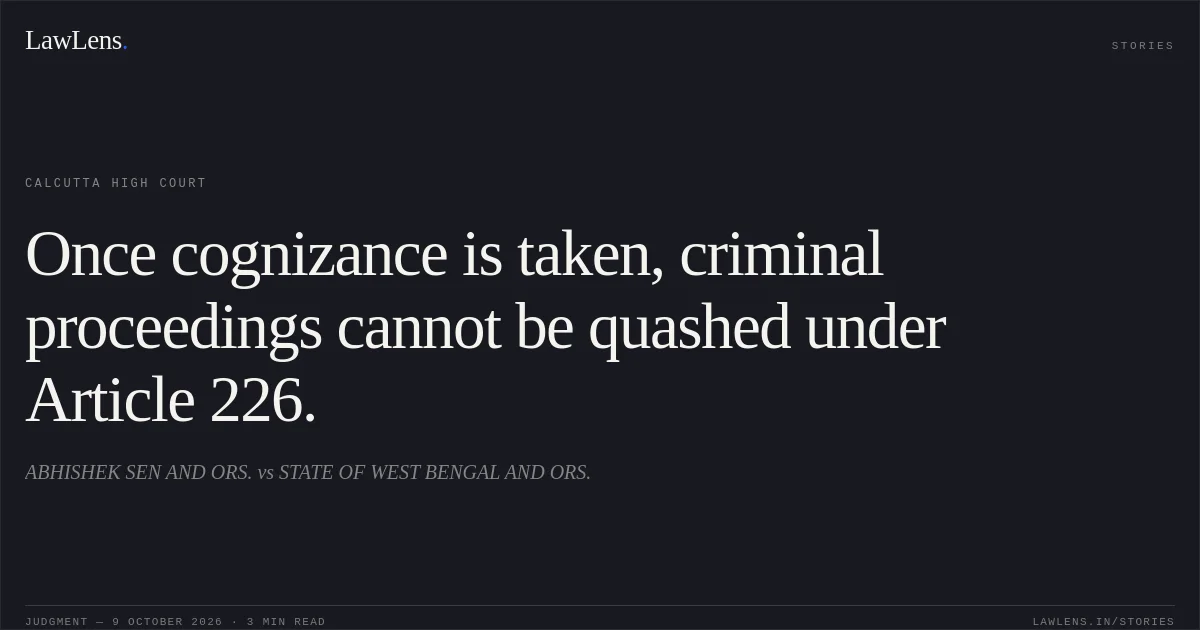
The Court held that the Article 226 petition could not be entertained after cognizance had been taken.
¶ 18, 20–21The Court dismissed W.P.A. No. 25796 of 2023, without expressing any view on the merits and with no order as to costs.
¶ 18, 20–21The dismissal does not preclude the petitioners from challenging the charge-sheet and cognizance order under Section 482 CrPC or Section 528 BNSS, as applicable, or from seeking discharge at the appropriate stage.
¶ 19Original Court PDF
ABHISHEK SEN AND ORS.vsSTATE OF WEST BENGAL AND ORS.
Click to open original judgment
Original judgment, available to read, download and summarize on LawLens.in