Facts
The Anti-Corruption Bureau (ACB), Srinagar, initiated verification into allegations that J&K Bank officials sanctioned loans worth crores to M/S Aman Hospitality Pvt. Ltd. (AHPL) and later declared them Non-Performing Assets (NPA) to facilitate a biased One-Time Settlement (OTS).
Source reference: p. 2-3AHPL, managed by Raj Singh Gehlot, obtained term loans totaling approximately ₹227 crores for a hotel project in Delhi.
Source reference: p. 3Investigations revealed that instead of project implementation, funds were diverted through Turnkey Contractor M/S Ambience Pvt. Ltd. (APL) to various shell entities and personal accounts of the promoters to pay self-assessment taxes and create FDs.
Source reference: p. 6-7, 10-11The case was later transferred to the CBI, which filed a supplementary charge sheet alleging a total loss of ₹289.28 crores to the bank after a "dubious" OTS of ₹128.94 crores was reached.
Source reference: p. 4, 8-9The petitioners moved the High Court under Section 482 Cr.P.C. to quash the charge sheets.
Source reference: p. 2, 9Issues
1. Whether the allegations and material collected by the investigating agencies prima facie constitute offences of cheating and criminal misconduct warranting a trial.
Source reference: p. 30, 392. Whether the diversion of loan funds for purposes other than the sanctioned project implementation amounts to a criminal offence despite the ultimate completion of the project and the existence of an OTS.
Source reference: p. 30, 38Law Applied
Section 482 of the Cr.P.C. regarding the inherent powers of the High Court to quash proceedings, guided by the landmark parameters set in State of Haryana v. Bhajan Lal, which allow quashing only if allegations, even if taken at face value, do not disclose an offence.
Source reference: p. 25-26Establishment of a four-step test to determine if the defense material is of "sterling and impeccable quality" sufficient to reject factual assertions without a trial, as per Rajiv Thapar v. Madan Lal Kapoor and Pradeep Kumar Kesarwani v. State of Uttar Pradesh.
Source reference: p. 26-29Section 420 (Cheating), Section 409 (Criminal Breach of Trust), and Section 120-B of the RPC, alongside Section 5(1)(d) of the J&K Prevention of Corruption Act regarding criminal misconduct by public servants.
Source reference: p. 5, 21Reasoning
The Court observed that while the project was eventually completed, the material evidenced a systematic diversion of loan tranches to unrelated entities managed by the promoters.
Source reference: p. 35, 38The petitioners’ defense—that the loan was a "reimbursement" for previously spent personal funds—was rejected because the sanction conditions explicitly mandated that funds be used solely for project implementation through a designated account.
Source reference: p. 35-36The Court noted that the Bank was "dishonestly induced" to release funds based on representations that they were for project costs, whereas they were used for FDs, taxes, and interest payments to other banks.
Source reference: p. 37, 39The Court found the Forensic Audit reports cited by the defense inconclusive, as they were based on limited information provided by the accused.
Source reference: p. 37The fact that the OTS was settled at a value less than the principal amount reinforced the prima facie finding of pecuniary loss to the Bank.
Source reference: p. 40Holding
The Court dismissed the petitions, holding that a prima facie case of cheating and criminal conspiracy exists against the petitioners.
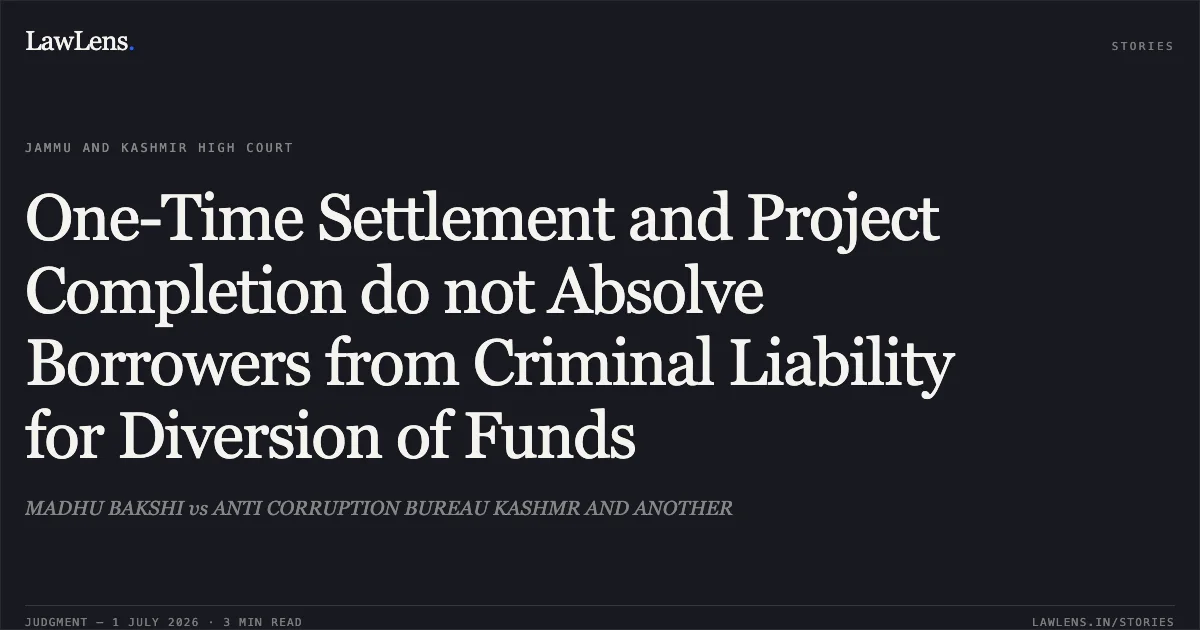
The Court ruled that entering into an OTS does not wipe away criminal liability if the loan was procured or utilized through fraudulent conduct.
Source reference: p. 39The High Court declined to quash the charge sheets, vacating all interim stays and directing the trial court to proceed independently with the framing of charges, including investigating the role of the involved public servants.
Source reference: p. 40-41Acts & Sections Cited
3 provisions across 1 statute referred to in this judgment. Each provision opens on LawLens.
Code of Criminal Procedure, 19733
Original Court PDF
MADHU BAKSHIvsANTI CORRUPTION BUREAU KASHMR AND ANOTHER
Click to open original judgment
Original judgment, available to read, download and summarize on LawLens.in