01Facts
The Respondent retired from the Indian Air Force on 31.10.2017 after over 39 years of service
p. 2A Release Medical Board (RMB) held on 19.12.2016 diagnosed him with Diabetes Mellitus Type-II (20% disability) and Cataract
p. 2The RMB opined the diabetes was "Neither Attributable to Nor Aggravated" (NANA) by military service because it was metabolic in nature and its onset occurred while the Respondent was posted at a "peace station" (Jaisalmer)
p. 2After his claims were rejected by the Petitioners, the Armed Forces Tribunal (AFT) granted him disability pension, rounding off the 20% disability to 50% for life
p. 2The Union of India challenged this order via the present writ petition, citing the Entitlement Rules for Casualty Pensionary Awards, 2008
p. 302Issues
i.Whether the Entitlement Rules, 2008, place the onus of proving attributability of a disease on the service personnel rather than the administration
p. 4 / para. 8ii.Whether a medical opinion classifying a disease as NANA based solely on "onset in a peace station" or its "metabolic nature" constitutes a reasoned medical opinion
pp. 5-7 / para. 9, 13, 1403Law Applied
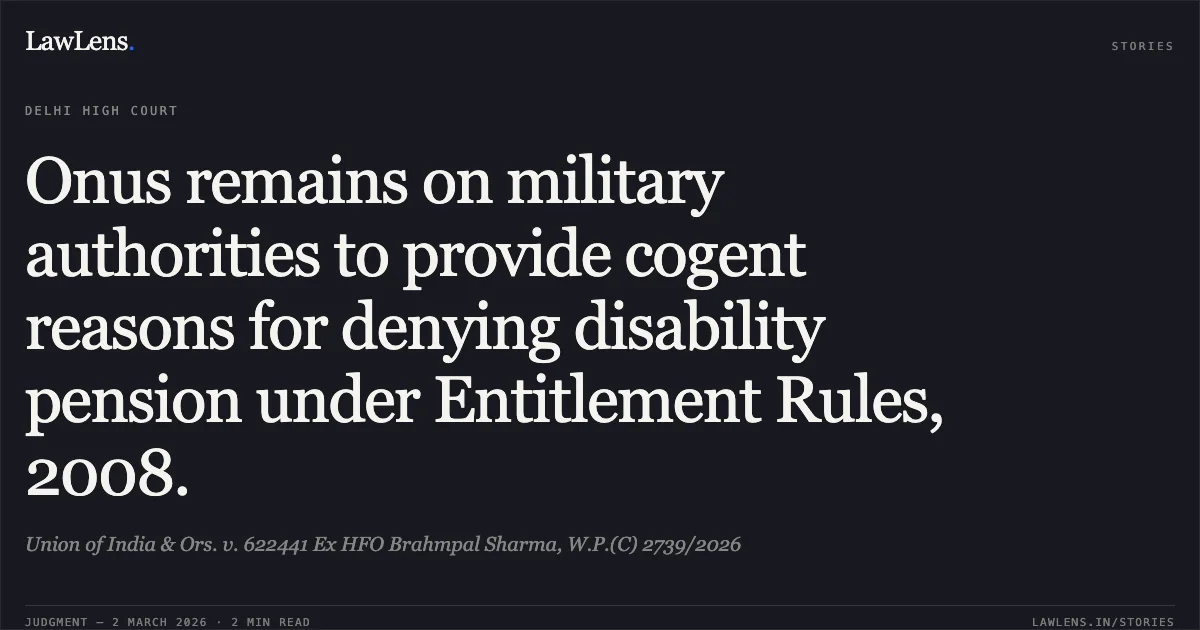
The court applied the Entitlement Rules for Casualty Pensionary Awards to Armed Forces Personnel, 2008, noting that the burden of proof to disentitle a member from pension remains on the administration
p. 4It relied on the Supreme Court precedents in Dharamvir Singh v. Union of India regarding the presumption of sound health at entry
p. 3Bijender Singh v. Union of India, which mandates that the Medical Board must provide cogent reasons to prove a disease is NANA
p. 5the distinction between a "conclusion" and "reasoning" established in Rajumon T.M. v. Union of India
p. 5followed High Court coordinate bench rulings in Col. Balbir Singh (Retd.) and Ex. Sub Gawas Anil Madso, which invalidated "onset in peace station" as a sole ground for denial
p. 4, 704Reasoning
The Court rejected the Petitioners' argument that the 2008 Rules abolished the presumption in favor of the claimant.
It reasoned that even under the 2008 regime, if a disease arises during service, the administration must provide "cogent reasons" and identify a specific non-service cause to deny attributability
p. 5In this case, the RMB’s findings were deemed "unreasoned" because they merely stated conclusions—that the disease was "metabolic" or occurred at a "peace station"—without explaining the causative factors or why military service did not aggravate the condition
pp. 7-8The Court noted the Respondent served for 35 years before the onset of the disease, and the RMB itself recorded that the disability did not exist prior to entry and was not due to negligence
pp. 7-8Consequently, the "bald statement" of the RMB failed the legal test of a reasoned medical opinion
p. 5, 805Holding
The High Court dismissed the writ petition, upholding the AFT's order granting the disability element of pension to the Respondent
p. 8The Court held that the Respondent is entitled to the benefit notwithstanding the 2008 Rules, as the Petitioners failed to discharge the burden of proving the disease was NANA with a reasoned medical opinion
p. 8Additionally, the petition was held to be barred by delay and laches, having been filed more than two years after the impugned order without explanation
p. 8Original Court PDF
Union of India & Ors. v. 622441 Ex HFO Brahmpal Sharma, W.P.(C) 2739/2026
Click to open original judgment
Original judgment, available to read, download and summarize on LawLens.in