Facts
The Respondent, Sergeant Praveen Kumar Upadhyay, was discharged from the Indian Air Force on June 30, 2022, after 20 years of service.
Source reference: p. 2A Release Medical Board (RMB) held on August 27, 2021, diagnosed him with "Primary Hypertension," assessing a 30% disability for life.
Source reference: p. 2However, the RMB opined the condition was "Neither Attributable to Nor Aggravated" (NANA) by military service because it originated in May 2019 while the Respondent was stationed at a "peace station" (Pune).
Source reference: p. 2The Armed Forces Tribunal (AFT) granted the Respondent disability pension, prompting the Union of India to challenge the order via this writ petition, arguing that the Entitlement Rules, 2008—not the 1982 Rules—govern this case and do not allow for a presumption of service connection.
Source reference: p. 3Issues
1. Whether the Entitlement Rules for Casualty Pensionary Awards to Armed Forces Personnel, 2008, place the onus on the individual or the administration to prove a causal connection between disability and military service.
Source reference: p. 4 / para. 92. Whether the mere fact that a disease manifested at a "peace station" is sufficient grounds to categorize it as NANA (Neither Attributable to Nor Aggravated).
Source reference: p. 6 / para. 14-15Law Applied
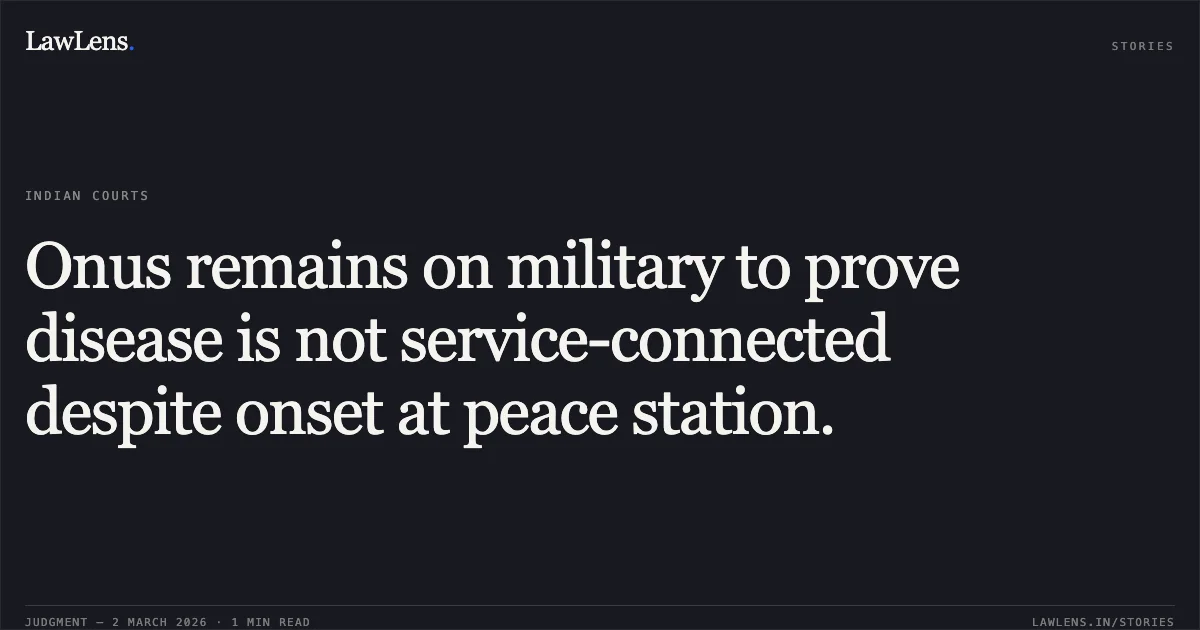
The court applied the Entitlement Rules for Casualty Pensionary Awards, 2008, noting that while they updated the 1982 regime, the burden of proof remains on the administration to disprove entitlement.
Source reference: p. 4It relied on *Dharamvir Singh v. Union of India* (2013) regarding the presumption of sound health at entry.
Source reference: p. 2It relied on *Union of India v. Col. Balbir Singh (Retd.)* (2025), which established that disability occurring in peace conditions is not a valid ground to deny pension.
Source reference: p. 6-7Furthermore, it cited *Rajumon T.M. v. Union of India* (2025) to distinguish between a "conclusion" and a "reasoned medical opinion," asserting that the Medical Board must provide causative factors, not just bald statements.
Source reference: p. 5Reasoning
The Court clarified that even under the 2008 Rules, an officer who develops a disease during service is ordinarily entitled to a disability pension unless the administration provides "cogent reasons" and identifies a specific cause other than military service.
Source reference: p. 4The Court found the RMB’s justification—that the disease started at a "peace station" without field-related stress—to be legally insufficient.
Source reference: p. 6Per Regulation 423(a) of the Medical Services Regulations, 2010, the location of the onset (peace vs. field) is immaterial if the disease is contracted during service tenure.
Source reference: p. 7Since the RMB failed to identify any non-service causative factor and explicitly stated the disability was not due to the Respondent's negligence or misconduct, the Court held that the legal presumption of service-related stress and strain must apply.
Source reference: p. 7-8Holding
The High Court dismissed the writ petition, upholding the AFT's order.
It held that the Respondent is entitled to a disability element of pension for "Primary Hypertension," rounded off to 50% for life.
Source reference: p. 1-2The Court also noted the petition was barred by delay and laches, as it was filed over a year after the AFT's judgment without adequate explanation.
Source reference: p. 8No costs were awarded.
Source reference: p. 8Original Court PDF
Union of India & Ors. v. 777792 SGT Praveen Kumar Upadhyay (Retd.); W.P.(C) 2574/2026
Click to open original judgment
Original judgment, available to read, download and summarize on LawLens.in