Facts
The Respondent was enrolled in the Indian Air Force on 25.08.1982 and served for 28 years until the onset of "Primary Hypertension" in November 2010 while posted at a peace station in Bangalore
Source reference: p. 5He was discharged on 31.01.2020 upon attaining the age of superannuation
Source reference: p. 2The Release Medical Board (RMB) assessed his disability at 30% for life but classified it as "Neither Attributable to Nor Aggravated" (NANA) by military service, citing the onset occurred at a peace station without connection to combat or high-altitude service
Source reference: p. 2, 6The Respondent’s claim for disability pension was rejected by the Petitioners
Source reference: p. 2The Armed Forces Tribunal (AFT) subsequently granted the pension, which the Union of India challenged in this writ petition
Source reference: p. 1-2Issues
Whether the Entitlement Rules for Casualty Pensionary Awards to Armed Forces Personnel, 2008, place the burden of proof on the claimant to establish a causal connection between the disability and military service
Source reference: p. 4 / para. 8Whether the mere fact that a disease manifested at a "peace station" is a sufficient legal ground to classify a disability as NANA
Source reference: p. 7 / para. 13Law Applied
The court applied the Entitlement Rules for Casualty Pensionary Awards to Armed Forces Personnel, 2008, and Regulation 423(a) of the Regulations for the Medical Services of the Armed Forces, 2010
Source reference: p. 4, 7It relied on the precedent in Dharamvir Singh v. Union of India, which established a presumption of service-connection for diseases not noted at entry
Source reference: p. 2Union of India v. Col. Balbir Singh (Retd.), which clarified that under the 2008 Rules, the onus remains on the administration to prove the lack of a causal connection
Source reference: p. 4Furthermore, Bijender Singh v. Union of India and Rajumon T.M. v. Union of India were cited to emphasize that the Medical Board must provide cogent "reasons" rather than mere "conclusions" to deny attributability
Source reference: p. 5Reasoning
The Court rejected the Petitioner’s argument that the 2008 Rules did away with the presumption in favor of the soldier.
Source reference: p. 4It held that even under the 2008 regime, an officer who contracts a disease during service is ordinarily entitled to a disability pension unless the administration provides specific, cogent reasons identifying a non-service cause
Source reference: p. 4The Court scrutinized the RMB’s opinion, noting it merely stated a conclusion—"Onset in Peace Station"—without explaining why the rigors of service did not contribute to the hypertension
Source reference: p. 7Following the ratio in Col. Balbir Singh, the Court observed that peace stations involve rigorous training and disciplinary stress, thus making the "peace station" justification an invalid ground for denying attributability
Source reference: p. 7-8Since the Respondent entered service in a fit state and no misconduct was noted, the military establishment failed to discharge its heavy burden of proof to rebut the connection to service
Source reference: p. 7Holding
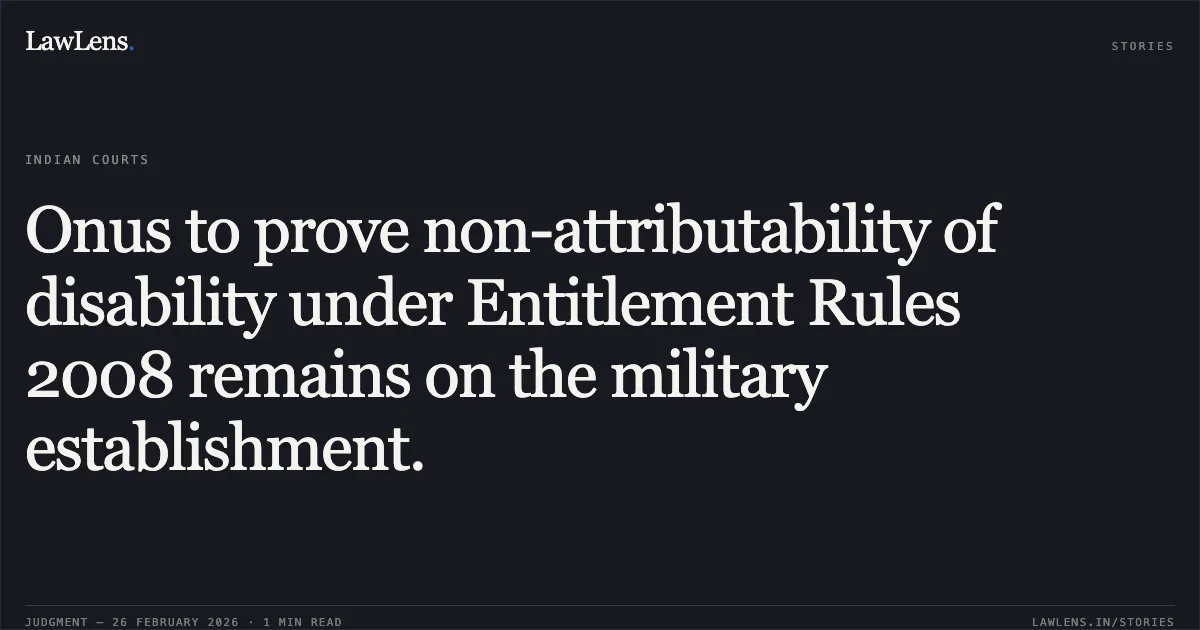
The Court answered the issues by holding that the burden of proof remains on the Military Establishment even under the 2008 Rules, and a "peace station" onset is insufficient to deny a claim
The High Court upheld the AFT's order, confirming the Respondent's entitlement to a disability pension of 30% for life, rounded off to 50%
Source reference: p. 1, 8The writ petition filed by the Union of India was dismissed with no costs
Source reference: p. 8Original Court PDF
Union of India Through Secretary & Ors. v. 681464 Ex JWO Harekrushna Sahoo, W.P.(C) 1013/2026
Click to open original judgment
Original judgment, available to read, download and summarize on LawLens.in