Facts
The petitioner was recorded as an eligible beneficiary in Annexure II and was allotted Flat No. 408, Kushinara CHS, under a Slum Rehabilitation Scheme.
Source reference: paras. 2–3She executed a Power of Attorney in favour of Nitin Patel and permitted him to remain in possession of the flat with his family.
Source reference: para. 4In 2015, respondent No. 3 was found residing in the flat and stated to the Inspection Officer that she was occupying it as a tenant.
Source reference: para. 4On that basis, the authorities concluded that the petitioner had parted with possession in breach of Section 3E of the Maharashtra Slum Areas (Improvement, Clearance and Redevelopment) Act, 1971, and directed eviction.
Source reference: paras. 4–6, 28The petitioner’s statutory appeal was dismissed on 18 June 2016, prompting the present writ petition under Articles 226 and 227 of the Constitution.
Source reference: paras. 1, 5–7The petitioner argued that there was no registered sale, lease, gift, exchange, or other documentary proof of transfer, whereas the respondents relied on the inspection report and the alleged handing over of possession.
Source reference: paras. 8–11Issues
1. Whether the petitioner had transferred or otherwise parted with possession of the rehabilitation tenement in contravention of Section 3E(1) of the Maharashtra Slum Areas Act, despite the absence of a registered sale deed, lease deed, or other formal conveyance.
Source reference: paras. 12–15, 262. Whether the authorities were justified in directing eviction under Section 3E(2) on the basis of the Power of Attorney, the petitioner’s non-occupation, and respondent No. 3’s occupation as a tenant.
Source reference: paras. 18–19, 28–333. Whether the allegations concerning the petitioner’s alleged fraudulent inclusion in Annexure II and the original occupant’s competing claim could be determined in proceedings under Section 3E.
Source reference: para. 27Law Applied
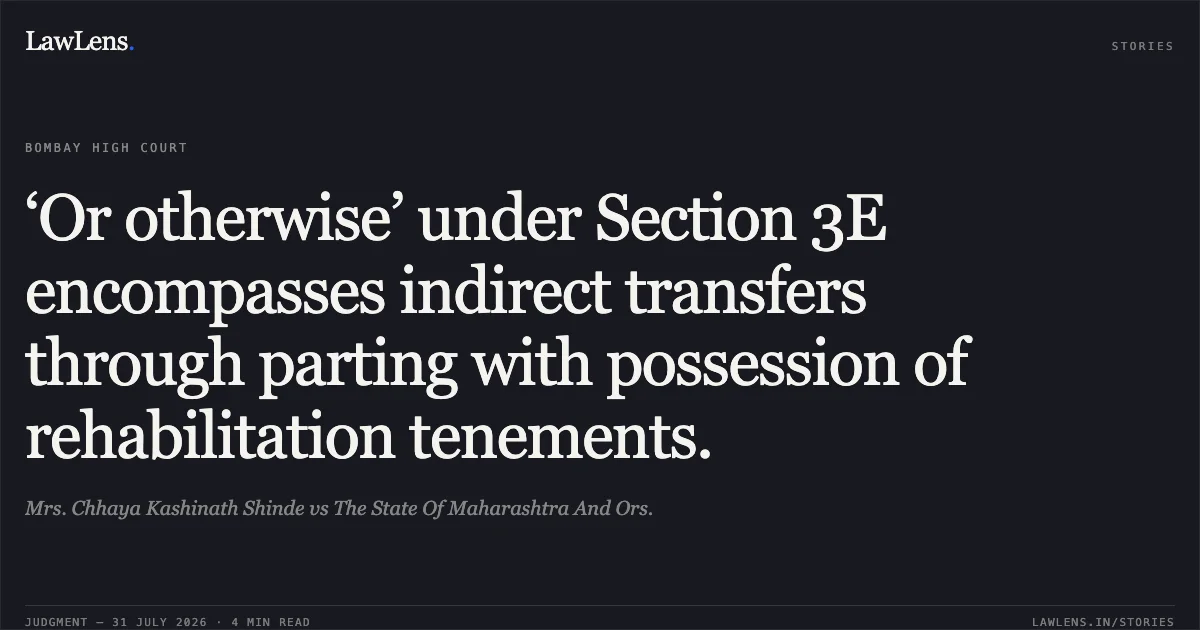
The Court applied Section 3E(1) of the Maharashtra Slum Areas (Improvement, Clearance and Redevelopment) Act, 1971, which prohibits transfer of a rehabilitation tenement by “sale, gift, exchange, lease or otherwise” during the prescribed period and requires permission of the Slum Rehabilitation Authority for transfers thereafter.
Source reference: para. 15Section 3E(2) authorises the Competent Authority to evict a person found in possession where the tenement has been transferred in contravention of Section 3E(1), subject to a reasonable opportunity to show cause.
Source reference: paras. 15, 18–19The expression “or otherwise” was construed broadly to include indirect arrangements by which the allottee parts with possession or enjoyment, even without a registered conveyance.
Source reference: paras. 17, 20, 25The Court relied on Lila Vati Bai v. State of Bombay, (1957) 1 SCC 411, which held that “or otherwise” is a phrase of extension covering all possible modes; Vinayakrao v. State of Maharashtra, AIR 1976 Bom 10, which treated enumerated modes of transfer as non-exhaustive; and Naginbhai Lallubhai Patel v. Union Territory of Dadra and Nagar Haveli, 2003 (3) Mah LJ 678, which held that “otherwise” is intended to plug avenues of escape.
Source reference: paras. 21–24However, the authorities must still establish, on material evidence, that the allottee actually parted with possession; mere suspicion or assumption is insufficient.
Source reference: para. 26Reasoning
The Court held that the absence of a registered sale or lease deed did not resolve the matter because Section 3E expressly extends beyond formal transfers through the words “or otherwise”.
Source reference: paras. 14, 25, 32The relevant inquiry was therefore the substance and effect of the arrangement.
Source reference: no citationThe petitioner’s Power of Attorney placed Nitin Patel in possession, while the inspection report recorded that respondent No. 3 was occupying the flat as a tenant and that the original allottee was not residing there.
Source reference: paras. 28–30The Society’s No Objection Certificate merely showed that Nitin Patel had occupied the flat for some time; it did not explain respondent No. 3’s subsequent occupation or establish that the petitioner continued to reside there.
Source reference: para. 31Taken cumulatively, these circumstances provided sufficient material for the authorities to infer that the petitioner had parted with possession in a manner prohibited by Section 3E.
Source reference: paras. 32–34The Court further held that allegations regarding the petitioner’s eligibility, fraudulent inclusion in Annexure II, and rival claims of the original occupant fell outside the limited scope of Section 3E proceedings, which concerned only the alleged prohibited transfer.
Source reference: para. 27The authorities had therefore acted within jurisdiction and complied with the requisite opportunity to show cause.
Source reference: paras. 18–19, 34Holding
The Court answered the principal issues against the petitioner, holding that a prohibited transfer under Section 3E may be established through actual parting with possession or indirect arrangements, even without a registered conveyance.
The inspection material, the petitioner’s non-occupation, the Power of Attorney, and respondent No. 3’s occupation as a tenant justified the authorities’ conclusion that Section 3E was attracted.
Source reference: paras. 33–34The writ petition was dismissed; the order of the Competent Authority directing eviction and the order of the Appellate Authority were upheld.
Source reference: para. 35The Rule was discharged, with no order as to costs, and any pending interim applications were disposed of.
Source reference: para. 35Original Court PDF
Mrs. Chhaya Kashinath ShindevsThe State Of Maharashtra And Ors.
Click to open original judgment
Original judgment, available to read, download and summarize on LawLens.in