Facts
The Plaintiff (Respondent) filed a suit for eviction and mesne profits regarding Suit Property No. 198, Munirka Enclave.
Source reference: p. 2The Defendant (Appellant) was inducted as a tenant via a Lease Deed dated 23.12.2011, which was renewed multiple times until it finally expired by efflux of time on 30.06.2018.
Source reference: p. 3, 12The Defendant refused to vacate, claiming that an oral Agreement to Sell was entered into in October 2014 for Rs. 1.72 Crores, of which he allegedly paid Rs. 25,00,000 in cash.
Source reference: p. 5Consequently, the Defendant filed a separate suit for Specific Performance.
Source reference: p. 5The Trial Court allowed the Plaintiff’s application under Order XII Rule 6 of the CPC, passing a decree for possession based on the Defendant's admissions of the landlord-tenant relationship and the expiry of the lease.
Source reference: p. 7-8Issues
1. Whether a decree for possession under Order XII Rule 6 CPC can be passed when the tenant claims the existence of an oral Agreement to Sell.
Source reference: p. 13-142. Whether the Defendant was entitled to protection of possession under Section 53A of the Transfer of Property Act, 1882.
Source reference: p. 15-163. Whether the Civil Court's jurisdiction was barred by an arbitration clause in the expired lease deed.
Source reference: p. 8-9Law Applied
The court applied Order XII Rule 6 of the CPC, which permits judgment on admissions where the landlord-tenant relationship and the termination of tenancy are undisputed.
Source reference: p. 11-12It relied on Section 106 and Section 108(B)(q) of the Transfer of Property Act, 1882, establishing that a lessee is bound to restore possession upon determination of the lease.
Source reference: p. 14The court invoked the principle of "once a tenant, always a tenant," citing M.R. Sawhney v. Doris Randhawa.
Source reference: p. 16It further applied Section 53A of the Transfer of Property Act and Section 17(1A) of the Registration Act, 1908, which stipulate that protection of part-performance requires a registered document.
Source reference: p. 15Precedents like Md. Raza v. Geeta and M/s Jagdambey Builders v. J.S. Vohra were used to clarify that an agreement to sell does not transfer title or alter the character of possession from tenant to owner until a decree of specific performance is executed.
Source reference: p. 14, 17Reasoning
The Court observed that the Defendant categorically admitted to being a tenant and that the lease had expired by efflux of time.
Source reference: p. 12-13The Court rejected the defense of an oral Agreement to Sell, noting it was vague, lacked proof of payment (Rs. 25 Lakhs in cash), and was contradicted by the fact that the Defendant continued to sign new Lease Deeds after the alleged 2014 agreement.
Source reference: p. 13-14Legally, the Court reasoned that even if an oral agreement existed, it does not create interest in the property nor does it entitle a tenant to resist eviction unless the requirements of Section 53A of the TPA are met—specifically, a written and registered document, which was absent here.
Source reference: p. 15The Court held that the character of the Defendant's possession remained that of a tenant, and the mere filing of a suit for specific performance does not grant him the right to continue in occupation without paying rent or defying the landlord's title.
Source reference: p. 16-17Regarding arbitration, the Court noted the Defendant had waived the right by not pressing his Section 8 application and submitting to the court's jurisdiction.
Source reference: p. 7, 11Holding
The High Court upheld the Trial Court's judgment, answering that a decree under Order XII Rule 6 CPC is mandated when the jural relationship and lease expiry are admitted.
The Court held that without a registered document, the Defendant cannot claim protection under Section 53A of the TPA.
Source reference: p. 16-18The Appeal and pending applications were dismissed, affirming the decree for possession in favor of the Respondent.
Source reference: p. 18Acts & Sections Cited
8 provisions across 4 statutes referred to in this judgment. Each provision opens on LawLens.
Code of Civil Procedure, 19084
Arbitration and Conciliation Act, 19961
Transfer of Property Act, 18822
Registration Act, 19081
Original Court PDF
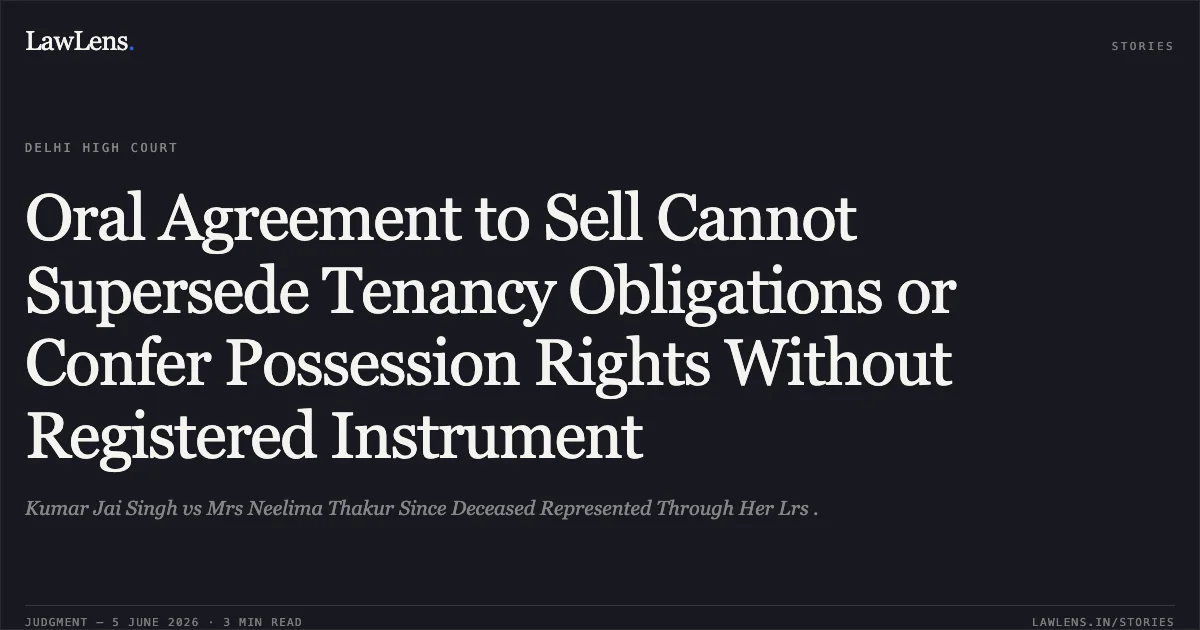
Kumar Jai SinghvsMrs Neelima Thakur Since Deceased Represented Through Her Lrs .
Click to open original judgment
Original judgment, available to read, download and summarize on LawLens.in