Facts
The deceased, Kallu @ Arif, was allegedly assaulted with iron rods and sticks by the Respondents on April 11, 2009, in Sonia Vihar, Delhi
Source reference: p. 2Information was received via DD Entry 30-A, but the victim was unfit for a statement upon police arrival at the hospital and died the following day
Source reference: p. 3The prosecution’s case relied on an SMS chain initiated by PW-1 (Manju) to PW-4 (Danish, the victim's brother), who then informed PW-2 and PW-3
Source reference: p. 6PW-4 further alleged that the deceased made an oral dying declaration at the hospital gate naming the assailants
Source reference: p. 11The Trial Court acquitted all seven accused on February 25, 2012, citing a failure to prove guilt beyond reasonable doubt
Source reference: p. 2The victim’s father appealed the acquittal; however, following his death, his legal representatives failed to join the proceedings
Source reference: p. 8Issues
1. Whether the oral dying declaration allegedly made to PW-4 was reliable and sufficient to sustain a conviction
Source reference: p. 12 / para. 33-342. Whether the circumstantial evidence, specifically the SMS communication chain and testimonies of PW-2, PW-3, and PW-4, established an unbroken chain of guilt
Source reference: p. 16 / para. 363. Whether the findings of the Trial Court were perverse or based on a misreading of evidence justifying interference in an appeal against acquittal
Source reference: p. 11 / para. 31Law Applied
The Court applied Section 372 of the Cr.P.C. regarding the victim's right to appeal and the settled principle that an appellate court should not interfere with an acquittal unless the findings are perverse or ignore material evidence
Source reference: p. 2, 11Regarding evidence, it applied Section 32(1) of the Indian Evidence Act, 1872, pertaining to dying declarations, and followed the Supreme Court precedent in Irfan @ Naka v. State of Uttar Pradesh, which mandates that a dying declaration must inspire full confidence, be free from tutoring, and be made in a fit state of mind
Source reference: p. 12-15Reasoning
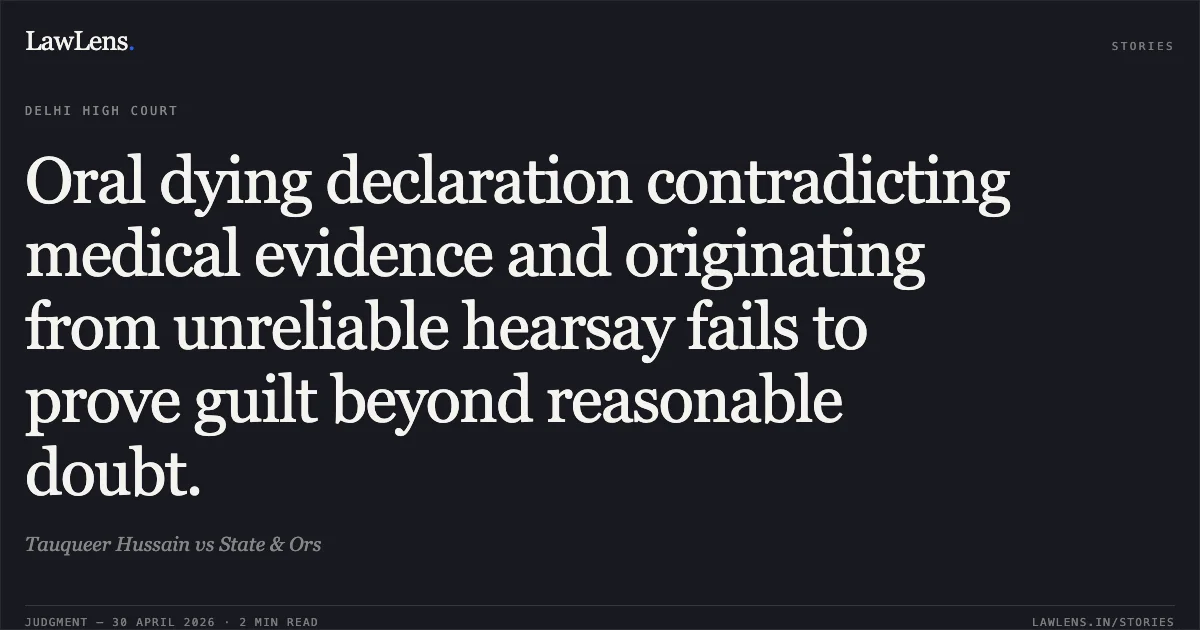
The Court found the alleged oral dying declaration recorded by PW-4 unreliable because it lacked the deceased’s signature/thumb impression, was contradicted by the MLC (which declared the victim "unfit for statement" at 02:15 AM), and was missing from the earliest hospital records
Source reference: p. 16Furthermore, the FSL report found no alcohol in the deceased’s blood, contradicting the declaration’s claim that the victim was intoxicated when assaulted
Source reference: p. 16The SMS chain (the "foundation" of the case) collapsed because the originator (PW-1) disowned the incriminating messages and admitted only to a neutral text
Source reference: p. 16-17PW-4 was also unable to provide basic details of the incident spot or the restaurant during cross-examination, rendering his presence at the scene doubtful
Source reference: p. 17The Court concluded that the prosecution's reliance on hearsay and a discredited SMS chain failed to form a complete chain of evidence
Source reference: p. 18Holding
The High Court upheld the Trial Court's judgment, holding that the prosecution failed to prove the case beyond reasonable doubt
The Court ruled that the alleged dying declaration was undocumented and scientifically contradicted, while the oral testimonies were based on a "discredited SMS chain"
Source reference: para. 38The appeal was dismissed, and the bail/surety bonds of the respondents were cancelled
Source reference: para. 39-40Acts & Sections Cited
5 provisions across 2 statutes referred to in this judgment. Each provision opens on LawLens.
Code of Criminal Procedure, 19732
Indian Penal Code, 18603
Original Court PDF
Tauqueer HussainvsState & Ors
Click to open original judgment
Original judgment, available to read, download and summarize on LawLens.in