Facts
The appellant (plaintiff) filed a suit for specific performance based on a registered sale agreement dated 07.04.2011 for a consideration of Rs. 1,50,000/-, asserting an advance payment of Rs. 90,000/- with a two-year period for completion
Source reference: p. 2The respondent (defendant) contended the agreement was a sham document executed as security for a loan of Rs. 1,00,000/- and that the property was joint family property
Source reference: p. 3The Trial Court decreed the suit, but the First Appellate Court reversed the decision, dismissing the relief for specific performance while directing the refund of the loan amount
Source reference: p. 4Issues
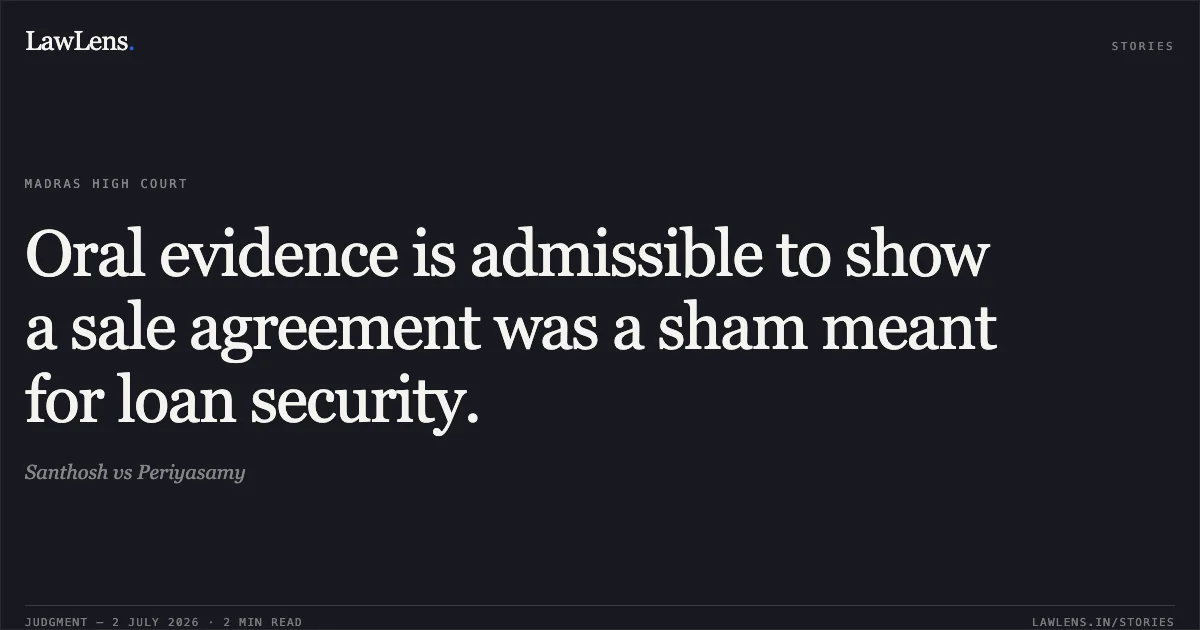
1. Whether the sale agreement (Ex.A1) was a genuine transaction intended for the sale of property or a sham document executed as security for a loan
Source reference: p. 52. Whether the plaintiff demonstrated continuous readiness and willingness to perform his part of the contract as required under Section 16(c) of the Specific Relief Act
Source reference: p. 8Law Applied
The Court applied Section 92 of the Indian Evidence Act, 1872, regarding the exclusion of oral evidence against written contracts, as interpreted by the Supreme Court in Ganga Bai v. Chhabubai (1982) 1 SCC 4, which permits oral evidence to prove that a document was intended to be sham or a different transaction altogether
Source reference: p. 6-7The Court also relied on the requirements of Section 16(c) of the Specific Relief Act, 1963, necessitating the plaintiff to prove continuous readiness and willingness throughout the contract period
Source reference: p. 9Reasoning
The Court found that the First Appellate Court rightly accepted oral evidence to dispute the character of the document (security vs. sale) rather than to contradict its terms, aligning with the Ganga Bai precedent
Source reference: p. 6The Court observed that the fixation of a two-year time limit for a small balance of Rs. 60,000/- after paying 2/3 of the consideration was "unusual and unnatural," supporting the theory of a loan transaction
Source reference: p. 7-8Furthermore, the Court scrutinized the plaintiff’s conduct regarding readiness: the plaintiff issued a notice calling the defendant to the Sub-Registrar’s office on a Sunday (07.04.2013) and failed to provide evidence of communicating a change of date to 05.04.2013
Source reference: p. 8-9This was viewed as a "scheme" to create artificial evidence of readiness rather than a genuine intent to perform
Source reference: p. 9Holding
The High Court dismissed the Second Appeal, holding that no substantial question of law arose
The Court affirmed that (i) the agreement was executed as security for a loan and not a genuine sale, and (ii) even if the agreement were valid, the plaintiff failed to prove continuous readiness and willingness
Source reference: p. 9-10The judgment of the First Appellate Court, dismissing specific performance but ordering the refund of the admitted loan amount, was upheld
Source reference: p. 10Acts & Sections Cited
1 provisions across 1 statute referred to in this judgment. Each provision opens on LawLens.
Code of Civil Procedure, 19081
Original Court PDF
SanthoshvsPeriyasamy
Click to open original judgment
Original judgment, available to read, download and summarize on LawLens.in