Facts
During the COVID-19 pandemic lockdown in March 2020, the Chief Minister of Delhi, in a press conference held on March 29, 2020, appealed to landlords not to force impoverished tenants to pay rent
Source reference: para. 4He stated that if a tenant was unable to pay due to lack of means, "the Government will pay for it"
Source reference: para. 4On the same day, the Delhi Disaster Management Authority (DDMA) issued Order No. 122-A, proscribing landlords from demanding rent for one month or evicting migrant workers
Source reference: para. 30, 43Six petitioners (five tenants and one landlord) sought a writ of mandamus to compel the State to fulfill the Chief Minister's assurance
Source reference: para. 9A learned Single Judge ruled in favor of the petitioners on July 22, 2021, holding the promise enforceable under promissory estoppel and legitimate expectation, and directed the Government to take a decision on implementation
Source reference: para. 5-6The State appealed this decision
Source reference: para. 7Issues
1. Whether a verbal assurance given by a Chief Minister in a press conference constitutes a legally enforceable promise against the State under the doctrine of promissory estoppel
Source reference: para. 1, 342. Whether the doctrine of legitimate expectation can be invoked to compel the Government to implement an assurance that has not been translated into a formal written policy or executive instruction
Source reference: para. 15, 763. Whether a writ of mandamus can be issued to enforce a statement made by a constitutional functionary absent compliance with Article 166 of the Constitution or statutory authorization
Source reference: para. 21, 48, 81Law Applied
The Court primarily applied the doctrine of Promissory Estoppel, which requires a clear and unequivocal promise made with the intent to create legal relations, upon which a party acts to their detriment
Source reference: para. 28, 59.3It relied on Union of India v. Ganesh Rice Mills, established that a Minister's statement on the floor of the House does not constitute an enforceable promise
Source reference: para. 57.1It further applied the principle from State of Karnataka v. K.K. Mohandas that estoppel does not operate at the level of government policy
Source reference: para. 58.2Regarding Legitimate Expectation, the Court cited Sivanandan C.T. v. High Court of Kerala, holding that the doctrine provides procedural protection but is not a substantive legal right or an independent basis for judicial review
Source reference: para. 74The Court also considered the Disaster Management Act, 2005 and Epidemic Diseases Act, 1897, noting that executive power must be exercised within the bounds of statutory guidelines
Source reference: para. 64-66Reasoning
The Court analyzed the distinction between political campaign rhetoric and statements made by an incumbent Chief Minister, acknowledging that the latter carries significant weight but is not automatically a "promise" in law
Source reference: para. 36-37The Court found that for a statement to be enforceable against the State, it must be reduced to a formal document—such as an Office Memorandum, Notification, or Circular—reflecting a deliberate policy decision
Source reference: para. 48, 51The CM's statement had two parts: (1) a proscription against eviction, which was supported by DDMA Order 122-A, and (2) an assurance that the State would pay the rent, which lacked any statutory or executive documentation
Source reference: para. 42-43, 62The Court reasoned that under the Disaster Management Act and Epidemic Diseases Act, while the State could take measures to prevent the spread of disease, the assurance to pay rent from the exchequer was not supported by any existing guidelines or financial assessment
Source reference: para. 64-69Consequently, the lack of a formal "policy" meant there was no legal liability that a mandamus could compel the State to perform
Source reference: para. 53, 71Holding
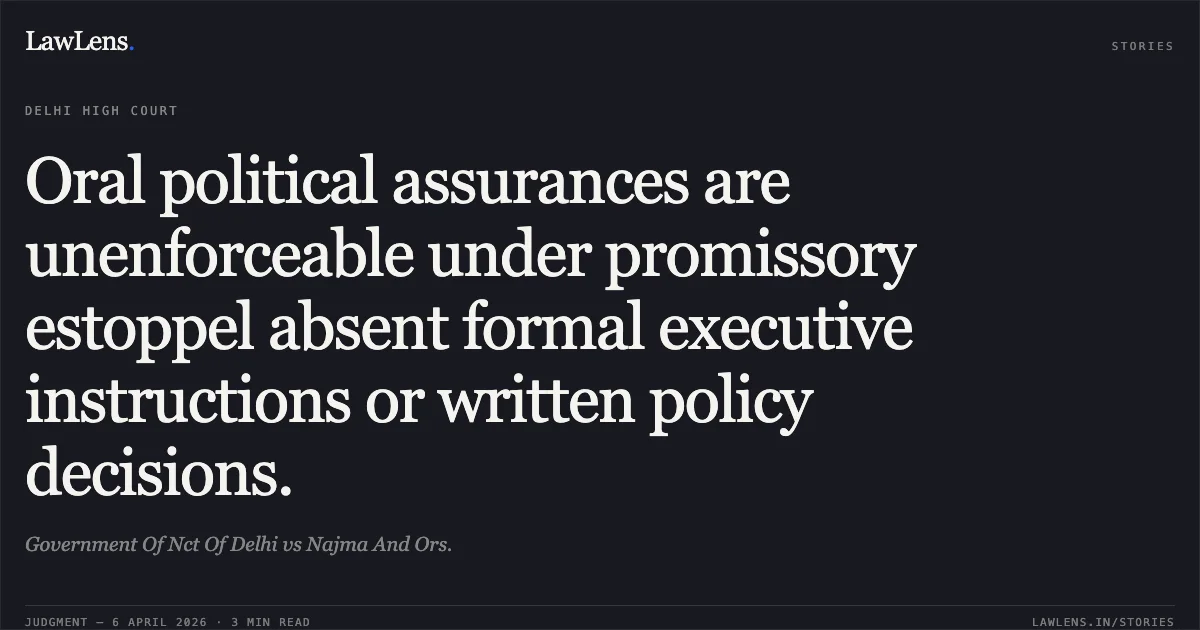
The prayer for a mandamus to implement the Chief Minister's assurance is rejected as the statement alone, without a formal policy, is unenforceable
Under DDMA Order 122-A, landlords are prohibited from recovering rent from impoverished migrant tenants for the specific duration of the lockdown
Source reference: para. 82(ii)The State Government retains the discretion to take a policy decision regarding the assurance but cannot be judicially compelled to do so
Source reference: para. 82(iii)The Court set aside the direction requiring the State to frame a specific policy or implementation scheme based solely on the press conference statement
Source reference: para. 81-82Acts & Sections Cited
5 provisions across 3 statutes referred to in this judgment. Each provision opens on LawLens.
Disaster Management Act, 20053
Epidemic Diseases Act, 18971
Customs Act,19621
Original Court PDF
Government Of Nct Of DelhivsNajma And Ors.
Click to open original judgment
Original judgment, available to read, download and summarize on LawLens.in