Facts
The petitioner, Md. Shunahar Ali, challenged an opinion dated 30.08.2017 passed by the Foreigners Tribunal 1, Nalbari, which declared him a foreigner of the post-25.03.1971 stream
Source reference: para. 2The petitioner claimed Indian citizenship by birth (born in 1985/1987) and asserted that his father, Ibrahim Ali, and grandfather, Sangser Ali, were Indian citizens whose names appeared in voter lists of 1966 and 1985
Source reference: para. 3-6He produced 16 documents, including voter lists, NRC extracts, PAN cards, an EPIC, a school certificate, and Gaonburah certificates, and examined five witnesses including his projected parents
Source reference: para. 6, 16The High Court had previously ordered a verification report from the SP (Border) regarding his lineage
Source reference: para. 5Issues
1. Whether the petitioner was denied a reasonable opportunity to defend himself due to the alleged non-furnishing of grounds for suspecting him to be a foreigner
Source reference: para. 3, 322. Whether the petitioner is entitled to citizenship by birth under Section 3 of the Citizenship Act, 1955
Source reference: para. 4, 383. Whether the documents produced (voter lists, school certificates, Gaonburah certificates, and oral testimony) were sufficient to establish the petitioner's linkage to his projected ancestors and discharge the burden of proof under Section 9 of the Foreigners Act, 1946
Source reference: para. 17-31Law Applied
Section 9 of the Foreigners Act, 1946, which mandates that the burden of proving that a person is not a foreigner lies upon that person
Source reference: para. 11, 36Section 6A of the Citizenship Act, 1955, as a special provision overriding general citizenship laws for the state of Assam
Source reference: para. 39Under Section 106 of the Evidence Act, 1872, the court held that facts within the personal knowledge of the proceedee must be proved by them
Source reference: para. 36Precedents including State of Assam v. Moslem Mondal (2013) were used to define the limits of certiorari jurisdiction
Source reference: para. 8, 14Sarbananda Sonowal v. Union of India (2005) was cited regarding the "aggression" of illegal migration and the necessity of Section 9
Source reference: para. 36Reasoning
The court found that the notice served to the petitioner sufficiently disclosed the grounds of suspicion, and since the petitioner did not raise this plea before the Tribunal, he could not do so under certiorari jurisdiction
Source reference: para. 33-34Regarding citizenship by birth, the court ruled that Section 6A of the Citizenship Act is a special provision for Assam that overrides the general Section 3; since the petitioner failed to prove his father was an Indian citizen prior to 1971, Section 3 was inapplicable
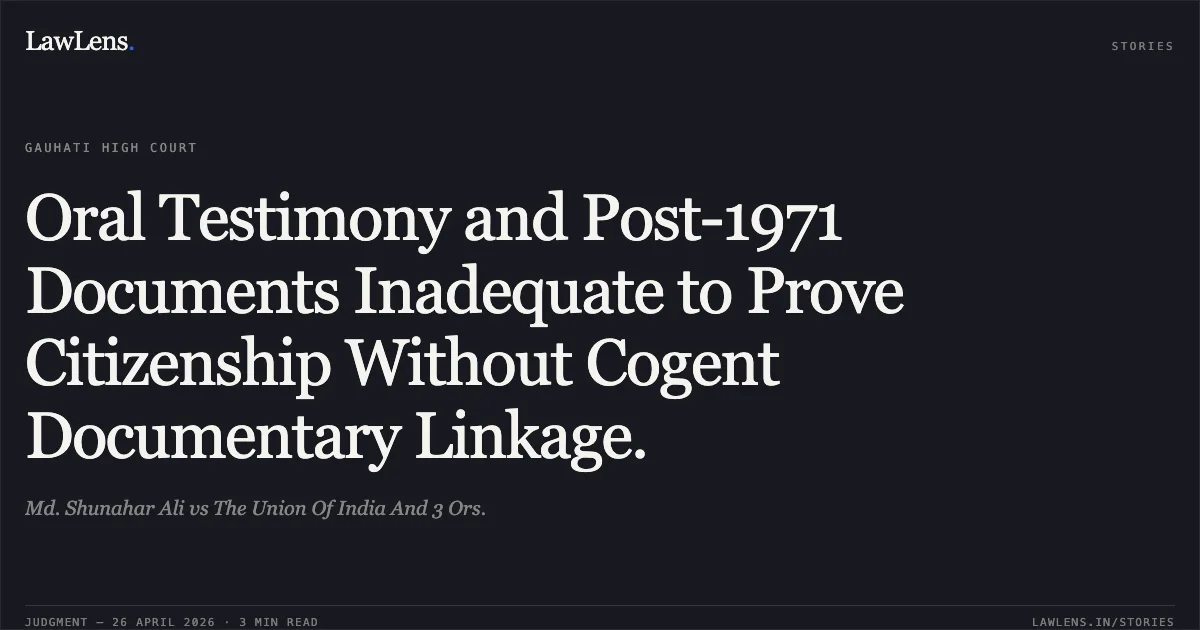
Source reference: para. 39On evidentiary value, the court discarded the NRC extracts as inadmissible [para. 18], and the school certificate (Ext. 14) as secondary evidence not supported by original admission registers [para. 27-28]. Gaonburah certificates were deemed private documents with no statutory weight [para. 24-25]. The court noted significant discrepancies in the petitioner's date of birth across documents (1985 vs 1987) and held that oral testimony from projected parents, without corroborating documentary linkage, is insufficient proof of citizenship
Source reference: para. 11, 27, 31Holding
The court answered all issues against the petitioner, holding that he failed to discharge the burden of proof under Section 9 of the Foreigners Act, 1946
The court upheld the Foreigners Tribunal's opinion dated 30.08.2017, declaring the petitioner a foreigner of the post-25.03.1971 stream. The writ petition was dismissed, and the Registry was directed to return the records to the Tribunal for necessary legal consequences
Source reference: para. 44-45Acts & Sections Cited
6 provisions across 2 statutes referred to in this judgment. Each provision opens on LawLens.
Illegal Migrants (Determination by Tribunals) Act, 19831
Original Court PDF
Md. Shunahar AlivsThe Union Of India And 3 Ors.
Click to open original judgment
Original judgment, available to read, download and summarize on LawLens.in