Facts
The plaintiffs filed a suit on November 3, 2022, for declaration of title and possession based on a 2019 sale deed
Source reference: para. 2Prior to the suit’s institution, the petitioner purchased a portion of the suit property from one Tijan Kushwaha via a sale deed dated February 24, 2020
Source reference: para. 2Tijan Kushwaha died before the suit was filed, and his legal representatives (defendants No. 2–6 and 8) failed to disclose the sale to the petitioner in their written statements
Source reference: para. 2–3The Trial Court decreed the suit on June 19, 2025, affecting the entire property, including the petitioner's portion
Source reference: para. 4During the appellate proceedings, the petitioner filed an application under Order 1 Rule 10 of the C.P.C. to be impleaded. The Appellate Court rejected the application on November 18, 2025, holding that Order 1 Rule 10 applies only to original suits and Order 41 Rule 20 applies only to parties already present in the original suit
Source reference: para. 1, 5Issues
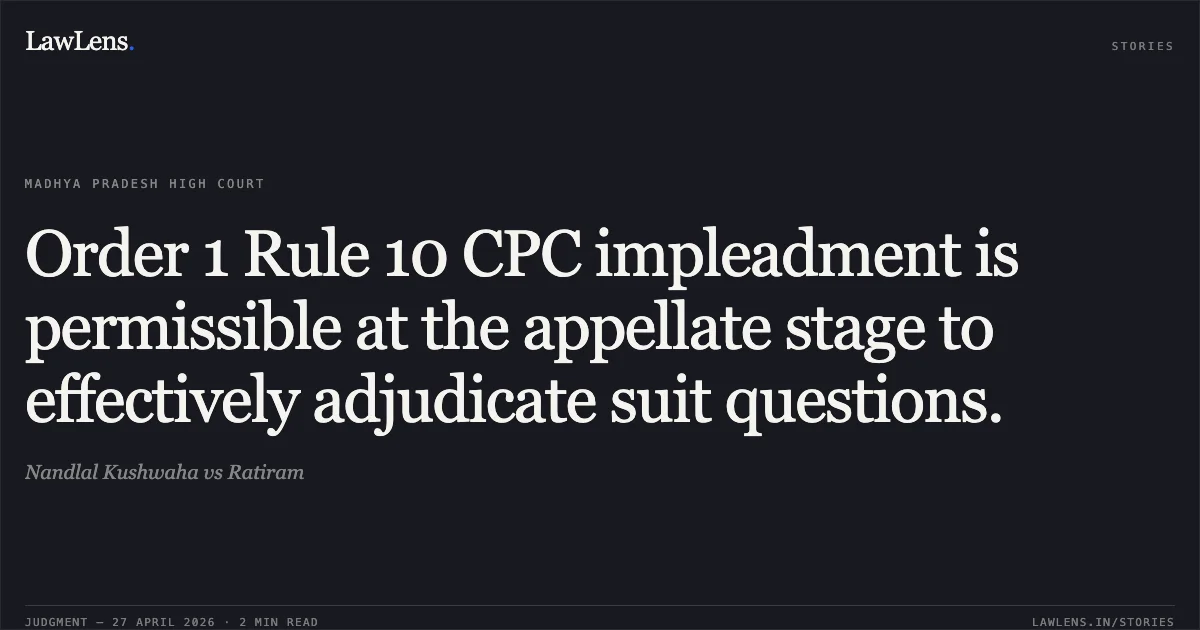
1. Whether a person who was not a party to the original suit can be impleaded as a respondent during appellate proceedings under Order 41 Rule 20 of the C.P.C.
Source reference: para. 8–92. Whether the Court has the power to implead a necessary party at the appellate stage under Order 1 Rule 10 of the C.P.C.
Source reference: para. 10–11Law Applied
Order 41 Rule 20 of the C.P.C., which allows an Appellate Court to implead interested persons, provided they were parties to the original suit
Source reference: para. 8Order 1 Rule 10(2) of the C.P.C., which grants courts wide discretion to add a party "at any stage of the proceedings" if their presence is necessary for effective adjudication
Source reference: para. 10Pankajbhai Rameshbhai Zalavadiya v. Jethabhai Kalabhai Zalavadiya (2017), which establishes that Order 1 Rule 10 enables the impleadment of vital parties at any stage to avoid multiplicity of proceedings and settle all questions involved in the suit
Source reference: para. 10Reasoning
The Court agreed with the lower court that the petitioner could not be impleaded under Order 41 Rule 20 because he was not a party to the original trial
Source reference: para. 9Since the petitioner purchased the property prior to the institution of the suit, he was a "necessary party" whose title was directly impacted by the decree
Source reference: para. 7The High Court dismissed the respondents' objections regarding the petitioner's alleged prior knowledge of the suit, noting that the legal representatives of the vendor had suppressed the sale transaction during the trial
Source reference: para. 3, 6Applying the principle from Pankajbhai Rameshbhai Zalavadiya, the Court determined that "at any stage" includes appellate proceedings, and impleadment was necessary to effectively settle the controversy and prevent prejudice to the affected purchaser
Source reference: para. 10–11Holding
The Court answered the first issue in the negative and the second issue in the affirmative, holding that while Order 41 Rule 20 is restrictive, Order 1 Rule 10(2) provides the requisite power to implead a necessary party during an appeal
The High Court set aside the Order dated November 18, 2025, allowed the petitioner’s application under Order 1 Rule 10 of the C.P.C., directed that the petitioner be impleaded as a respondent in the appeal, and allowed the petition
Source reference: para. 11, 12Acts & Sections Cited
2 provisions across 1 statute referred to in this judgment. Each provision opens on LawLens.
Code of Civil Procedure, 19082
Original Court PDF
Nandlal KushwahavsRatiram
Click to open original judgment
Original judgment, available to read, download and summarize on LawLens.in