Facts
Sandeep Sood, claiming to be the landlord, instituted a petition under Section 14 of the Himachal Pradesh Urban Rent Control Act, 1987 (“Rent Control Act”) against Dimple Malhotra for eviction on the ground of non-payment of rent.
Source reference: para. 4.1During the pendency of the rent petition, and when the matter was listed for arguments, Kuldeep Sood applied under Order I Rule 10(2) read with Section 151 of the Code of Civil Procedure, 1908 (“CPC”), seeking impleadment as petitioner No. 2 on the ground that he was a co-owner/co-sharer of the demised premises.
Source reference: paras. 4.2–4.3The Rent Controller dismissed the application on 30 March 2026.
Source reference: para. 4.4Kuldeep Sood challenged that order under Article 227 of the Constitution.
Source reference: no citationThe High Court noted that the petitioner had separately instituted a declaration and partition suit in 2023, including claims for partition, rendition of accounts of rents received from tenants, payment of his share, and injunction against unilateral collection of rent.
Source reference: para. 9Issues
Whether an application under Order I Rule 10(2) read with Section 151 CPC was maintainable before the Rent Controller under the Himachal Pradesh Urban Rent Control Act, 1987?
Source reference: paras. 10, 12–13Whether the petitioner, merely by asserting co-ownership/co-sharer status, was a necessary or proper party to the landlord’s eviction petition?
Source reference: paras. 4.3, 7, 10, 13Whether the petitioner’s challenge to the Rent Controller’s order was maintainable under Article 227, or whether the statutory appellate remedy under Section 24(1)(b) of the Rent Control Act was applicable?
Source reference: para. 11Law Applied
The Court applied Section 2(c) of the Rent Control Act, which defines a “Controller” as a person appointed by the State Government to perform the statutory functions of the Controller, and Section 2(d), which defines “landlord”.
Source reference: para. 12Section 24(1)(b) provides a statutory appeal to any person aggrieved by an order of the Controller, subject to the prescribed limitation period.
Source reference: para. 11Rule 12 of the Himachal Pradesh Urban Rent Control Rules requires the Controller to be guided by the principles of procedure under the CPC, rather than making the CPC directly applicable to rent-control proceedings.
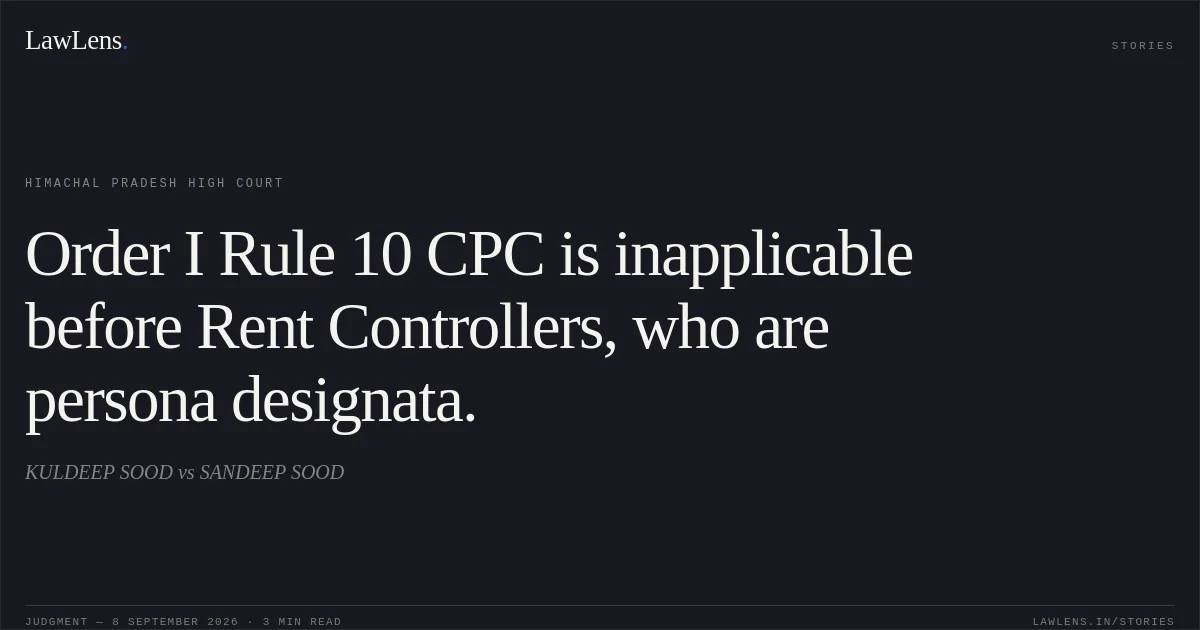
Source reference: paras. 19–22Relying on Pitman’s Shorthand Academy v. B. Lila Ram & Sons, AIR 1950 P&H 181, and Ram Dass v. Sukhdev Kaur, AIR 1981 P&H 301, the Court held that a Rent Controller is a persona designata and not a civil court stricto sensu; consequently, Section 141 CPC and ordinary CPC provisions do not apply proprio vigore to rent-control proceedings.
Source reference: para. 12The Rent Controller’s jurisdiction is confined to disputes arising within the landlord–tenant relationship under the Rent Control Act, and a person seeking impleadment must show a legally relevant status within that statutory framework.
Source reference: paras. 10, 15–22Reasoning
The Court held that the petitioner’s application, expressly founded on Order I Rule 10(2) and Section 151 CPC, was not maintainable because the Rent Controller is a statutory persona designata and not a civil court to which the CPC applies generally.
Source reference: para. 13Rule 12 merely permits the Controller to be guided by CPC principles; it does not incorporate the CPC in its entirety or confer jurisdiction under Order I Rule 10(2).
Source reference: paras. 19–22Independently, the petitioner’s assertion that he was a co-sharer did not establish that he was a “landlord” entitled to participate in the eviction proceedings.
Source reference: no citationThe application did not claim entitlement to receive rent from the tenant, while the landlord’s eviction petition was based on the asserted landlord–tenant relationship with Dimple Malhotra.
Source reference: para. 10The petitioner’s separate partition and accounting suit could determine his alleged proprietary or monetary rights, but the pleadings before the Rent Controller were insufficient to make him a necessary or proper party to the summary eviction proceedings.
Source reference: paras. 9–10, 13The Court also observed that an aggrieved person had a statutory appellate remedy under Section 24(1)(b) of the Rent Control Act.
Source reference: para. 11Holding
The High Court dismissed the petition and upheld the rejection of Kuldeep Sood’s impleadment application.
It held that an application under Order I Rule 10(2) CPC was not maintainable before the Rent Controller and that the petitioner’s bare claim of co-ownership did not confer upon him the status of a landlord or establish that he was a necessary or proper party to the eviction petition.
Source reference: paras. 10, 13The pending applications, if any, were also dismissed; no order as to costs was made.
Source reference: no citationThe parties were directed to appear before the Rent Controller on 24 September 2026 at 10:00 a.m.
Source reference: paras. 13–15Acts & Sections Cited
4 provisions across 2 statutes referred to in this judgment. Each provision opens on LawLens.
Code of Civil Procedure, 19083
Manipur Municipalities Act, 19941
Original Court PDF
KULDEEP SOODvsSANDEEP SOOD
Click to open original judgment
Original judgment, available to read, download and summarize on LawLens.in