Facts
The petitioner invoked Article 227 of the Constitution challenging the order dated 06.09.2025 passed by the Principal Judge, Family Court, East District, Karkardooma, Delhi, in S.M.A. Case No. 13/2022.
Source reference: p.1, paras. 1–2By that order, the Family Court allowed the respondent’s application under Order IX Rule 7 read with Section 151 CPC and set aside the order dated 22.03.2023 by which she had been proceeded ex parte.
Source reference: p.1, paras. 1–2The respondent had entered appearance through counsel on 09.01.2023 but was unrepresented on 17.02.2023 and 22.03.2023, resulting in ex parte proceedings.
Source reference: p.3, para. 8Thereafter, evidence was completed, written arguments were filed, final arguments were heard, and on 21.08.2023 the matter was expressly reserved for judgment.
Source reference: p.2, para. 6; p.11, para. 26The respondent filed an application under Order IX Rule 7 CPC on 25.08.2023, after the matter had been reserved for judgment.
Source reference: p.2, para. 7; p.11, para. 27The Family Court allowed the application on the ground that the respondent’s advocate had allegedly failed to inform or properly represent her, and also considered her prior attempt to seek transfer of the proceedings before the Supreme Court.
Source reference: p.3–4, para. 8Issues
1. Whether an application under Order IX Rule 7 CPC is maintainable after the hearing of the suit has concluded and the matter has been reserved for pronouncement of judgment
Source reference: p.5–7, paras. 14–172. Whether the Family Court could consider the respondent’s explanation of sufficient cause and set aside the ex parte order at that procedural stage
Source reference: p.11–12, paras. 28–303. Whether the respondent’s reliance on Lal Devi v. Vaneeta Jain enabled the Trial Court to exercise jurisdiction under Order IX Rule 7 CPC after conclusion of the hearing
Source reference: p.12, paras. 31–32Law Applied
The Court applied Order IX Rules 6, 7 and 13 CPC.
Source reference: no citationOrder IX Rule 7 permits a defendant against whom ex parte proceedings have been directed to appear at or before the next hearing, show good cause for the earlier non-appearance, and participate in the proceedings while the hearing is still continuing.
Source reference: p.5–6, paras. 11–14Once evidence and arguments are concluded and the matter is reserved for judgment, there is no further “hearing” to which Order IX Rule 7 can apply; the provision does not contemplate an intermediate stage between conclusion of hearing and pronouncement of judgment.
Source reference: p.6–7, paras. 15–19This principle was authoritatively laid down in Arjun Singh v. Mohindra Kumar, AIR 1964 SC 993, and reiterated in Rasiklal Manikchand Dhariwal v. MSS Food Products, (2012) 2 SCC 196.
Source reference: p.8–10, paras. 20–22After an ex parte decree is passed, the defendant’s separate remedy is under Order IX Rule 13 CPC.
Source reference: p.7–8, paras. 18–19The Court distinguished Lal Devi v. Vaneeta Jain, 2007 (7) SCC 200, which concerned the High Court’s appellate power to set aside an ex parte decree, not the Trial Court’s jurisdiction to entertain an Order IX Rule 7 application after conclusion of the hearing.
Source reference: p.12, paras. 31–32Reasoning
The order-sheet dated 21.08.2023 conclusively showed that written arguments had been filed, final arguments had been heard, and the matter had been listed only for pronouncement of judgment; therefore, the hearing had ended before the respondent filed her application.
Source reference: p.11, paras. 26–27The Family Court wrongly proceeded directly to assess whether the respondent had shown sufficient cause, without first determining whether it possessed jurisdiction to entertain the application under Order IX Rule 7 CPC.
Source reference: p.11–12, paras. 28–30Applying Arjun Singh and Rasiklal Manikchand Dhariwal, the High Court held that reservation of a matter for judgment is not an adjournment of the hearing contemplated by Order IX Rule 7.
Source reference: p.12, paras. 30–32Consequently, the respondent’s alleged lack of communication from her advocate, her status as a layperson, and her earlier transfer proceedings could not confer jurisdiction where the statutory stage for invoking Order IX Rule 7 had already passed.
Source reference: p.12, paras. 30–32Holding
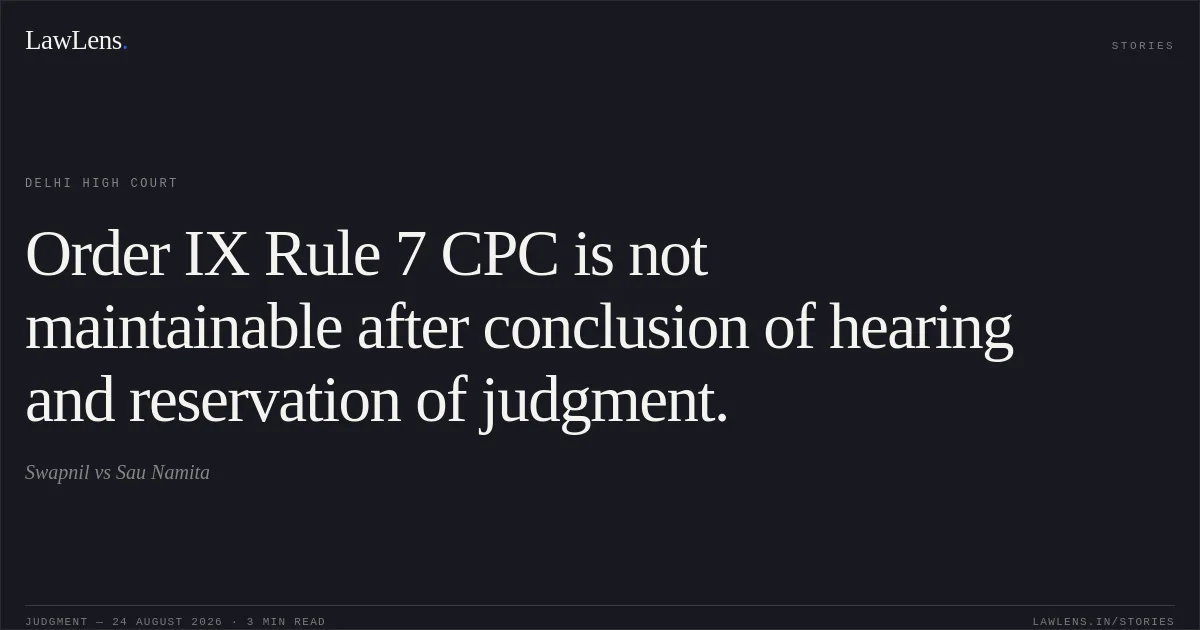
The High Court held that the application under Order IX Rule 7 read with Section 151 CPC was not maintainable because it was filed after final arguments had been heard and the matter had been reserved for judgment.
The petition under Article 227 was allowed; the Family Court’s order dated 06.09.2025 was set aside; and the respondent’s application under Order IX Rule 7 CPC was dismissed as not maintainable at that stage.
Source reference: p.13, paras. 35–37Acts & Sections Cited
1 provisions across 1 statute referred to in this judgment. Each provision opens on LawLens.
Code of Civil Procedure, 19081
Original Court PDF
SwapnilvsSau Namita
Click to open original judgment
Original judgment, available to read, download and summarize on LawLens.in