Facts
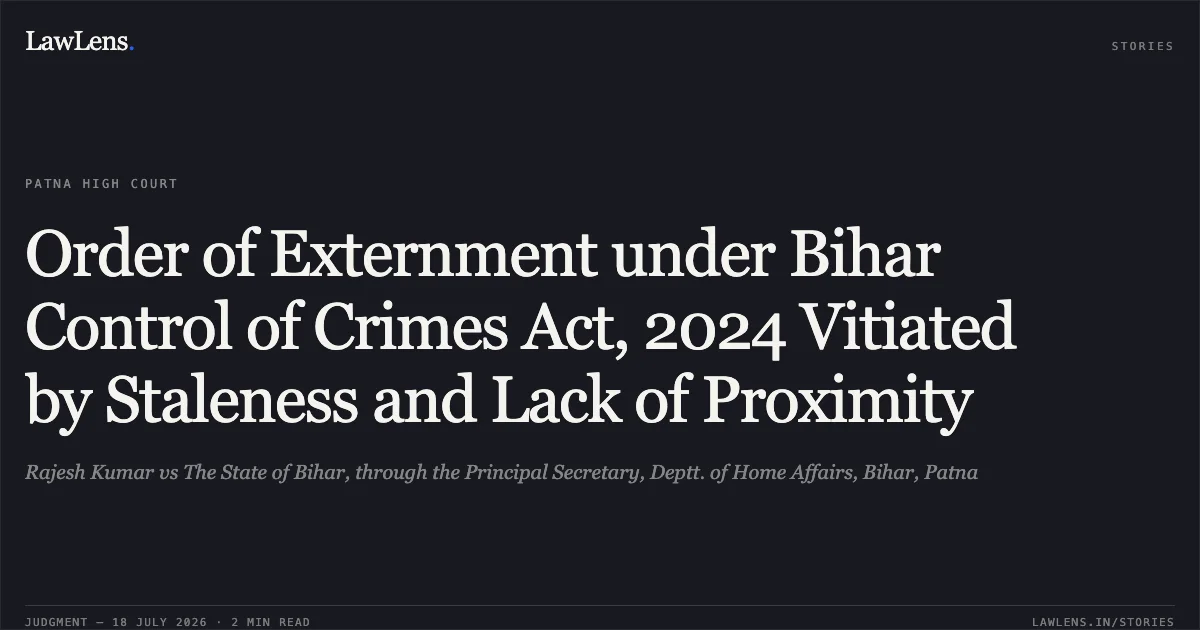
The petitioner, Rajesh Kumar, challenged an order dated 20.03.2026 passed by the District Magistrate (DM), Nalanda, under Section 3(3) of the Bihar Control of Crimes Act, 2024 (BCC Act).
Source reference: p. 1-2The DM declared the petitioner an "anti-social element" based on six criminal cases registered between 2016 and 2021 and a Sanha (police diary entry) dated 19.01.2026.
Source reference: para. 4The order required the petitioner to mark his attendance at Silao Police Station every Monday and Friday for one month to prevent potential law and order breaches during upcoming festivals.
Source reference: para. 2, 5The petitioner contended that no cases were filed against him in the 24 months preceding the action and that he had not been convicted in any case.
Source reference: para. 6, 27Issues
1. Whether the petitioner meets the statutory definition of an "anti-social element" under Section 2(b) read with Section 2(f) of the BCC Act, 2024.
Source reference: para. 18-212. Whether the DM’s order lacked application of mind and failed the test of "public order" as distinguished from "law and order".
Source reference: para. 22-26, 293. Whether the procedural haste and choice of reporting station invalidated the externment order.
Source reference: para. 35, 39-40Law Applied
The court primarily applied the definitions under Section 2(b), 2(f), and 2(g) of the Bihar Control of Crimes Act, 2024, which require at least two police reports showing involvement in specific offences within the 24 months preceding the action to qualify a person as an "anti-social element".
Source reference: para. 18-21It relied on Ram Manohar Lohia v. State of Bihar and Arjun v. State of Maharashtra to distinguish between "law and order" (individual infractions) and "public order" (community-wide disturbance).
Source reference: p. 14, 15It applied Article 21 of the Constitution regarding the right to reputation and personal liberty, citing Subramanian Swamy v. Union of India.
Source reference: p. 31Reasoning
The Court found the DM’s order legally unsustainable as it failed the "24-month rule" established in Section 2(f); the petitioner’s last criminal case was in 2021, far beyond the two-year window required for commencement of action in 2026.
Source reference: para. 21The DM acted "mechanically," relying on a Sanha and stale cases without proving a recent threat to the "even tempo of life" (Public Order).
Source reference: para. 24, 26The Court noted extreme procedural haste, where reports from four levels of police hierarchy were generated and forwarded on the same day (19.01.2026), indicating a lack of independent verification or subjective satisfaction.
Source reference: para. 38-39Requiring the petitioner to report to a station 20km away instead of his local station violated Rule 6 of the Bihar Control of Crime Rules, 1978.
Source reference: para. 35Holding
The Court held that the order was a nullity as the petitioner did not statutory qualify as an "anti-social element".
The Court allowed the writ petition and quashed the impugned order dated 20.03.2026, directing the State to pay ₹1,00,000 in compensation and ₹10,000 in litigation costs, to be recovered from erring officials.
Source reference: para. 42, 43-44Acts & Sections Cited
8 provisions across 3 statutes referred to in this judgment. Each provision opens on LawLens.
Essential Commodities Act, 19551
Public Gambling Act, 18671
Indian Penal Code, 18606
Original Court PDF
Rajesh KumarvsThe State of Bihar, through the Principal Secretary, Deptt. of Home Affairs, Bihar, Patna
Click to open original judgment
Original judgment, available to read, download and summarize on LawLens.in