01Facts
The Appellant (Plaintiff), an Indian agro-chemical company, filed a suit seeking a permanent injunction against the Respondents (Defendants) for copyright infringement and passing off regarding the trademark "PADAN" and its associated packaging/artwork
¶ 9The Plaintiff claimed continuous use of the mark since 1988 and asserted that its sister concerns, Agrimas and Coromandel Agrico Pvt. Ltd. (CAPL), operated as its licensees
¶ 3-6Although the Defendants held registrations for the mark, the Plaintiff alleged they had not used it in India and that Defendant No. 2 recently launched a product using deceptively similar packaging
¶ 4, 8The Defendants filed an application under Order VII Rule 11(a) of the Code of Civil Procedure, 1908 (CPC), seeking rejection of the plaint for failure to disclose a cause of action
¶ 10A learned Single Judge allowed the application, holding the cause of action was "illusory" because the Plaintiff relied on documents involving CAPL (a distinct legal entity) and suppressed a Distribution Agreement (DA) that identified CAPL as the Defendants' licensee
¶ 11-15The Plaintiff appealed this rejection
¶ 1602Issues
i.1. Whether the learned Single Judge exceeded the jurisdiction of Order VII Rule 11(a) CPC by relying on documents filed by the Defendants and evaluating the merits of the Plaintiff's case
¶ 35, 61ii.2. Whether the averments in the plaint, taken as true, disclosed a sufficient cause of action to maintain a suit for copyright infringement and passing off
¶ 5903Law Applied
The Court applied Order VII Rule 11(a) of the CPC, which mandates the rejection of a plaint that fails to disclose a cause of action
¶ 36It relied on ABC Laminart (P) Ltd. v. A.P. Agencies, defining "cause of action" as a bundle of material facts that a plaintiff must prove to obtain relief
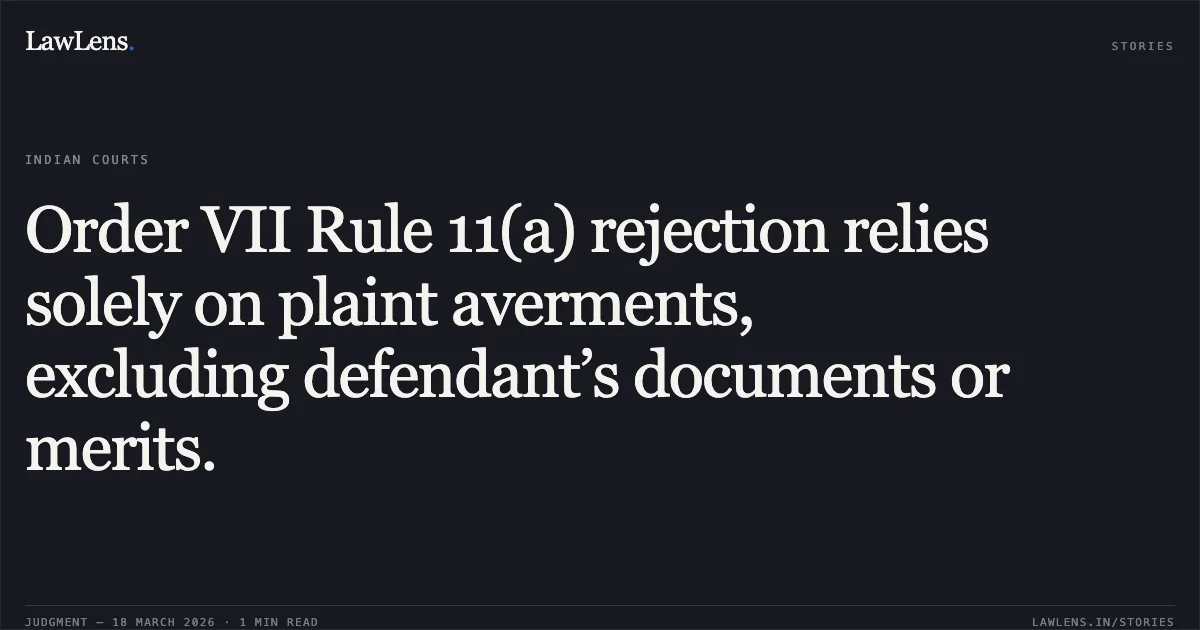
¶ 39Under the principles established in Saleem Bhai v. State of Maharashtra and Madanuri Sri Rama Chandra Murthy v. Syed Jalal, the Court held that only the averments in the plaint and annexed documents are germane at this stage; the defense or documents filed by the defendant must be ignored
¶ 47, 49The Court referenced Inspiration Clothes & U. v. Colby International Ltd. to distinguish between the non-disclosure of a cause of action (rejection) and the eventual failure of a cause of action on merits (dismissal)
¶ 50Provisions in the judgment · 7 · Linked ones open on LawLens
Copyright Act, 1957 Section 14Section 19
Trade Marks Act, 1999 Section 47Section 48
Insecticides Act, 1968 Section 9
Code of Civil Procedure, 1908 Section 20Section 2
04Reasoning
The Division Bench found that the learned Single Judge improperly conducted a "mini-trial" at a preliminary stage
¶ 17, 72The Bench observed that the Single Judge erred by incorporating the Distribution Agreement (DA) into the plaint by reference; while documents "sued upon" by a plaintiff can be so incorporated, a document introduced by a defendant to defeat a claim cannot be used to reject a plaint under Order VII Rule 11(a)
¶ 61The Court emphasized that the Plaintiff had pleaded material facts: its role as a parent company, the existence of a royalty-based license with CAPL, prior use of the mark, and the adoption of similar packaging by the Defendants
¶ 59, 67The Court held that whether use by a licensee (CAPL) inures to the benefit of the licensor (Plaintiff) and whether the 2004 license agreement was "fabricated" are triable issues requiring evidence, not summary rejection
¶ 67-69The Bench concluded that "clever drafting" (as per T. Arivandandam) was not present here, as the Plaintiff had pleaded essential legal ingredients for passing off and copyright infringement which, if proven, would entitle them to a decree
¶ 71, 7605Holding
The High Court allowed the appeal and set aside the impugned judgment
¶ 79It held that the plaint disclosed a valid cause of action and that the learned Single Judge erred by assessing the "success" of the suit rather than the "disclosure" of the claim
¶ 72, 77The suit was restored to its original number for adjudication on merits, with the Bench clarifying that all observations were limited to the Order VII Rule 11 stage and should not influence the final trial
¶ 80The parties were directed to appear before the Roster Bench on March 30, 2026
¶ 81Original Court PDF
Coromandel Indag Products India Ltd.vsSumitomo Chemical Company Ltd. & Anr.
Click to open original judgment
Original judgment, available to read, download and summarize on LawLens.in