Facts
The respondent-plaintiff instituted a suit seeking declaration of title, cancellation of sale deeds executed by defendant No.1 in favour of defendants Nos.2–5, and permanent injunction concerning the suit property.
Source reference: para. 11The plaintiff claimed that he had purchased the property through a registered sale deed dated 10 July 1984 and alleged that defendant No.1 had fraudulently relied upon a forged Will dated 10 December 1985 to execute sale deeds in favour of defendants Nos.2–5.
Source reference: paras. 12–13Defendants Nos.2–5, the present appellants, filed a written statement and counter-claim. They asserted that they had purchased the property for consideration from defendant No.1, had received possession, and had been induced to enter into the transactions through collusion between the plaintiff and defendant No.1.
Source reference: para. 14Their counter-claim sought relief against both the plaintiff and defendant No.1, including recovery of the sale consideration and other consequential reliefs.
Source reference: para. 15The plaintiff applied under Order VII Rule 11 CPC for rejection of the counter-claim, contending that it was barred by limitation and that no relief had been claimed against the plaintiff.
Source reference: para. 16By order dated 3 November 2023, the Trial Court rejected the limitation objection but allowed the application on the ground that the counter-claim was essentially directed against defendant No.1, a co-defendant, and was therefore impermissible.
Source reference: para. 17The appellants filed the present appeal with a delay of 108 days.
Source reference: para. 3The delay arose because the original suit had been dismissed for want of prosecution on 28 November 2023, leading the appellants to believe that the threat to their title had ended; they challenged the rejection of the counter-claim after the plaintiff sought restoration of the suit.
Source reference: paras. 3–7Issues
1. Whether the appellants had shown sufficient cause for condonation of the delay in filing the appeal against rejection of their counter-claim?
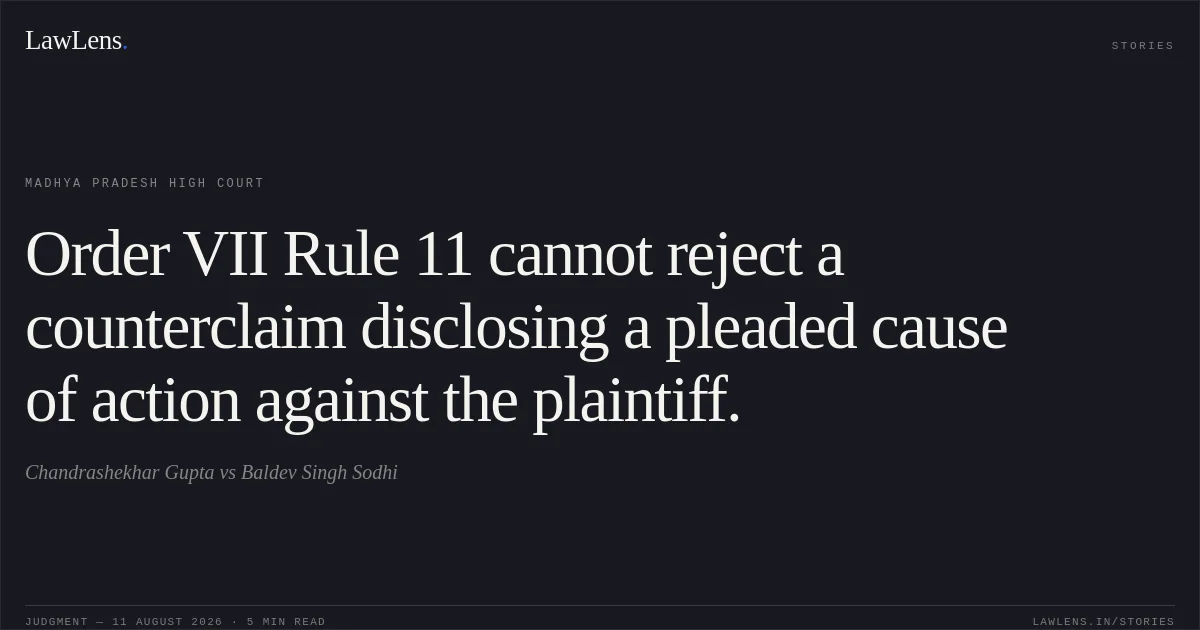
Source reference: paras. 3–92. Whether the counter-claim disclosed a cause of action and sought relief against the plaintiff so as to survive an application under Order VII Rule 11 CPC?
Source reference: paras. 16–233. Whether the Trial Court was entitled, while deciding the application under Order VII Rule 11 CPC, to rely upon external documents, assess the truth or specificity of the pleadings, and examine the merits of the alleged collusion?
Source reference: paras. 18–27Law Applied
Under Section 5 of the Limitation Act, 1963, the expression “sufficient cause” must receive a liberal construction advancing substantial justice; delay should ordinarily be condoned where there is no mala fide conduct and the party has acted with reasonable diligence.
Source reference: para. 8The Court relied on S. Ganesharaju v. S. Narasamma, (2013) 11 SCC 341, which held that limitation rules are not intended to destroy substantive rights and that matters should ordinarily be decided on merits.
Source reference: para. 8Under Order VII Rule 11 CPC, the court must examine the averments in the plaint or counter-claim as a whole and determine whether they disclose a cause of action or are barred by law; the defence, external evidence, and disputed factual matters are irrelevant at that stage.
Source reference: para. 21The Court relied on P.V. Guru Raj Reddy v. P. Neeradha Reddy, (2015) 8 SCC 331, which characterized rejection under Order VII Rule 11 as a drastic threshold power and held that disputed claims must ordinarily be adjudicated at trial.
Source reference: para. 21The Court also applied Section 13 of the Court Fees Act, 1870, as interpreted in Suresh Kumar Chowkse v. State of Madhya Pradesh, AIR 1986 MP 130, to direct refund of the court fee paid in the appeal.
Source reference: paras. 30–31Reasoning
The High Court found the appellants’ explanation for the delay reasonable.
Source reference: paras. 7–9Since the suit had been dismissed for want of prosecution, their belief that the dispute and threat to their title had ended was not unjustified; the subsequent restoration application revived their apprehension and prompted the appeal.
Source reference: paras. 7–9The delay was therefore condoned in the interest of substantial justice.
Source reference: paras. 7–9On the counter-claim, the Court examined the appellants’ pleadings alone, as required under Order VII Rule 11 CPC.
Source reference: para. 22The pleadings specifically alleged that the plaintiff and defendant No.1 had colluded in selling the property to the appellants and appropriating the sale consideration, thereby disclosing a cause of action against the plaintiff as well as defendant No.1.
Source reference: para. 22The relief clause likewise sought relief against both parties, contrary to the Trial Court’s conclusion that the counter-claim was directed only against defendant No.1.
Source reference: para. 23The Trial Court improperly relied upon the plaintiff’s FIR and assessed whether the allegations of collusion were clear, specific, and factually established.
Source reference: para. 24It also treated the absence of pleaded contact between the appellants and the plaintiff, or proof that the plaintiff received the sale consideration, as fatal.
Source reference: paras. 24–27These matters concerned the truth and evidentiary strength of the appellants’ case and could not be determined under Order VII Rule 11 CPC.
Source reference: paras. 24–27Since the plaintiff’s suit had meanwhile been restored and was pending, adjudication of the counter-claim on merits was considered necessary for a complete resolution of the dispute.
Source reference: para. 28Holding
The High Court held that the appellants had shown sufficient cause for the delay and accordingly condoned it.
It further held that the counter-claim pleaded a cause of action against the plaintiff, claimed relief against both the plaintiff and defendant No.1, and could not be rejected by examining disputed facts or relying upon external material under Order VII Rule 11 CPC.
Source reference: paras. 22–27The Trial Court’s order dated 3 November 2023 was set aside, the plaintiff’s application under Order VII Rule 11 CPC was rejected, and the matter was remitted to the Trial Court for adjudication of the counter-claim on merits.
Source reference: para. 29The appeal was allowed, and the appellants were directed to receive a refund of the court fee paid in the appeal under Section 13 of the Court Fees Act, 1870.
Source reference: paras. 30–31Acts & Sections Cited
2 provisions across 2 statutes referred to in this judgment. Each provision opens on LawLens.
Limitation Act, 19631
Court-Fees Act, 18701
Original Court PDF
Chandrashekhar GuptavsBaldev Singh Sodhi
Click to open original judgment
Original judgment, available to read, download and summarize on LawLens.in