Facts
The respondent initiated proceedings under Section 13 of the Karnataka Protection of Interest of Depositors in Financial Establishments (KPIDFE) Act, 2004, seeking the attachment of properties allegedly belonging to the petitioner
Source reference: para. 2Upon receiving notice, the petitioner filed objections and simultaneously moved an application under Order VII Rule 11 of the Code of Civil Procedure (CPC), 1908, seeking rejection of the respondent's petition for lack of cause of action
Source reference: para. 3The Special Court rejected the application, holding it non-maintainable in proceedings conducted under Section 13 of the KPIDFE Act
Source reference: para. 4the petitioner subsequently filed this writ petition challenging the Special Court's order, contending that the CPC applies to summary procedures unless specifically excluded
Source reference: para. 1, 5Issues
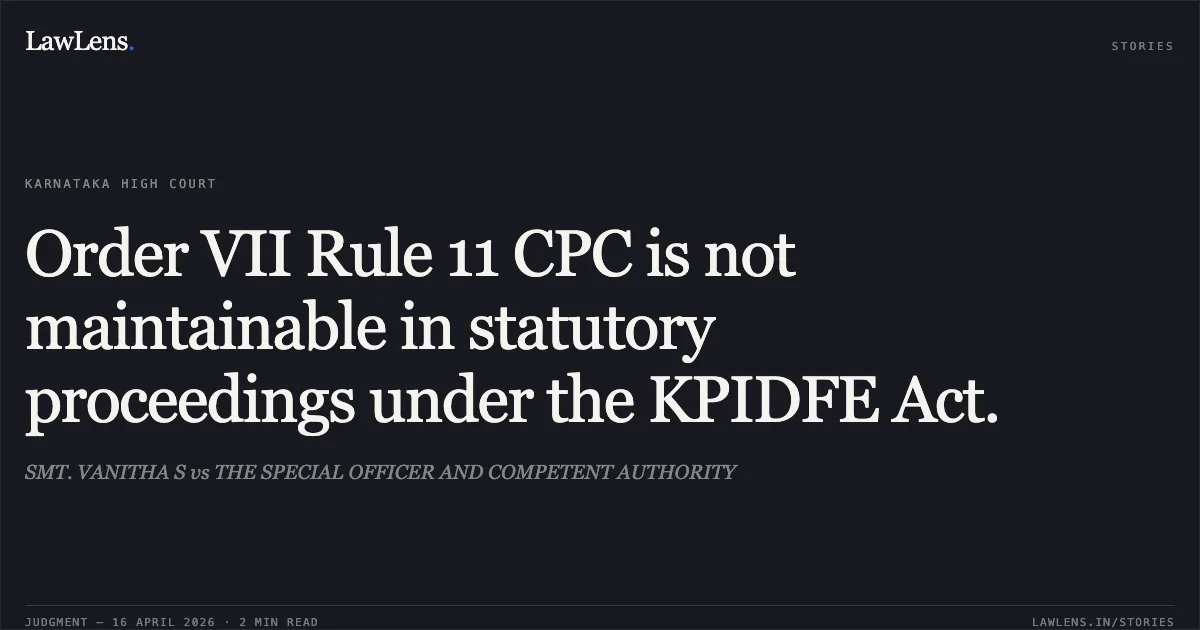
Whether an application under Order VII Rule 11 of the CPC is maintainable in proceedings before the Special Court under Section 13 of the KPIDFE Act?
Source reference: para. 7Law Applied
The court primarily applied the KPIDFE Act, 2004, characterizing it as a special, self-contained, and recovery-oriented legislation intended to protect depositors
Source reference: para. 8It interpreted Section 12(5) of the KPIDFE Act, which prescribes a summary procedure akin to Order XXXVII of the CPC, noting that such applicability is "subject to the provisions of this Act"
Source reference: para. 10The court further applied the procedural requirements of Order VII Rule 11 of the CPC, which specifically governs the rejection of a "plaint" in a civil "suit"
Source reference: para. 12Finally, it relied on the principle of statutory interpretation that beneficial legislation must be construed to advance its object and that special statutes override general procedural laws in case of inconsistency
Source reference: para. 13, 20Reasoning
The court reasoned that KPIDFE Act proceedings are statutory actions triggered by the State and do not constitute a "suit" initiated by a "plaint"
Source reference: para. 9Therefore, the jurisdictional foundation required to invoke Order VII Rule 11 CPC—the existence of a plaint—is absent
Source reference: para. 12Although Section 12(5) of the Act mentions the summary procedure of Order XXXVII CPC, the court clarified that this is a limited, purpose-specific incorporation intended to expedite trials, not a wholesale adoption of the CPC
Source reference: para. 18The court emphasized that the KPIDFE Act mandates the Special Court to investigate objections and adjudicate claims on their substantive merits
Source reference: para. 16Permitting threshold challenges under Order VII Rule 11 would introduce preliminary delays and procedural technicalities that frustrate the legislative mandate for time-bound asset preservation and recovery
Source reference: para. 14, 19, 21The court distinguished the precedent Jammu and Kashmir Bank Ltd. v. Digvijay Cement, noting it involved a standard civil suit rather than a specialized statutory proceeding
Source reference: para. 22Holding
The court concluded that an application under Order VII Rule 11 CPC is incompatible with the statutory framework of the KPIDFE Act
It held that proceedings under Section 13 are not suits and thus cannot be terminated at the threshold via technical objections regarding the maintainability of a plaint
Source reference: para. 23The High Court dismissed the writ petition and upheld the Special Court's order, while leaving all merits-based contentions open for final adjudication by the Special Court
Source reference: para. 24Acts & Sections Cited
4 provisions across 2 statutes referred to in this judgment. Each provision opens on LawLens.
Code of Civil Procedure, 19081
KARNATAKA PROTECTION OF INTEREST OF DEPOSITORS IN FINANCIAL ESTABLISHMENTS ACT, 20043
Original Court PDF
SMT. VANITHA SvsTHE SPECIAL OFFICER AND COMPETENT AUTHORITY
Click to open original judgment
Original judgment, available to read, download and summarize on LawLens.in