01Facts
The plaintiff-respondent (Sube Singh) filed Civil Suit No. CS-682-2021 before the Civil Judge (Junior Division), Karnal, seeking a mandatory injunction for vacant possession and a permanent injunction against alienation or change in the nature of the suit property.
¶ 2He pleaded that the defendants occupied the property as licensees, that the licence was orally revoked on 15.01.2021, and that they refused to vacate.
¶ 2The petitioner-defendant No. 1 filed an application under Order VII Rule 11 read with Section 151 CPC seeking rejection of the plaint.
¶ 2.1He argued that the civil court lacked jurisdiction because the matter fell within the Executive Magistrate's domain, and that the suit was undervalued given the property's approximate market value of ₹80 lakh.
¶ 2.1The Trial Court dismissed the application.
¶ 2.1The petitioner then filed this revision under Article 227 of the Constitution.
¶ 2.2At the hearing, he pressed only one ground: that the plaintiff failed to pay ad valorem court fee, because the suit was in substance one for recovery of possession.
¶ 2.202Issues
i.1. Whether the Trial Court erred in refusing to reject the plaint under Order VII Rule 11 CPC on the ground that the suit, in substance a suit for possession, required payment of ad valorem court fee on the value of the property.
¶ 2.2, 3.203Law Applied
Under Order VII Rule 11 CPC, scrutiny is confined to the averments in the plaint read with the documents relied upon, and the defence or disputed questions raised by the defendant are irrelevant at that stage.
¶ 3Jit Singh v. Prithi Singh, 2022(4) Law Herald (P) 3111 holds that upon revocation of a licence, express or implied, the licensee is bound to surrender vacant possession, and a suit for mandatory injunction to enforce this obligation is maintainable.
¶ 3.1The nature of the relief cannot be mechanically equated with a suit for possession merely because restoration of possession is the consequential result, and maintainability and valuation for court fee and jurisdiction must be determined by the substantive averments constituting the cause of action.
¶ 3.2Interference under Article 227 is limited to jurisdictional error, illegality, or material irregularity.
¶ 3.4The Section 151 CPC and court fee statutory provisions were not specifically discussed.
Provisions in the judgment · 1 · Linked ones open on LawLens
Code of Civil Procedure, 1908 Section 151
04Reasoning
Applying the Order VII Rule 11 standard, the Court examined only the plaint's averments, which showed that the defendants entered as licensees, that the licence was revoked, and that they were called upon to surrender possession.
¶ 3.1Under Jit Singh, a mandatory injunction is the appropriate remedy for enforcing that obligation, so the relief sought was not, on its face, a suit for possession simpliciter.
¶ 3.1-3.2The court fee objection could not be resolved on a prima facie reading and required a fuller examination of the cause of action and the reliefs founded on it, which meant the Trial Court could not be said to have erred in refusing rejection.
¶ 3.2, 3.4The valuation objection was left open for adjudication on the merits, and the petitioner was permitted to press it before the Trial Court, which was directed to consider it independently and in accordance with law.
¶ 3.3The jurisdictional objection based on the Executive Magistrate was not pursued at the hearing.
¶ 2.205Holding
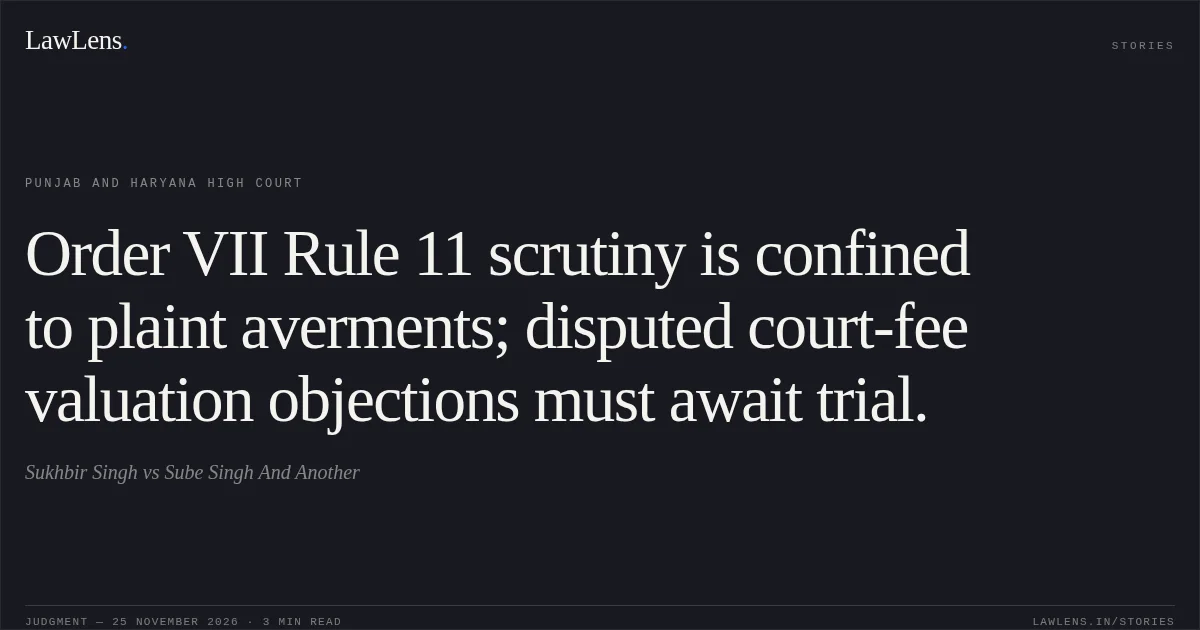
The Trial Court committed no jurisdictional error, illegality, or material irregularity in refusing to reject the plaint under Order VII Rule 11 CPC. The valuation and court fee dispute could not be conclusively determined at the prima facie stage.
¶ 3.2, 3.4The revision petition under Article 227 was dismissed. The petitioner may raise the valuation and court fee objection before the Trial Court, which must decide it on the merits. The observations are confined to the present proceedings and do not prejudice the merits of the suit. Pending miscellaneous applications, if any, stand disposed of.
¶ 3.4, 3.3, 4, 5Original Court PDF
Sukhbir SinghvsSube Singh And Another
Click to open original judgment
Original judgment, available to read, download and summarize on LawLens.in