01Facts
Respondents Nos. 1 to 3 filed a suit for declaration and permanent injunction challenging the resolutions passed at the Board and Annual General Meeting of the petitioner-Company, which removed one plaintiff as Director and appointed defendant No. 3 as Director.
¶ 2The plaintiffs also sought an ad interim injunction under Order XXXIX Rules 1 and 2 CPC restraining defendants Nos. 2 and 3 from holding themselves out as Directors or officers, dealing with the Company's assets, and interfering with its management.
¶ 2The petitioners contested the suit and the application, contending that the Civil Court lacked jurisdiction in view of the Companies Act, 2013, that the impugned meetings were valid, that the plaintiffs lacked locus standi, and that the balance of convenience lay against the plaintiffs.
¶ 3By order dated 05.03.2020, the Civil Judge directed status quo pending adjudication of the validity of the meetings, directed production of books of account, and restrained alienation of movable property and major decisions without prior permission.
¶ 4On appeal, the Additional District Judge partly allowed the appeal and modified that order. The Company was to maintain status quo as it existed before the impugned resolution. Plaintiff No. 1 and defendant No. 2 were to continue as Directors, and defendant No. 3 was not to hold office as Director.
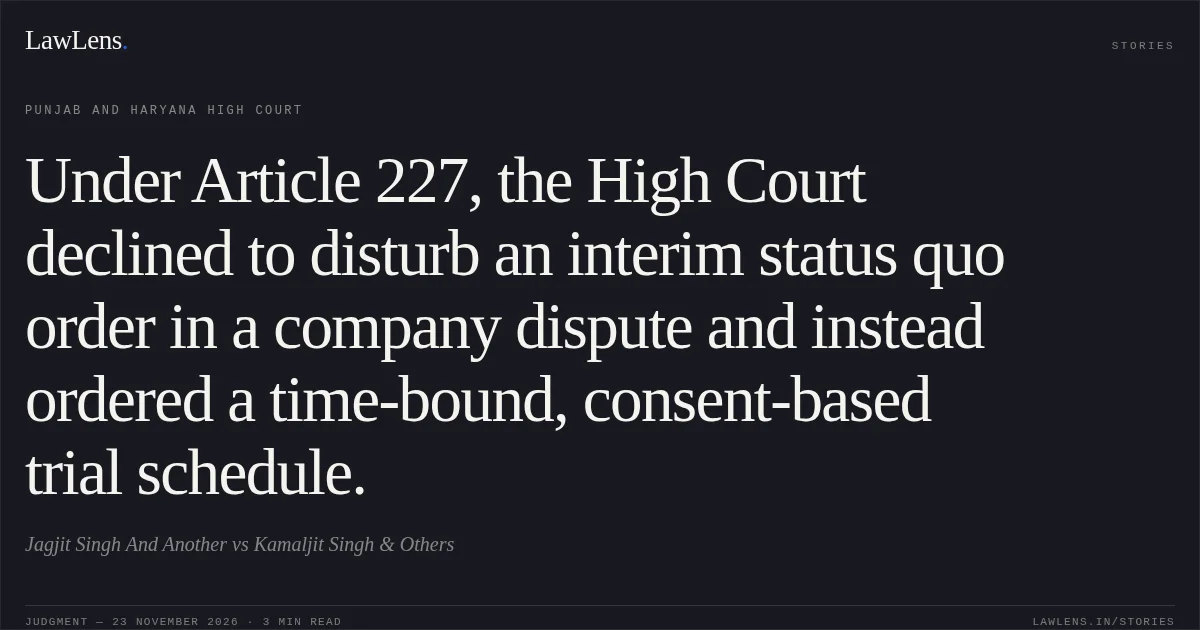
¶ 4.1The petitioners challenged that modification under Article 227 of the Constitution.
¶ 102Issues
i.1. Whether the modification of the Civil Judge's status quo order by the Additional District Judge, allegedly rendering the Company unable to conduct ordinary business and make statutory filings, warrants interference under Article 227 of the Constitution.
¶ 1, 5ii.2. Whether the impasse can be resolved, without adjudicating the merits, by directing expeditious trial of the suit and interim cooperation obligations agreed to by the parties.
¶ 6, 6.103Law Applied
The Court invoked its supervisory jurisdiction under Article 227 of the Constitution to review the First Appellate Court's order.
¶ 1The underlying dispute concerns interim relief under Order XXXIX Rules 1 and 2 CPC, which governs temporary injunctions and status quo orders pending suit.
¶ 1, 2The petitioners' threshold objection, that the Civil Court lacked jurisdiction because of the Companies Act, 2013, was raised but not decided.
¶ 3No precedent was cited or relied upon. The Court's disposal rested on the consent of the parties, recorded as a binding consensus, to expedite the suit and to cooperate in the Company's statutory compliance.
¶ 6, 6.1–6.2The Court clarified that its observations do not determine any question of fact or law in the main suit.
¶ 704Reasoning
The petitioners argued that the Additional District Judge's modification created an unworkable situation: the Company could not conduct ordinary business or meet mandatory statutory filings, exposing it to penalties, and they sought restoration of the Civil Judge's order. The respondents opposed this.
¶ 5Rather than deciding whether the modification was legally sustainable, the Court recorded the parties' consensus to a time-bound trial of the suit, preferably within nine months. It also recorded their agreement to cooperate in statutory filings, including inspection of records and signing of documents where required.
¶ 6, 6.1(iv)–(v)Because the parties had resolved the operational deadlock by agreement, the Court held that interference with the First Appellate Court's order was unnecessary.
¶ 6.1The Court confined its observations to the disposal of this petition and expressly left the merits and the jurisdictional objection open before the Civil Judge.
¶ 705Holding
The Court declined to interfere with the Additional District Judge's modified order, having regard to the parties' consensus.
¶ 6.1The petition was disposed of with the following directions: (i) The Civil Judge shall endeavour to decide the suit on merits, preferably within nine months of receipt of a certified copy of the order. (ii) Plaintiffs to conclude evidence within two months, followed by defendants within a further four months. (iii) Rebuttal evidence, if any, to be permitted before final adjudication within the nine-month period. (iv)–(v) Defendants to make books of account available for plaintiffs' inspection, and plaintiffs to cooperate and sign statutory filings as required. (vi) Parties to cooperate with the Civil Judge and avoid unnecessary adjournments.
¶ 6.1(i)–(vi)All pending miscellaneous applications were disposed of.
¶ 8Original Court PDF
Jagjit Singh And AnothervsKamaljit Singh & Others
Click to open original judgment
Original judgment, available to read, download and summarize on LawLens.in