Facts
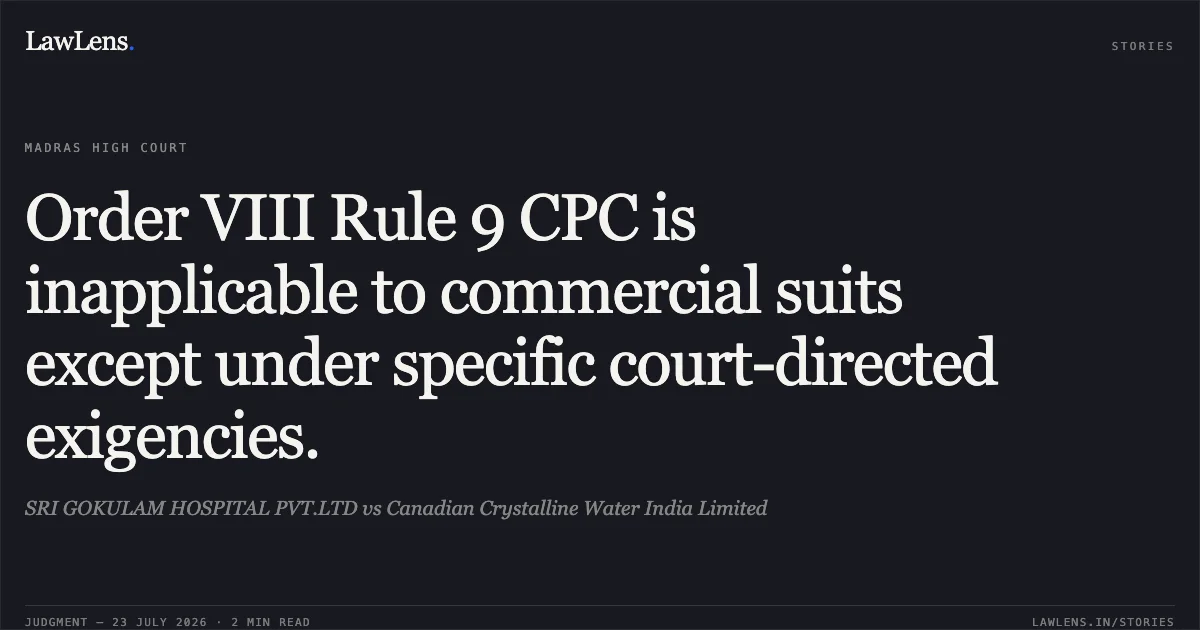
The Petitioner (Defendant) sought leave from the Principal Commercial Court, Egmore, to file an additional written statement under Order VIII Rule 9 of the CPC to include a specific plea of forgery regarding documents filed with the plaint
Source reference: p. 2The Petitioner claimed they discovered the alleged forgery only after filing the initial written statement
Source reference: p. 2The Commercial Court dismissed the application (I.A. No. 5 of 2024), citing the delay since the initial filing in 2022 and noting that the disputed documents were available from the suit's inception
Source reference: p. 2-3The Petitioner challenged this dismissal via a Civil Revision Petition under Article 227 of the Constitution
Source reference: p. 1Issues
1. Whether an application seeking leave of the Commercial Court to file an additional written statement under Order VIII Rule 9 CPC is maintainable in a commercial suit
Source reference: para. 12. Whether the strict timelines for filing written statements under the Commercial Courts Act, 2015, preclude discretionary subsequent pleadings under Order VIII Rule 9 CPC
Source reference: para. 9, 12Law Applied
The Court interpreted the Commercial Courts Act, 2015, specifically Section 21, which grants the Act overriding effect over inconsistent laws
Source reference: para. 14The Court applied the amended provisions of the CPC as applicable to commercial suits, including Order XI Rules 3, 4, and 5 regarding disclosure, inspection, and production of documents
Source reference: para. 6-8The Court relied on the mandatory 120-day outer limit for filing written statements in commercial disputes to emphasize the legislative intent for speedy disposal
Source reference: para. 16The Court also referenced the inherent powers of the Court under Section 151 CPC to meet the ends of justice in specific exigencies
Source reference: para. 19-20Reasoning
The Court reasoned that the Commercial Courts Act is a "self-contained code" designed for accelerated adjudication
Source reference: para. 13Allowing applications under Order VIII Rule 9 CPC would permit parties to circumvent the mandatory 120-day deadline for written statements, thereby defeating the Act’s primary objective of speedy disposal
Source reference: para. 9, 12, 18The Court observed that the Petitioner had already denied the execution of the documents in the initial written statement; thus, a specific plea of forgery could be addressed through cross-examination and arguments without needing additional pleadings
Source reference: para. 10, 22While the Court held that Rule 9 is generally inapplicable to commercial suits to prevent procedural delays, it clarified that the Court may suo motu direct additional pleadings under Section 151 CPC in rare exigencies, such as responding to an amended plaint or substitution of legal heirs
Source reference: para. 19-20Holding
The Court dismissed the Civil Revision Petition, holding that Order VIII Rule 9 CPC does not apply to commercial suits as it conflicts with the Act's mandatory timelines
The Court affirmed the Court's inherent power under Section 151 CPC to require additional statements in specific, limited exigencies
Source reference: para. 19, 23The Court held that the Petitioner retains the right to raise the plea of forgery during the trial based on their initial denial of document execution
Source reference: para. 22-23No costs were awarded
Source reference: para. 23Acts & Sections Cited
3 provisions across 2 statutes referred to in this judgment. Each provision opens on LawLens.
Code of Civil Procedure, 19081
Commercial Courts Act, 20152
Original Court PDF
SRI GOKULAM HOSPITAL PVT.LTDvsCanadian Crystalline Water India Limited
Click to open original judgment
Original judgment, available to read, download and summarize on LawLens.in