01Facts
The Plaintiffs instituted a suit for recovery of ₹1,21,24,400, contractual interest, pendente lite interest and damages, alleging that the Defendants had obtained various amounts as financial assistance and acknowledged the liability through promissory notes, receipts, cheques and a Memorandum of Understanding (MoU) dated 2 November 2020.
pp. 1–4 · ¶ 1–5The Defendants contended that the transaction was not a loan but an investment for acquiring 1,000 square yards of land proposed to be allotted to Defendant No. 1, and that the land had not yet been allotted.
pp. 3–5 · ¶ 6–7They further asserted that the payments were governed by the MoU, under which repayment would arise only upon non-allotment of the land for specified reasons, and that the cheques issued were security cheques.
pp. 3–5 · ¶ 6Relying on alleged admissions in the written statement regarding receipt and adjustment of money, the Plaintiffs filed an application under Order XII Rule 6 CPC seeking a decree for the principal amount.
pp. 5–8 · ¶ 8–902Issues
i.Whether the Defendants’ statements in the written statement constituted clear, unequivocal and unambiguous admissions entitling the Plaintiffs to a decree under Order XII Rule 6 CPC?
pp. 8–14 · ¶ 10–13ii.Whether the admitted receipt of money and execution of the MoU established, without trial, that the transaction was a loan or financial-assistance transaction rather than an investment for purchase of land?
pp. 14–15 · ¶ 14–16iii.Whether the Plaintiffs were entitled to an immediate decree for ₹1,21,24,400 despite the Defendants’ contention that repayment was conditional upon non-allotment of the land?
pp. 3–5, 14–15 · ¶ 6, 14–1603Law Applied
The Court applied Order XII Rule 6 CPC, which permits a court to pronounce judgment at any stage on clear admissions of fact made in pleadings or otherwise, with the object of granting speedy judgment to the extent of the admitted claim.
pp. 8–10 · ¶ 11–12Relying on Uttam Singh Duggal & Co. Ltd. v. United Bank of India, (2000) 7 SCC 120, the Court held that the provision should not be construed narrowly but requires a plain, clear and unambiguous admission establishing the claimant’s entitlement.
pp. 8–10 · ¶ 11The Court also relied on Karam Kapahi v. Lal Chand Public Charitable Trust, (2010) 4 SCC 753, concerning the broad scope of admissions under Order XII Rule 6 CPC.
pp. 10–12 · ¶ 12Vikrant Kapila v. Pankaja Panda, (2024) 18 SCC 695, held that a valid admission must be clear, unequivocal, unconditional, unambiguous and made with an intention to be bound, so that the opposite party can succeed without adducing evidence.
pp. 12–14 · ¶ 13Provisions in the judgment · 3 · Linked ones open on LawLens
Code of Civil Procedure, 1908 Section 8Section 12Section 15
04Reasoning
The Court distinguished between an admission of receipt of money and an admission of an unconditional liability to repay it.
pp. 3–5, 14 · ¶ 6, 14Although the Defendants admitted receiving and adjusting amounts under the MoU, they consistently maintained that the transaction concerned investment in land and that repayment was governed by a contractual condition linked to non-allotment of the land.
pp. 3–5, 14 · ¶ 6, 14Their assertion that the cheques were issued as security and that the land had not yet been allotted created a substantive dispute regarding the nature of the transaction, the enforceability and timing of repayment, and the legal effect of the MoU.
pp. 5, 14–15 · ¶ 7, 14–16Consequently, the alleged admissions did not conclusively establish that the Defendants owed the claimed amount as a loan or that the Plaintiffs were immediately entitled to recover it.
pp. 14–15 · ¶ 14–16Since the admissions did not satisfy the requirement of being clear and unambiguous, the matter could not be determined under Order XII Rule 6 CPC without trial.
pp. 14–15 · ¶ 14–1605Holding
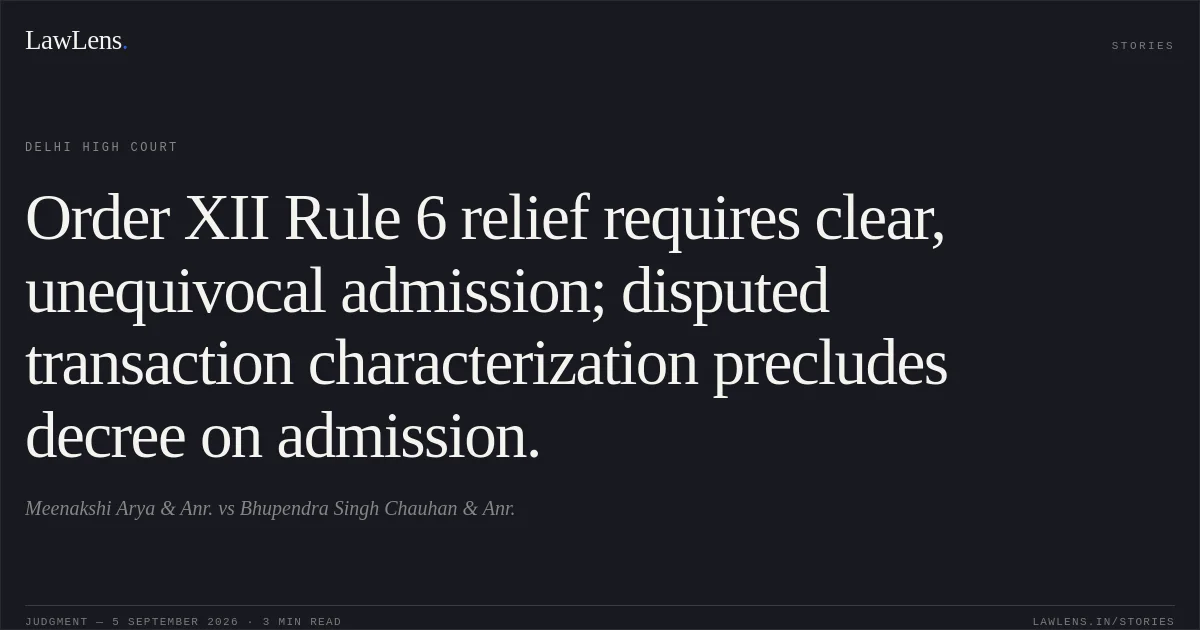
The Court held that the Defendants had not made any clear, unequivocal and unambiguous admission entitling the Plaintiffs to a judgment on admission.
p. 15 · ¶ 15–16The admitted documents and payments did not establish that the transaction was a pure loan transaction or that the repayment obligation had become immediately enforceable.
p. 15 · ¶ 15–16The application under Order XII Rule 6 CPC was dismissed, and the suit was directed to be listed on 28 October 2026.
p. 15 · ¶ 17–18Original Court PDF
Meenakshi Arya & Anr.vsBhupendra Singh Chauhan & Anr.
Click to open original judgment
Original judgment, available to read, download and summarize on LawLens.in