01Facts
The Plaintiff instituted a suit for partition and permanent injunction concerning property bearing No. 146, Sukhdev Vihar, New Delhi, claiming a 50% share on the basis of an alleged oral partition with his deceased brother, Dr. Shanti Swarup Karwal.
pp. 1–3Defendant No. 3, Ashok Dang, claimed to be a bona fide purchaser under an Agreement to Sell dated 22 December 2005 and was impleaded under Order I Rule 10 CPC as a necessary party.
pp. 3–6The impleadment order dated 13 February 2019 permitted the Plaintiff to file an amended plaint; the Plaintiff thereafter filed an amended plaint seeking, inter alia, declarations based on adverse possession and challenging the validity of the Agreement to Sell and the General Power of Attorney.
pp. 8–10Defendant No. 3 filed an application under Order VII Rule 11 CPC, contending that the amended plaint could not have been filed without a formal application under Order VI Rule 17 CPC.
pp. 7–802Issues
i.Whether the Joint Registrar could permit the filing of an amended plaint containing substantive amendments and new reliefs while disposing of an application under Order I Rule 10 CPC, without a formal application under Order VI Rule 17 CPC?
pp. 8–11ii.Whether the amended plaint could be taken on record in the absence of an order under Order VI Rule 17 CPC?
pp. 9–12iii.Whether Defendant No. 3’s application under Order VII Rule 11 CPC was maintainable or required adjudication in the circumstances?
pp. 8–9, 1203Law Applied
The Court applied Order VI Rule 17 CPC, which requires the Court to consider and permit amendments to pleadings through a formal application and authorises amendments necessary for determining the real controversy, subject to the limitation imposed by its proviso after commencement of trial.
pp. 10–11It relied on Chapter II Rule 3(2) of the Delhi High Court (Original Side) Rules, 2018, under which the Registrar may exercise the Court’s powers only in relation to amendments that are formal in nature.
pp. 9–10The Court held that substantive amendments introducing new causes of action or reliefs require judicial consideration and cannot be authorised mechanically or suo motu under Section 151 CPC.
pp. 10–11It further relied on Ganga Bai v. Vijay Kumar, (1974) 2 SCC 393, for the principle that an amendment ordinarily dates back to the institution of the suit, thereby affecting the substantive rights of the parties.
p. 11Provisions in the judgment · 1 · Linked ones open on LawLens
Code of Civil Procedure, 1908 Section 151
04Reasoning
The Court found that the amendments were not merely formal. The amended plaint introduced a claim of absolute ownership by adverse possession and sought declarations that the Agreement to Sell dated 22 December 2005 and the General Power of Attorney dated 17 July 2004 were forged, void, or unenforceable—reliefs absent from the original plaint.
pp. 9–10Consequently, the amendments required the Court to apply its mind under Order VI Rule 17 CPC, including considering whether they changed the nature of the suit, revived a dead claim, or affected existing admissions and substantive rights.
pp. 10–11Since even the Court could not permit such substantive amendments without a formal application under Order VI Rule 17 CPC, the Joint Registrar lacked authority to do so under Chapter II Rule 3(2), which is confined to formal amendments.
pp. 9–11The amended plaint therefore could not be taken on record pursuant to the impleadment order alone.
pp. 11–1205Holding
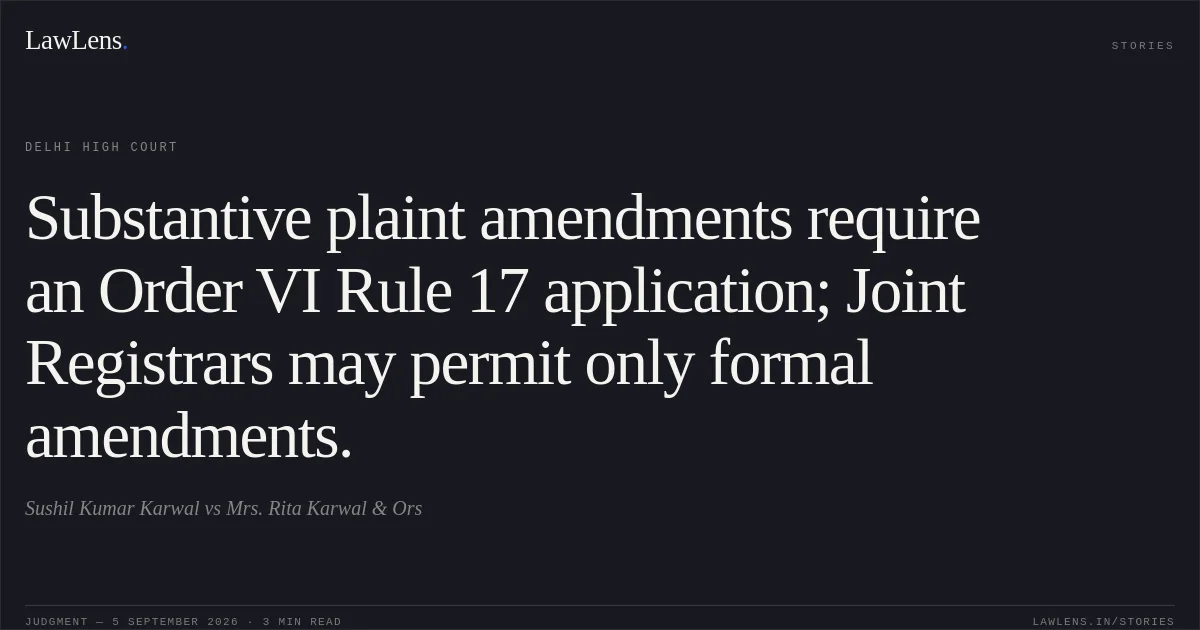
The Court held that the amended plaint, containing substantive new reliefs, could not be taken on record without an application under Order VI Rule 17 CPC and an appropriate judicial order permitting the amendments.
pp. 11–12The amended plaint was accordingly returned to the Plaintiff, with liberty to file an application under Order VI Rule 17 CPC.
p. 12The written statement filed by Defendant No. 3 to the amended plaint was also returned as a consequential step.
p. 12Defendant No. 3’s application under Order VII Rule 11 CPC was disposed of as infructuous, with liberty to the Defendants to file a fresh application if the amendment application was allowed and the amended plaint was brought on record.
p. 12The matter was listed for 14 December 2026.
p. 12Original Court PDF
Sushil Kumar KarwalvsMrs. Rita Karwal & Ors
Click to open original judgment
Original judgment, available to read, download and summarize on LawLens.in