Facts
The Appellant (Plaintiff) obtained a decree for specific performance in O.S.No.622 of 2010 against the 2nd Respondent (Defendant) regarding a sale agreement dated 21.11.2007.
Source reference: para. 2Following the decree, the Appellant deposited the balance consideration, and the Court executed a registered sale deed in his favor on 08.10.2018 via E.P.No.20 of 2017.
Source reference: para. 2The Appellant then filed E.P.No.90 of 2019 for recovery of vacant possession.
Source reference: para. 2During these proceedings, the 1st Respondent (a Temple/Madam) filed E.A.No.1 of 2023 under Order XXI Rule 58 of the CPC, claiming the property was endowed to the temple via a 1928 settlement deed and that subsequent transfers were void.
Source reference: para. 2 & 7The Executing Court allowed the 1st Respondent’s application, dismissed the Appellant’s execution petition for possession, and declared various registered documents—including a Will, settlement deeds, and a power of attorney—as nullified or cancelled.
Source reference: para. 2The Appellant challenged this order on the grounds of maintainability and jurisdictional error.
Source reference: no citationIssues
1. Whether an application under Order XXI Rule 58 of the CPC is maintainable in an execution petition filed for recovery of possession where no attachment of property has been effected.
Source reference: para. 9Law Applied
The Court applied Order XXI Rule 58 of the CPC, which provides an adjudicatory mechanism for claims or objections regarding the attachment of property in execution of a decree.
Source reference: para. 19-20It relied on the Supreme Court precedent in L.K.Prabhu @ L.Krishna Prabhu (Died) through Lrs Vs. K.T.Mathew @ Thampan Thomas and others (2026 (1) CTC 113), which held that Rule 58 is an adjudicatory mechanism specifically for property attached before judgment and cannot be expanded into a substantive enquiry under Section 53 of the Transfer of Property Act.
Source reference: para. 12The Court also followed Mirthubasini Vs. Easwaramurthy (CMSA.No.20 of 2007), establishing that Rule 58 cannot be invoked after the property has already been sold.
Source reference: para. 13Reasoning
The Court observed that the fundamental requirement for invoking Order XXI Rule 58 is the existence of an attachment of property.
Source reference: para. 14, 20In the present case, E.P.No.90 of 2019 was filed solely for recovery of possession based on a court-executed sale deed; no attachment was sought or made.
Source reference: para. 14Consequently, the Executing Court lacked the scope to entertain the application.
Source reference: para. 14The Court further reasoned that the 1st Respondent, claiming an independent title not derived from the judgment debtor, should have initiated a separate civil suit for declaration rather than utilizing summary execution proceedings.
Source reference: para. 14, 16The Court noted that the Executing Court exceeded its jurisdiction by "cancelling" a Will and nullifying registered deeds, noting that only a testator can cancel a Will, and a Court can only declare it genuine or otherwise.
Source reference: para. 16The 1st Respondent also failed to provide sufficient evidence of a specific endowment or vesting of the property.
Source reference: para. 18Holding
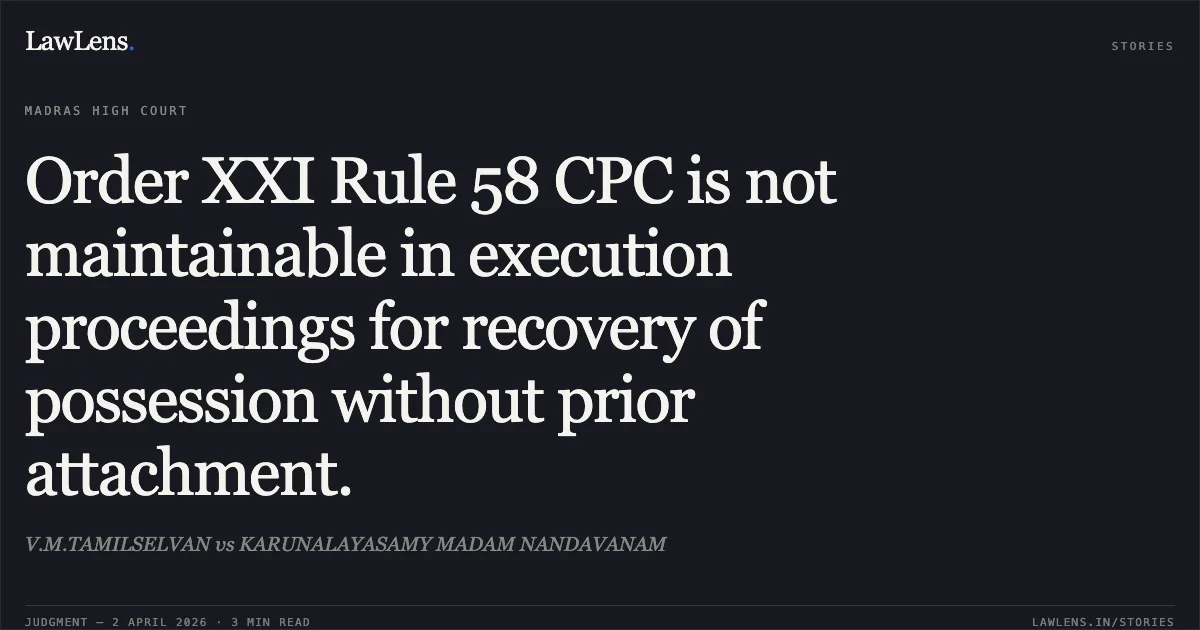
The High Court answered the issue in favor of the Appellant, holding that Order XXI Rule 58 is not maintainable in the absence of an attachment.
The Appeal Suit was allowed, and the order of the II Additional District and Sessions Judge, Tiruppur, in E.A.No.1 of 2023 was set aside.
Source reference: para. 21The Court clarified that the 1st Respondent remains at liberty to independently establish its title through a proper civil suit, subject to the law of limitation.
Source reference: para. 21Acts & Sections Cited
6 provisions across 2 statutes referred to in this judgment. Each provision opens on LawLens.
Code of Civil Procedure, 19085
Transfer of Property Act, 18821
Original Court PDF
V.M.TAMILSELVANvsKARUNALAYASAMY MADAM NANDAVANAM
Click to open original judgment
Original judgment, available to read, download and summarize on LawLens.in


