Facts
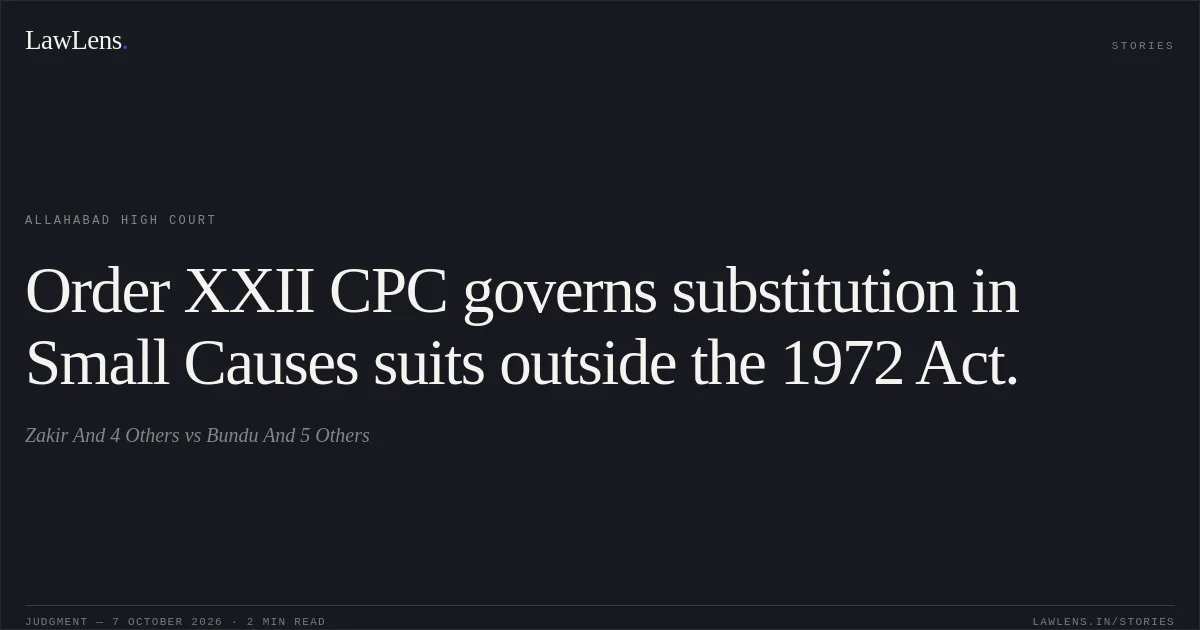
Bundu instituted an SCC suit for eviction and damages against Afaq, predecessor of the petitioners. After Bundu died on 23 May 2023, his legal representatives applied on 18 July 2023 to be substituted under Order XXII Rule 3 read with Section 151 CPC.
Source reference: para. 2–6The petitioners objected that the application was beyond the one-month period under Rule 25 of the U.P. Urban Buildings (Regulation of Letting, Rent and Eviction) Rules, 1972, and that the suit had abated. The Small Causes Court allowed substitution, and the revisional court dismissed the petitioners’ revision. The petitioners challenged both orders under Article 227.
Source reference: para. 2–6Issues
Whether Rule 25 of the 1972 Rules governed substitution of the legal representatives of a deceased plaintiff in this SCC suit.
Source reference: para. 7Whether the suit abated when the substitution application was filed more than one month, but within ninety days, after the plaintiff’s death.
Source reference: para. 7, 27–29Law Applied
Section 17 of the Provincial Small Cause Courts Act, 1887 makes CPC procedure applicable to Small Causes Court suits and proceedings, subject to express exclusions or modifications. Section 7 and Order L Rule 1 CPC enumerate provisions excluded from such courts; Order XXII is not among them.
Source reference: para. 15–18Order XXII Rule 3 CPC provides for bringing a deceased plaintiff’s legal representatives on record where the right to sue survives, while Article 120 of the Limitation Act, 1963 prescribes ninety days for such an application.
Source reference: para. 22–25Rule 25 of the 1972 Rules applies only where the proceeding falls within the statutory field of the 1972 Act; its application cannot be presumed merely because the dispute concerns a tenancy or is before a Small Causes Court.
Source reference: para. 9–14, 20–21The Court also relied on Raju Kashyap and 2 others v. Smt. Archana Jain and Kishalaya Banerjee and others v. Smt. Kamala Devi Budhia Dharamshala Trust on the applicability of CPC procedure and Order XXII in the relevant circumstances.
Source reference: para. 19–20Reasoning
The Court found no material establishing that the premises were governed by the 1972 Act; rather, the plaint described them as a newly constructed building. Rule 25’s one-month period therefore did not govern the substitution application.
Source reference: para. 10–14Because the suit was an SCC suit and Order XXII was not excluded, the application was governed by Order XXII Rule 3 and Article 120 of the Limitation Act. Filed within ninety days of Bundu’s death, it was timely, so the condition for abatement under Order XXII Rule 3(2) did not arise.
Source reference: para. 21–25, 27–30Holding
The Court held that the suit had not abated and that no application for condonation of delay or setting aside abatement was required.
Finding no jurisdictional error or patent illegality in the orders permitting substitution, it dismissed the Article 227 petition and directed that the SCC suit proceed in accordance with law, uninfluenced by observations on its merits.
Source reference: para. 31–36Acts & Sections Cited
27 provisions across 3 statutes referred to in this judgment. Each provision opens on LawLens.
Code of Civil Procedure, 1908
Provincial Small Cause Courts Act, 18871
Limitation Act, 19631
Original Court PDF
Zakir And 4 OthersvsBundu And 5 Others
Click to open original judgment
Original judgment, available to read, download and summarize on LawLens.in