Facts
The petitioner applied under Section 13(3) of the Registration of Births and Deaths Act, 1969 for registration and issuance of a death certificate concerning his predecessor.
Source reference: no citationThe Sub-Divisional Magistrate entertained the application and passed an order dated 7 January 2022.
Source reference: p.2Respondent No. 4 challenged that order before the 6th Additional Sessions Judge, Deesa, by filing Criminal Revision Application No. 4 of 2022 under Section 397 of the Code of Criminal Procedure, 1973.
Source reference: pp.2–3, 10The Sessions Judge passed an order dated 8 July 2022, which was challenged by the petitioner before the Gujarat High Court.
Source reference: pp.2–3, 10The petitioner contended that proceedings under Section 13(3) of the Act were administrative or executive in nature, that the Sub-Divisional Magistrate was not acting as an inferior Criminal Court, and that the Sessions Court lacked revisional jurisdiction.
Source reference: p.2He further relied on the corrective mechanism under Section 15 of the Act.
Source reference: p.2The State opposed the petition, arguing that the Sub-Divisional Magistrate was subordinate to the Sessions Judge and that the revision was maintainable.
Source reference: p.3Issues
Whether an order passed by a Magistrate or Sub-Divisional Magistrate under Section 13(3) of the Registration of Births and Deaths Act, 1969 is revisable under Section 397 of the Code of Criminal Procedure, 1973?
Source reference: para. 5; p.4Whether the Sessions Court had jurisdiction to interfere with the order passed under Section 13(3), or whether an aggrieved person’s remedy lay under Section 15 of the Registration of Births and Deaths Act?
Source reference: paras. 6–8; pp.4–10Whether the nature of the inquiry under Section 13 of the Act changes in light of the 2023 amendment and Section 3(2)(a)–(b) of the Bharatiya Nagarik Suraksha Sanhita, 2023?
Source reference: paras. 3 and 7; pp.3, 9Law Applied
Section 13(3) of the Registration of Births and Deaths Act, 1969 authorises the designated Magistrate to make an inquiry into delayed information relating to a birth or death and to direct registration; the power is executive or administrative, not judicial, and the Magistrate acts as persona designata rather than as a Criminal Court.
Source reference: paras. 6–7; pp.5–9Consequently, an order under Section 13(3) is not an order of an inferior Criminal Court and is not revisable under Section 397 CrPC.
Source reference: para. 6; pp.6–9Section 15 of the Act provides the statutory mechanism by which the Registrar may correct or cancel an erroneous, fraudulent, or improperly made entry, including an entry made pursuant to an order under Section 13(3).
Source reference: paras. 6–7; pp.5, 8–9The Court relied principally on Nisar Fatema d/o Amiruddin Ansari v. State of Maharashtra, AIRONLINE 2018 BOM 684, which followed the Madras High Court’s decision in P. Duraisamy, holding that Section 13(3) proceedings are not judicial proceedings under the CrPC and are not revisable under Section 397.
Source reference: para. 6; pp.4–7The Court also distinguished Karimabibi, as that decision did not determine the revisability of an order under Section 13(3).
Source reference: para. 6; pp.8–9The Court further held that, under Section 3(2)(a)–(b) of the BNSS, an inquiry under another enactment which does not expose a person to punishment, penalty, detention, or trial is outside the criminal-procedural functions contemplated by the Sanhita.
Source reference: para. 7; p.9Reasoning
The Court held that the character of the authority exercised under Section 13(3) depends on the statutory function being performed, not merely on the designation of the officer as a Magistrate.
Source reference: para. 6; pp.5–7The proceeding involves verification for the limited purpose of directing delayed registration of a birth or death; it does not involve an offence, punishment, trial, or any procedure prescribed for criminal proceedings.
Source reference: para. 6; pp.5–7Since the Magistrate acts administratively and as persona designata, the order is not passed by an inferior Criminal Court within the meaning of Section 397 CrPC.
Source reference: para. 11; p.7Any grievance regarding the resulting entry can be raised before the Registrar under Section 15, which permits correction or cancellation of an entry that is erroneous, fraudulent, or improperly made; the entry is not conclusive proof of the underlying fact of birth or death.
Source reference: para. 13; p.8The 2023 amendment and the corresponding BNSS provisions did not alter this conclusion because the inquiry under Section 13 remains outside the criminal-procedural sphere and does not involve penal consequences.
Source reference: para. 7; p.9Accordingly, the Sessions Judge exercised a jurisdiction not vested in that court.
Source reference: paras. 8–9; p.10Holding
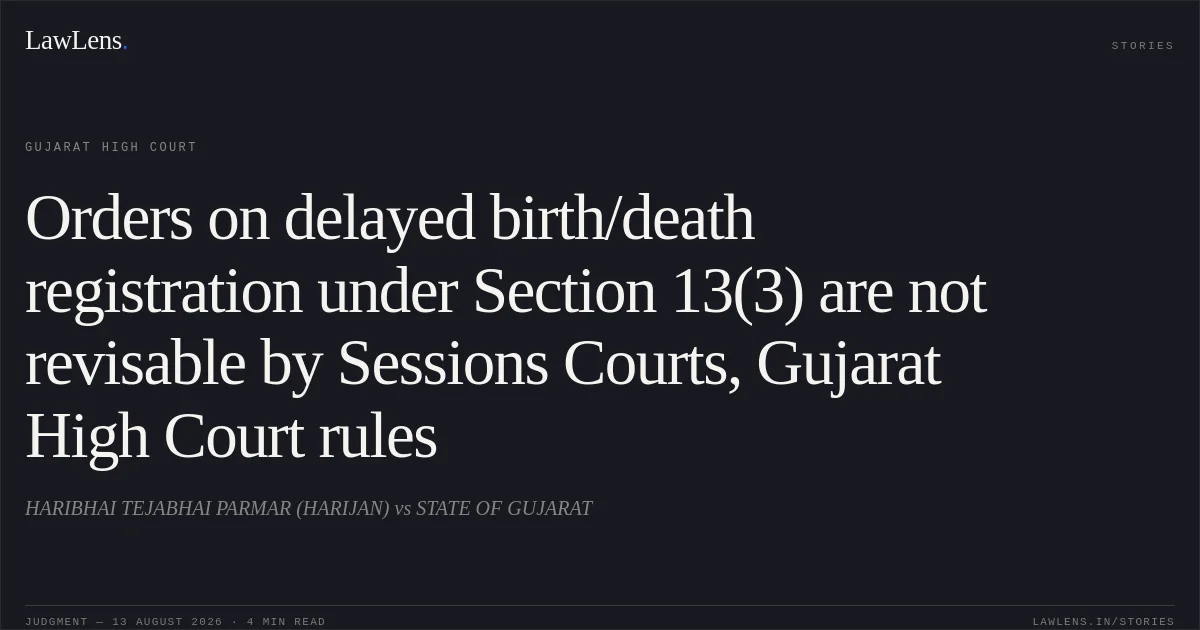
The Gujarat High Court answered the principal issue in the negative: an order passed under Section 13(3) of the Registration of Births and Deaths Act, 1969 is not revisable under Section 397 CrPC.
The Sessions Court’s order dated 8 July 2022 in Criminal Revision Application No. 4 of 2022 was therefore held to be without jurisdiction and a nullity.
Source reference: paras. 9–10; p.10The High Court quashed and set aside that order, allowing the Special Criminal Application and disposing of the petition accordingly.
Source reference: paras. 9–10; p.10Acts & Sections Cited
9 provisions across 3 statutes referred to in this judgment. Each provision opens on LawLens.
Code of Criminal Procedure, 19736
Registration of Births and Deaths Act, 19692
Bharatiya Nagarik Suraksha Sanhita, 20231
Original Court PDF
HARIBHAI TEJABHAI PARMAR (HARIJAN)vsSTATE OF GUJARAT
Click to open original judgment
Original judgment, available to read, download and summarize on LawLens.in