Facts
The respondent (plaintiff) instituted a civil suit for declaration and permanent injunction regarding agricultural land, claiming a prior partition.
Source reference: para. 2During the evidentiary stage, the plaintiff sought to exhibit a "Panchnama" dated 14.09.1992 (Ex.P-2).
Source reference: para. 2The petitioners (defendants) raised a formal objection, asserting that the document was inadmissible as it was neither duly stamped nor registered as required under the Indian Stamp Act and the Registration Act.
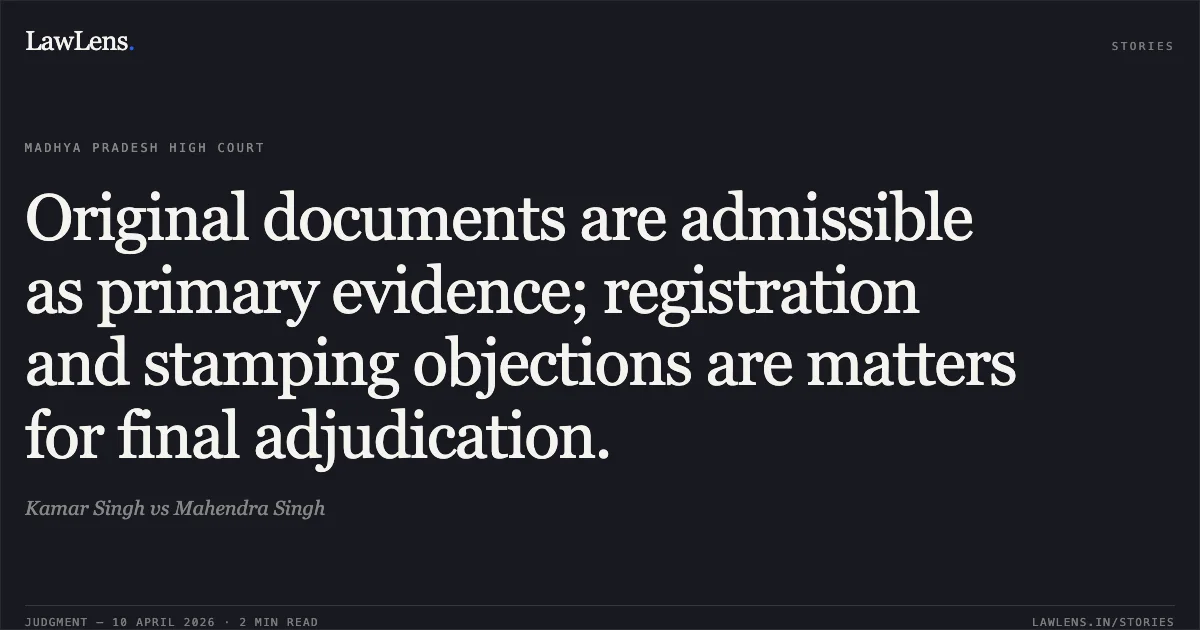
Source reference: para. 2-3On 04.02.2022, the Trial Court (Third District Judge, Ganj Basoda) rejected the objection and took the document on record, ruling that as an original document, it constituted "primary evidence" under Section 62 of the Indian Evidence Act.
Source reference: para. 2The petitioners challenged this interlocutory order under Article 227 of the Constitution of India.
Source reference: para. 1Issues
1. Whether the Trial Court erred in equating "primary evidence" with "admissible evidence" while ignoring mandatory statutory requirements of registration and stamping.
Source reference: para. 32. Whether the marking of a document as an exhibit at the evidentiary stage amounts to a final determination of its probative value or the truth of its contents.
Source reference: para. 5-6Law Applied
The Court primarily applied Sections 61 and 62 of the Indian Evidence Act, which define "primary evidence" as the document itself produced for the inspection of the Court.
Source reference: para. 5The Court further relied on the settled legal principle that the mere admission or marking of a document as an exhibit does not amount to proof of its execution or the veracity of its contents.
Source reference: para. 6The Court invoked the standards for supervisory jurisdiction under Article 227 of the Constitution of India, which limits interference to cases of patent perversity, jurisdictional error, or gross injustice.
Source reference: para. 7Reasoning
The High Court found that the Trial Court acted within its legal bounds by identifying the Panchnama as an original document, thereby qualifying it as primary evidence under Sections 61 and 62 of the Evidence Act.
Source reference: para. 5The Court reasoned that at the stage of exhibiting a document, the Trial Court is not required to deliver a final verdict on the document's legal effect or the validity of the transaction it records.
Source reference: para. 5It highlighted that substantive challenges regarding the lack of registration, insufficiency of stamping, and the document's impact on the title are matters to be adjudicated during final arguments and the appreciation of evidence.
Source reference: para. 5The Court emphasized that because the evidentiary weight of the document remains subject to judicial scrutiny, the act of taking it on record does not cause "gross injustice" or constitute a "jurisdictional error".
Source reference: para. 6-7Holding
The Court answered the issues in the negative, holding that the Trial Court’s order did not suffer from patent perversity.
The High Court affirmed that the marking of an original document as an exhibit is a procedural step and does not preclude the defendants from challenging its legal validity (stamping/registration) during final adjudication.
Source reference: para. 5-6Consequently, the miscellaneous petition was dismissed for lack of merit, and no order as to costs was made.
Source reference: para. 7Acts & Sections Cited
1 provisions across 1 statute referred to in this judgment. Each provision opens on LawLens.
Registration Act, 19081
Original Court PDF
Kamar SinghvsMahendra Singh
Click to open original judgment
Original judgment, available to read, download and summarize on LawLens.in


