01Facts
The appellant was convicted under Section 376(2)(n) IPC and sentenced to ten years’ rigorous imprisonment.
¶ 1, 5, 18The Trial Court acquitted him of the charges under Section 417 IPC and Section 6 of the POCSO Act, finding the victim’s age unproved; those acquittals were not challenged in this appeal.
¶ 1, 5, 18The prosecution alleged repeated sexual intercourse resulting in pregnancy.
¶ 3, 9–12, 20The victim’s Section 164 CrPC statement described a love relationship and a physical relationship developing on an assurance of marriage, while the appellant argued that her trial testimony materially differed from that statement and that the relationship was consensual.
¶ 3, 9–12, 20During the appeal, the Court received reports that the appellant had served approximately nine years and nine months of his sentence and had satisfactory prison conduct.
¶ 7, 1302Issues
i.Whether the prosecution proved beyond reasonable doubt that the repeated physical relationship between the appellant and the victim was without her consent, so as to sustain conviction under Section 376(2)(n) IPC.
¶ 19, 27ii.Whether the variations in the victim’s statements and the other evidentiary circumstances created reasonable doubt about the prosecution case.
¶ 20–2603Law Applied
Section 376(2)(n) IPC criminalises repeated rape, and the prosecution must prove the offence beyond reasonable doubt. A prosecutrix’s testimony, if wholly reliable and trustworthy, may alone sustain a conviction; corroboration is not a legal prerequisite. However, the entire relationship and surrounding circumstances must be assessed when determining consent, and a failed relationship or unfulfilled promise of marriage does not, by itself, convert consensual intercourse into rape.
¶ 20–21, 26–27The Court also considered the principles in Bikash Behera v. State of Orissa, CRA No. 288 of 1997, concerning assessment of the relationship, surrounding circumstances, disclosure, and medical or scientific evidence.
¶ 25Section 374(2) CrPC provided the procedural basis for the appeal.
¶ 1Provisions in the judgment · 9 · Linked ones open on LawLens
Code of Criminal Procedure, 1973 Section 374Section 164
Indian Penal Code, 1860 Section 376Section 493Section 417Section 323Section 34
Protection of Children from Sexual Offences Act, 2012 Section 6Section 29
04Reasoning
The Court considered the victim’s Section 164 statement describing a love relationship alongside her trial testimony, and found material variation between the two.
¶ 20–21, 26It also took account of the prior relationship, the Trial Court’s acquittal on the marriage-promise charge, the absence of DNA evidence establishing the appellant’s paternity of the child, the lack of significant medical corroboration, and discrepancies concerning the FIR.
¶ 22–24Although none of these circumstances alone defeated the prosecution case, the Court found that cumulatively they raised reasonable doubt as to whether the intercourse was without consent.
¶ 24–27It therefore concluded that the victim’s testimony did not, in these circumstances, safely sustain the conviction.
¶ 24–2705Holding
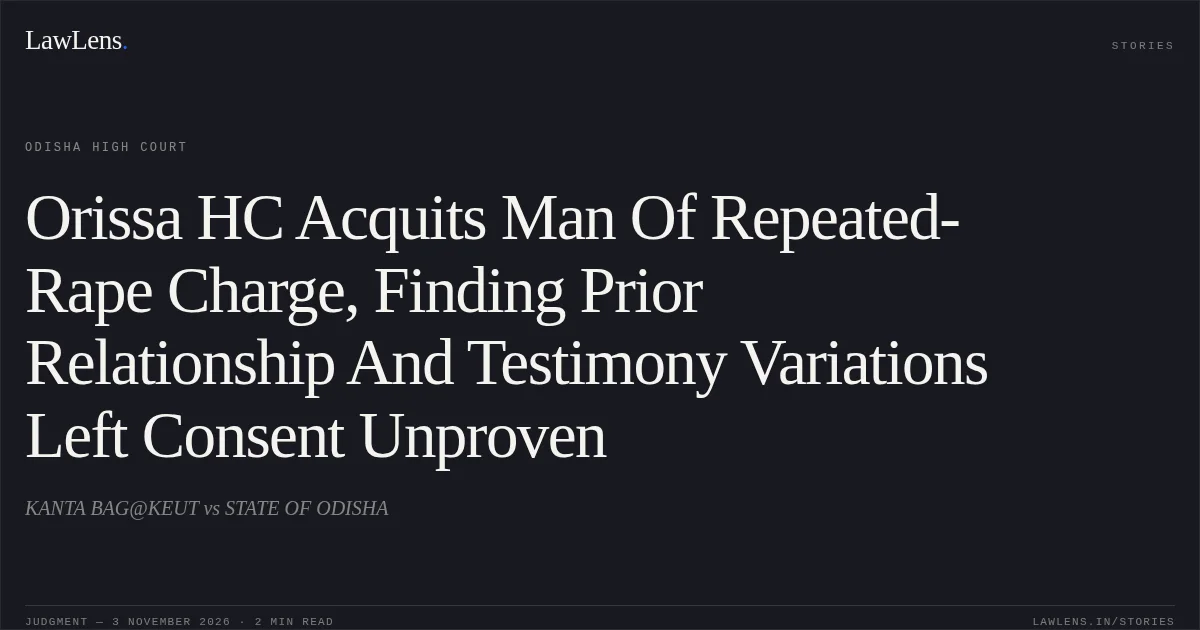
The Court held that the prosecution had not proved beyond reasonable doubt that the relationship was without the victim’s consent.
¶ 27–30It allowed the appeal, set aside the conviction and sentence under Section 376(2)(n) IPC, and acquitted the appellant.
¶ 27–30As he was in custody, the Court directed his release upon communication of the judgment.
¶ 27–30Original Court PDF
KANTA BAG@KEUTvsSTATE OF ODISHA
Click to open original judgment
Original judgment, available to read, download and summarize on LawLens.in