01Facts
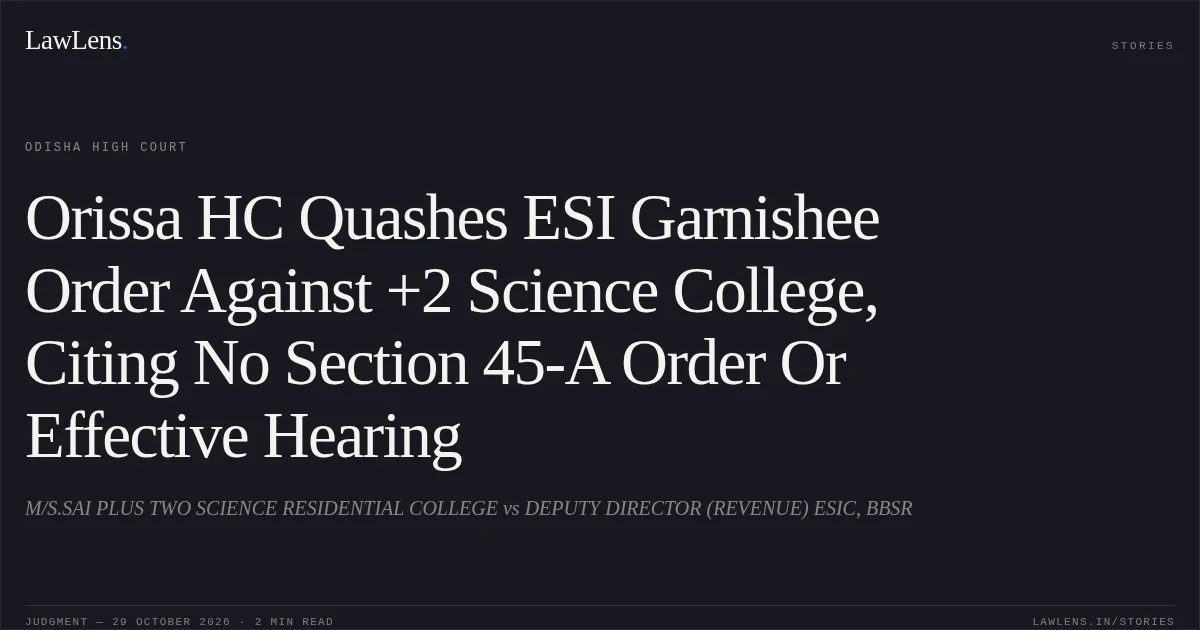
The petitioner, an educational institution, challenged a garnishee order dated 18 August 2025 issued under Section 45G of the Employees’ State Insurance Act, 1948, to recover alleged contribution arrears.
p. 1 · ¶ 1The Corporation’s notices and demands concerned contribution periods beginning in May 2013 and extending through January 2017; the petitioner disputed that it had admitted liability and contended that no order under Section 45A had been passed and no effective hearing had been afforded.
pp. 2–3 · ¶ 2–6 · pp. 4–8 · ¶ 8–18The Corporation confirmed that no Section 45A order had been passed, but argued that such an order was unnecessary and that the writ petition was barred by the alternative remedy under Section 75.
p. 4, 9 · ¶ 8, 21The petitioner invoked the High Court’s writ jurisdiction on grounds of procedural irregularity and denial of natural justice.
p. 9 · ¶ 2102Issues
i.Whether the Corporation could proceed to recover the alleged contribution arrears, including by a garnishee order under Section 45G, without passing an order under Section 45A and affording the petitioner an effective opportunity of hearing.
pp. 4, 9–10 · ¶ 8, 21, 26ii.Whether the availability of a remedy under Section 75 barred the petitioner from invoking Article 226 in the circumstances of the case.
p. 9 · ¶ 21 · pp. 11–14 · ¶ 25–2703Law Applied
Section 45A of the ESI Act was treated as requiring an adjudicatory order by the authority in the circumstances at issue, while Section 45G was the provision invoked for the garnishee recovery; Section 75 provides a statutory remedy but does not impose an absolute bar on writ jurisdiction.
p. 1, 4, 9 · ¶ 1, 8, 21Under Whirlpool Corporation v. Registrar of Trade Marks, a High Court may entertain a petition despite an alternative remedy, including where principles of natural justice have been violated or proceedings are without jurisdiction.
pp. 11–14 · ¶ 25The Court also relied on A.V. Venkateswaran v. Collector of Customs and Calcutta Discount Co. Ltd. v. ITO for the principle that the alternative-remedy rule is discretionary, and on Quinn v. Leathem for the proposition that decisions must be applied in light of their particular facts.
pp. 10–14 · ¶ 24–27Provisions in the judgment · 4
Employees Section 45GSection 45ASection 75
Income Tax Act, 1961 Section 34
04Reasoning
The Corporation expressly stated that no order under Section 45A had been passed, and the record did not demonstrate that the petitioner had received an effective hearing before recovery was pursued.
pp. 4, 9–10 · ¶ 8, 21, 26The letters relied on by the Corporation—including the petitioner’s request that the authority ascertain the actual contribution payable and its request to change its portal credentials—did not establish an admission of the assessed liability.
pp. 7–8 · ¶ 14–16, 19In those circumstances, the Court found procedural irregularity and a failure to comply with natural justice. Those defects justified entertaining the writ petition notwithstanding the Section 75 remedy.
pp. 9–10, 21, 26–2705Holding
The Court held that the impugned recovery action was procedurally irregular and could not stand in the absence of a Section 45A order and an effective opportunity of hearing.
p. 14 · ¶ 26It allowed the writ petition and set aside the orders dated 9 January 2018 and 28 May 2025, together with the garnishee order dated 18 August 2025.
p. 15 · ¶ 27Any amount appropriated from the petitioner’s bank account pursuant to those orders was directed to be restored forthwith; there was no order as to costs.
p. 15 · ¶ 27–28Original Court PDF
M/S.SAI PLUS TWO SCIENCE RESIDENTIAL COLLEGEvsDEPUTY DIRECTOR (REVENUE) ESIC, BBSR
Click to open original judgment
Original judgment, available to read, download and summarize on LawLens.in