01Facts
Chandri Sagaria died when the auto-rickshaw in which she was travelling was involved in a collision with a trolley auto on 9 January 2017.
p. 1The claimants, her dependants, sought compensation under Section 166 of the Motor Vehicles Act, 1988.
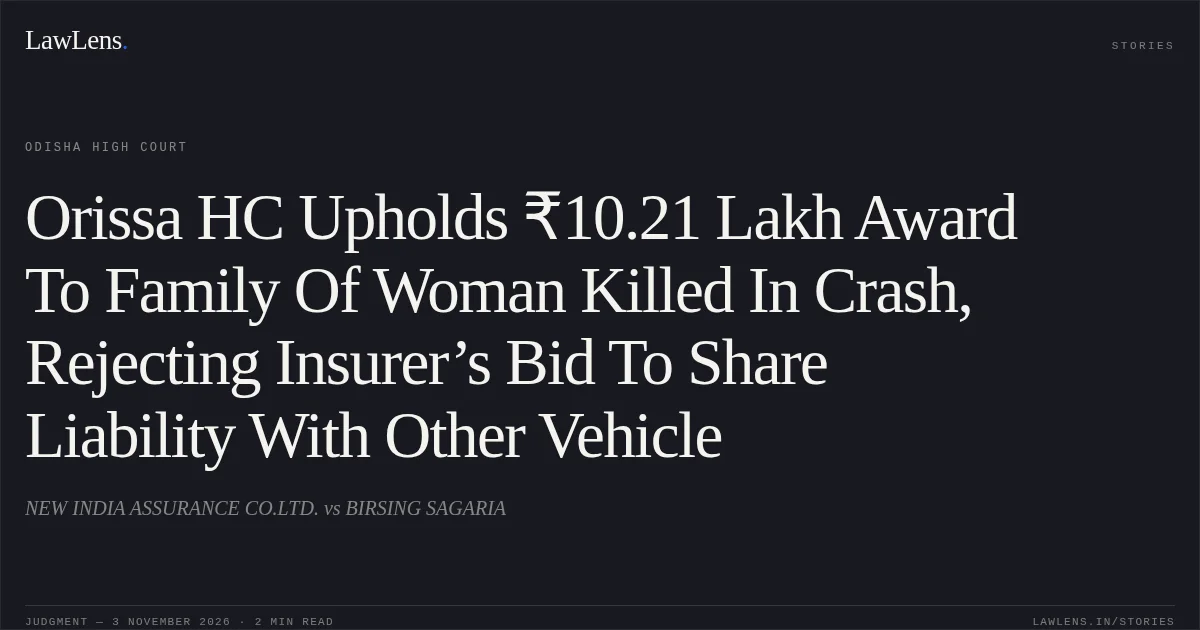
p. 1The Motor Accident Claims Tribunal awarded Rs.10,21,000 with interest at 7% per annum from 21 June 2017, holding the trolley auto’s driver responsible.
p. 1The insurer appealed, principally arguing that liability should be apportioned between the two vehicles on account of composite negligence.
pp. 1–3The Tribunal had also granted the insurer a right to recover from the vehicle owner on the ground that the offending vehicle lacked a valid route permit.
p. 702Issues
i.1. Whether the insurer of the trolley auto could avoid or reduce its liability to the claimants on the ground of composite negligence involving the auto-rickshaw in which the deceased was travelling.
pp. 4–6ii.2. Whether the Tribunal’s award required modification as to the amount of compensation, interest, or the insurer’s right of recovery against the vehicle owner.
pp. 6–803Law Applied
Section 166 of the Motor Vehicles Act, 1988 provides the basis for a claim for compensation arising from a motor-vehicle accident, while Section 173 provides for an appeal against an award.
pp. 4–5Applying Khenyei v. New India Assurance Co. Ltd., (2015) 9 SCC 273, the Court stated that in a case of composite negligence, the claimant may recover the entire compensation from any one of the joint tortfeasors; apportionment between tortfeasors is not permissible against the claimant.
pp. 4–5Where all joint tortfeasors are parties and the evidence permits, their inter se shares may be determined for recovery between them.
pp. 4–5The Court also referred to Sarla Verma v. Delhi Transport Corporation, 2009 ACJ 1298, in connection with the multiplier used to calculate loss of dependency.
p. 7Provisions in the judgment · 2 · Linked ones open on LawLens
Motor Vehicles Act, 1988 Section 173Section 166
04Reasoning
The deceased was a passenger and was not found to have contributed to the accident.
pp. 5–6The insurer’s request to divide liability between the two vehicles therefore did not defeat the claimants’ right to recover the full award from the insurer of the offending trolley auto.
pp. 5–6The claimants’ decision not to proceed against the auto-rickshaw did not require the Tribunal to shift or apportion liability against them.
pp. 5–6The Court left undisturbed the insurer’s right of recovery arising from the route-permit breach, subject to the insurer first satisfying the award and establishing the policy breach in separate proceedings.
pp. 7–8On interest, it reduced the rate from 7% to 6% per annum; the compensation amount itself was not altered.
pp. 7–805Holding
The appeal was dismissed on the composite-negligence challenge.
pp. 8–9The award was modified only as to interest: the insurer was directed to pay Rs.10,21,000 with simple interest at 6% per annum from 21 June 2017 until realization, within eight weeks.
pp. 8–9The insurer’s right to seek recovery from the vehicle owner for the route-permit breach was preserved, subject to first satisfying the award and proving the breach in separate proceedings.
pp. 8–9Original Court PDF
NEW INDIA ASSURANCE CO.LTD.vsBIRSING SAGARIA
Click to open original judgment
Original judgment, available to read, download and summarize on LawLens.in