Facts
The Appellant, a suspended director of the Corporate Debtor (CD), challenged an order dated 19.12.2025 passed by the NCLT Cuttack Bench admitting a Section 7 IBC application.
Source reference: para. 1The CD was sanctioned a loan of Rs. 7.55 Crores by DHFL (predecessor to R-1) between 2013 and 2015.
Source reference: para. 2.1Following defaults, the account was declared an NPA on 31.05.2015, and proceedings under the SARFAESI Act were initiated.
Source reference: para. 2.1The CD issued several letters in 2015 and submitted One Time Settlement (OTS) proposals on 05.01.2018, 28.09.2020, 23.07.2024, and 23.08.2024.
Source reference: paras. 2.1, 8The Section 7 application was filed on 01.03.2025.
Source reference: para. 2.1The Appellant contended that the MD was in judicial custody during the NCLT proceedings, leading to an ex-parte order in violation of natural justice, and that the claim was barred by limitation.
Source reference: para. 4Issues
Whether the Section 7 application was barred by limitation given that the first date of default was 01.12.2014 and NPA was declared on 31.05.2015.
Source reference: para. 6Whether the Adjudicating Authority violated the principles of natural justice by proceeding ex-party while the Managing Director was in judicial custody.
Source reference: para. 10Law Applied
The court primarily applied Section 7 of the Insolvency and Bankruptcy Code, 2016, regarding the initiation of CIRP by a financial creditor.
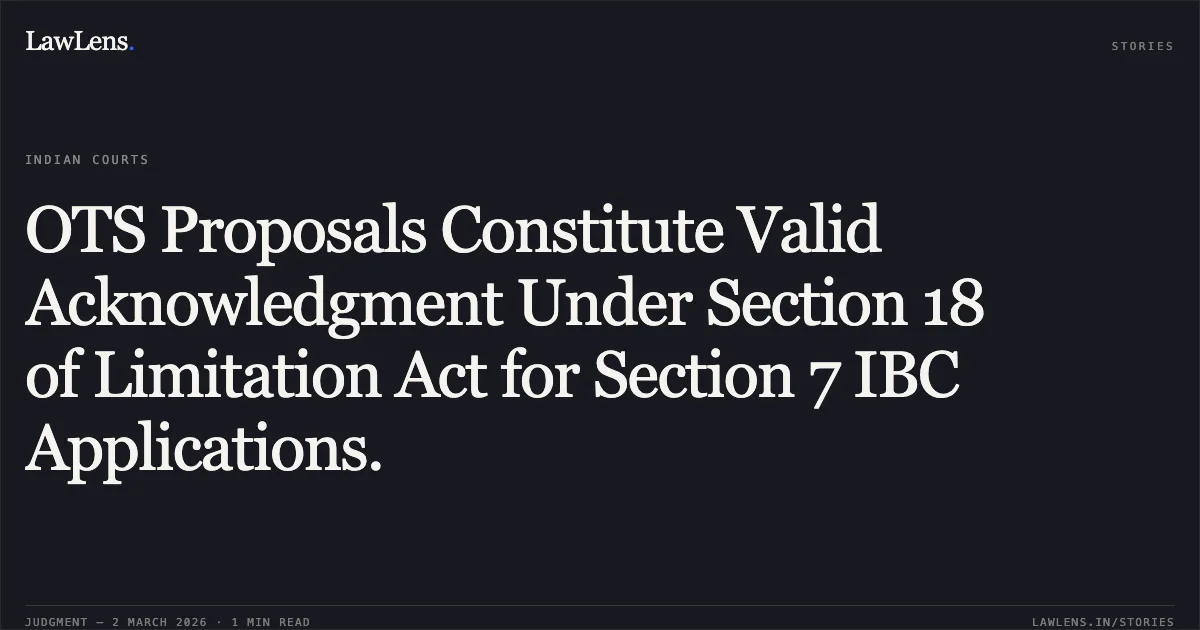
Source reference: para. 1It relied on Section 18 of the Limitation Act, 1963, which stipulates that a fresh period of limitation shall be computed from the time an acknowledgment of liability is made in writing and signed by the party against whom such right is claimed.
Source reference: paras. 8-9Furthermore, the court applied the principles of the Suo Moto Writ Petition No. 3 of 2020 by the Hon’ble Supreme Court, which extended limitation periods due to the COVID-19 pandemic.
Source reference: para. 8Reasoning
The Tribunal rejected the limitation argument, noting that although the initial default occurred in 2014, the CD made continuous written acknowledgments via a letter dated 02.11.2015 agreeing to pay arrears and subsequent OTS proposals in 2018, 2020, and 2024.
Source reference: paras. 6, 9Under Section 18 of the Limitation Act, each acknowledgment reset the three-year clock; specifically, the 2024 OTS proposal extended the limitation to 2027.
Source reference: para. 8The Tribunal also took judicial notice of the Financial Creditor’s own CIRP (2019–2021) and the Supreme Court’s Suo Moto extension, which protected the claim.
Source reference: para. 8On natural justice, the Tribunal observed that despite the MD's custody, counsel for the CD had appeared on 22.08.2025 and 16.09.2025 but failed to file a reply despite multiple opportunities.
Source reference: paras. 10-11The Tribunal reasoned that substituted service was properly effected and the CD had sufficient knowledge of the proceedings.
Source reference: para. 11Holding
The Appellate Tribunal held that the debt and default were clearly established by the loan disbursal and various OTS proposals.
The application was filed within the period of limitation due to valid acknowledgments of debt.
Source reference: para. 9The plea of violation of natural justice was dismissed as the CD was given "ample opportunity" which it failed to avail.
Source reference: para. 11The NCLAT upheld the Adjudicating Authority's order admitting the Section 7 application and dismissed the appeal.
Source reference: para. 13Original Court PDF
Durga Prasanna Mishra v. Piramal Capital & Housing Finance Ltd. & Anr. Company Appeal (AT) (Insolvency) No. 320 of 2026.
Click to open original judgment
Original judgment, available to read, download and summarize on LawLens.in