Facts
The respondent (plaintiff/owner) filed a suit for eviction against the appellant (defendant) in 2016, alleging the appellant was a trespasser in the suit property.
Source reference: para. 4, 11The appellant contended he was inducted as a tenant by one Sita Devi Kapur, who was allegedly a sub-tenant under Central Calcutta Investments Private Limited (the primary tenant recognized by the respondent).
Source reference: para. 10, 19The appellant had previously filed Title Suit No. 1829/2010 in the City Civil Court to protect his possession, which was dismissed for default in 2018.
Source reference: para. 5, 11The Trial Court (Single Judge) decreed the suit in favor of the respondent on January 25, 2023, finding that the respondent proved ownership and the appellant failed to prove a legal right to occupy.
Source reference: para. 16, 18The appellant appealed on the grounds of non-joinder of the primary tenant and his alleged status as a sub-tenant.
Source reference: para. 6-8Issues
1. Whether the respondent possessed the requisite legal status to institute the proceeding as the landlord/owner of the suit property.
Source reference: para. 172. Whether the suit was bad for non-joinder of the primary tenant (Central Calcutta Investments Private Limited) as a necessary and proper party.
Source reference: para. 6-83. Whether the appellant established a valid tenancy or sub-tenancy that protected him from eviction as a trespasser.
Source reference: para. 20-22Law Applied
The Court applied the principle that an owner can sue for possession against a trespasser without impleading the tenant, as the dispossession of a tenant constitutes dispossession of the owner, as held in Sadashiv Shyama Sawant v. Anita Anant Sawant (2010) 3 SCC 385.
Source reference: para. 13, 25The Court distinguished the precedent Hiralal Vallabhram v. Kastorbhai Lalbhai, AIR 1967 SC 1853, which requires impleading the tenant only when the owner specifically seeks to evict a sub-tenant through the tenant.
Source reference: para. 8, 24Additionally, the Court referred to Section 26 of the West Bengal Premises Tenancy Act, 1997, which mandates that a sub-tenant must give notice of their sub-tenancy to the landlord within two years of the Act's commencement to gain legal protection.
Source reference: para. 14Reasoning
The Court analyzed that while the respondent admitted Central Calcutta Investments Private Limited was a tenant in previous pleadings ("Exhibit-D"), the appellant failed to provide any documentary evidence to prove his own status as a sub-tenant under Sita Devi Kapur.
Source reference: para. 21-22The Court found that rent receipts issued by a Court-appointed Receiver did not create a tenancy, especially as they contained a disclaimer that no rights were created.
Source reference: para. 23Applying Sadashiv Shyama Sawant, the Court reasoned that the respondent, as the established owner ("Exhibit-A"), had the legal standing to evict a trespasser directly without joining the primary tenant.
Source reference: para. 18, 25-26Furthermore, the appellant's failure to comply with the mandatory notice requirements for sub-tenants under Section 26 of the West Bengal Premises Tenancy Act, 1997, stripped him of any potential statutory protection.
Source reference: para. 14Holding
The Court answered the issues in favor of the respondent, holding that the respondent had the legal status to sue and that the appellant was a trespasser.
It held that the primary tenant was not a necessary party in a suit against a trespasser.
Source reference: para. 25The appeal (APD/7/2023) was dismissed, the judgment and decree of the Trial Judge dated January 25, 2023, were upheld, and the prayer for a stay on the decree was refused.
Source reference: para. 27-29Acts & Sections Cited
1 provisions across 1 statute referred to in this judgment. Each provision opens on LawLens.
West Bengal Premises Tenancy Act, 19971
Original Court PDF
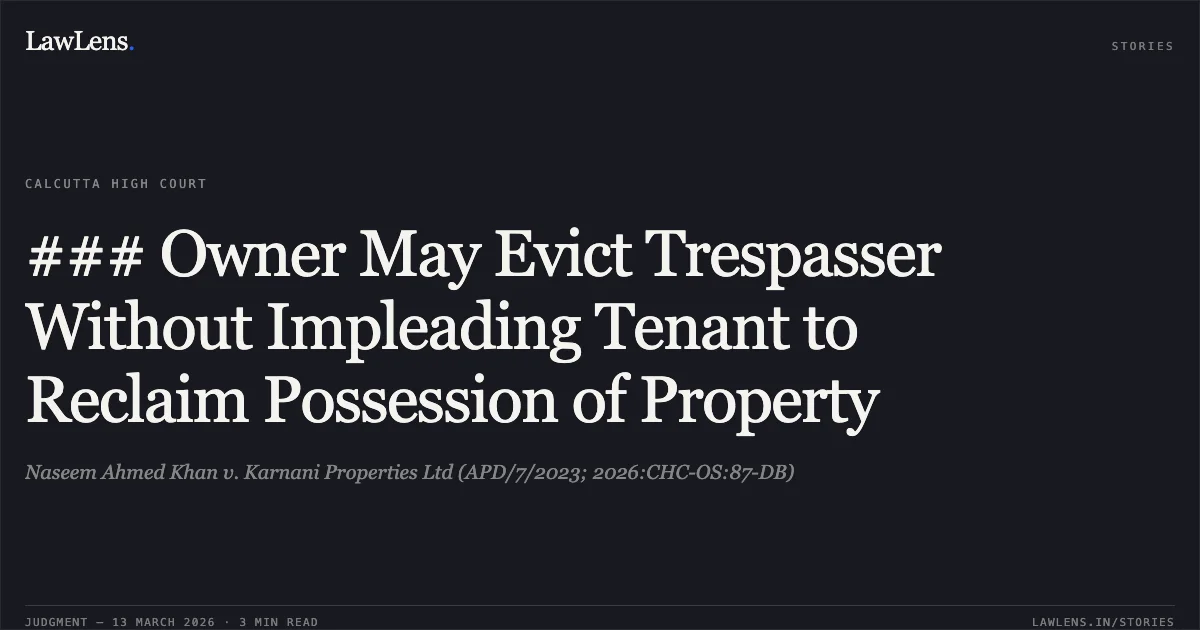
Naseem Ahmed Khan v. Karnani Properties Ltd (APD/7/2023; 2026:CHC-OS:87-DB)
Click to open original judgment
Original judgment, available to read, download and summarize on LawLens.in