Facts
The petitioners, legal heirs of the owners of a property comprising residential and non-residential portions, filed ten eviction petitions alleging wilful default and denial of title.
Source reference: paras. 4–7, pp. 12–14The tenants disputed any landlord–tenant relationship and asserted that the petitioners had not let the premises to them.
Source reference: paras. 4–7, pp. 12–14The Rent Controller ordered eviction, relying principally on oral evidence and a “balance of probabilities,” while the Rent Control Appellate Authority reversed those orders, finding that the petitioners had established ownership but not the landlord–tenant relationship.
Source reference: paras. 8–9, p. 15The petitioners challenged the appellate orders under Section 25 of the Tamil Nadu Buildings (Lease and Rent Control) Act, 1961.
Source reference: para. 1, p. 12Issues
1. Whether the Rent Control Appellate Authority erred in finding that the petitioners had failed to establish a landlord–tenant relationship with the respondents.
Source reference: paras. 16, 39–45, pp. 16, 29–342. Whether the appellate findings disclosed an error of law or perversity warranting interference under the High Court’s revisional jurisdiction under Section 25 of the Act.
Source reference: paras. 10–11, 16, 47, pp. 16–17, 34Law Applied
Section 25 of the Tamil Nadu Buildings (Lease and Rent Control) Act, 1961 confers revisional jurisdiction to examine the legality, correctness, propriety and regularity of the impugned order; it does not permit the High Court to act as a first appellate court or routinely reappreciate evidence.
Source reference: paras. 10–15, pp. 16–17Interference may be justified where findings are perverse, unsupported by evidence, reached without considering material evidence, or affected by an error of law.
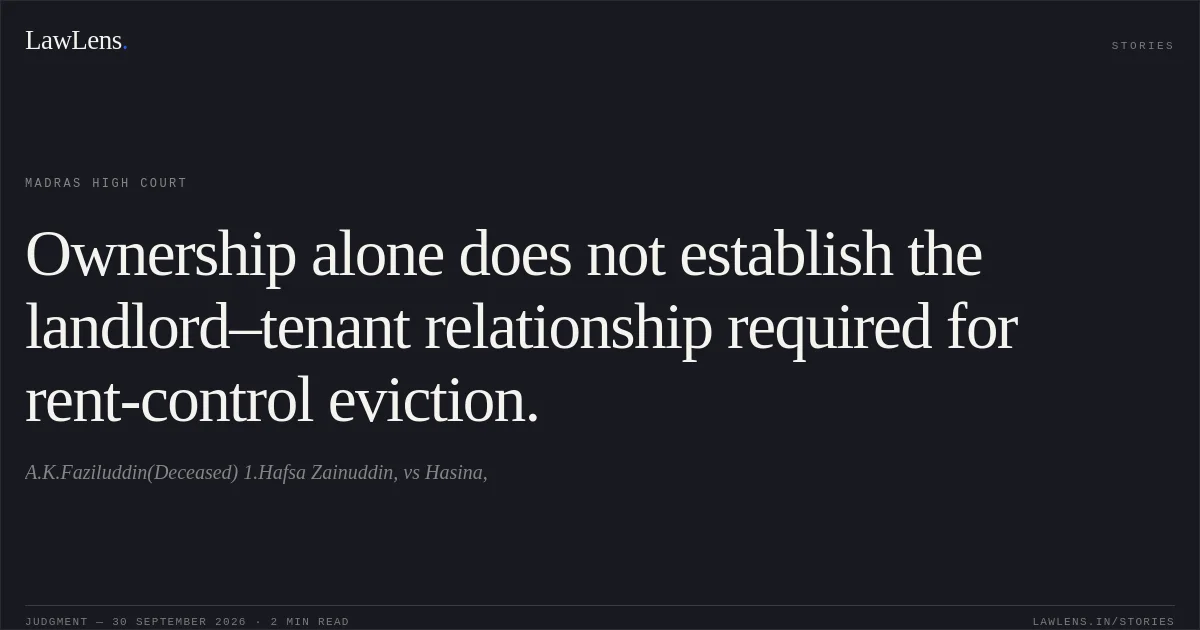
Source reference: paras. 10–15, pp. 16–17The landlord bears the burden of proving the jural relationship, particularly where it is specifically disputed; ownership alone does not establish that relationship, and the Rent Controller cannot proceed to determine eviction grounds unless the jurisdictional relationship is established.
Source reference: paras. 40–45, pp. 29–34The Court also referred to the Supreme Court’s decisions on the limits of rent-control revisional jurisdiction: Ramdoss v. K. Thangavelu, (2000) 2 SCC 135; V.M. Mohan v. Prabha Rajan Dwarka, (2006) 9 SCC 606; Rukminiamma Saradamma v. Kallyani Sulochana, (1993) 1 SCC 499; and Hindustan Petroleum Corporation Ltd. v. Dilbahar Singh, (2014) 9 SCC 78.
Source reference: paras. 12–15, p. 17Reasoning
The appellate authority had examined the evidence and given reasons for concluding that the documents relied on—where produced, including rental receipts, agreements, a memorandum of understanding and notices—did not reliably establish the tenancy; some documents had also been introduced without corresponding pleadings.
Source reference: paras. 17–38, pp. 18–28; para. 46, p. 34The Rent Controller’s reliance on a general “balance of probabilities” did not cure the failure to prove the essential landlord–tenant relationship, which was not a matter to be presumed from ownership.
Source reference: paras. 39–40, p. 29As the appellate findings were reasoned and supported by its assessment of the evidence, the High Court found no perversity or legal error warranting revision.
Source reference: paras. 45–47, pp. 33–34Holding
The Court answered the issues against the petitioners and dismissed all ten civil revision petitions, upholding the Rent Control Appellate Authority’s orders setting aside the eviction orders.
It left the petitioners at liberty to pursue their remedies before the competent civil court; there was no order as to costs.
Source reference: para. 48, p. 35Acts & Sections Cited
2 provisions across 2 statutes referred to in this judgment. Linked provisions open on LawLens.
Tamil Nadu Buildings (Lease and Rent Control) Act, 19611
Tamil Nadu Buildings (Lease and Rent Control) Act, 19601
Original Court PDF
A.K.Faziluddin(Deceased) 1.Hafsa Zainuddin,vsHasina,
Click to open original judgment
Original judgment, available to read, download and summarize on LawLens.in