Facts
The applicants (legal heirs of the original tenant) challenged a concurrent eviction decree passed by the Trial Court (17.02.1998) and the District Court, Navsari (09.12.2004) under the Bombay Rent Act.
Source reference: p. 1-2The landlord sought eviction from a 100 sq. ft. rented room and kitchen on the grounds that the tenant had acquired suitable alternative accommodation.
Source reference: p. 2Evidence showed the tenant owned two properties: a flat at Vaibhav Apartments (825 sq. ft.) and a multi-story building at Vishnu Nivas (450 sq. ft.).
Source reference: p. 2, 7The tenant contended the flat was occupied by her son due to strained relations and the other property was used for a lodging business, though no evidence supported these claims.
Source reference: p. 3, 6Issues
1. Whether the tenant had acquired suitable and alternate residential accommodation within the meaning of Section 13(1)(l) of the Bombay Rent Act.
Source reference: p. 2 / para. 32. Whether the findings of the lower courts regarding the suitability and acquisition of premises were perverse or legally erroneous so as to warrant interference in revisional jurisdiction.
Source reference: p. 3 / para. 5Law Applied
The court applied Section 13(1)(l) of the Bombay Rents, Hotel and Lodging House Rates Control Act, 1947, which permits eviction if the tenant has built, acquired, or been allotted suitable residence.
Source reference: p. 7It relied on the Constitutional Bench decision in Hindustan Petroleum Corporation Limited v. Dilbahar Singh (2014), which restricts the High Court’s revisional power under Section 29(2) of the Act to checking the "legality, propriety, or correctness" of an order rather than re-appreciating evidence as a court of first appeal.
Source reference: p. 8-9It further distinguished Harish Veljibhai Joshi v. Jitendra Veljibhai Joshi (2003) and Anandi D. Jadhav v. Nirmala Ramchandra Kore (2000), noting that acquisition of property by a spouse or son does not constitute acquisition by the tenant unless the tenant has a legal right to that property.
Source reference: p. 9-10Reasoning
The Court observed that the acquisition and ownership of the two alternative properties by the tenant and her late husband (of whom she became absolute owner) were undisputed facts.
Source reference: p. 5, 10The Court found that the Vaibhav Apartment flat was five times larger than the rented premises and equipped with better amenities.
Source reference: p. 6Applying the Dilbahar Singh principle, the Court held that since the lower courts had exhaustively analyzed the evidence—including the manipulated ration cards used to suggest family separation—the findings were not perverse.
Source reference: p. 6, 8The Court rejected the tenant’s reliance on precedents regarding property owned by family members, as here the tenant herself held absolute title to the new premises.
Source reference: p. 10Holding
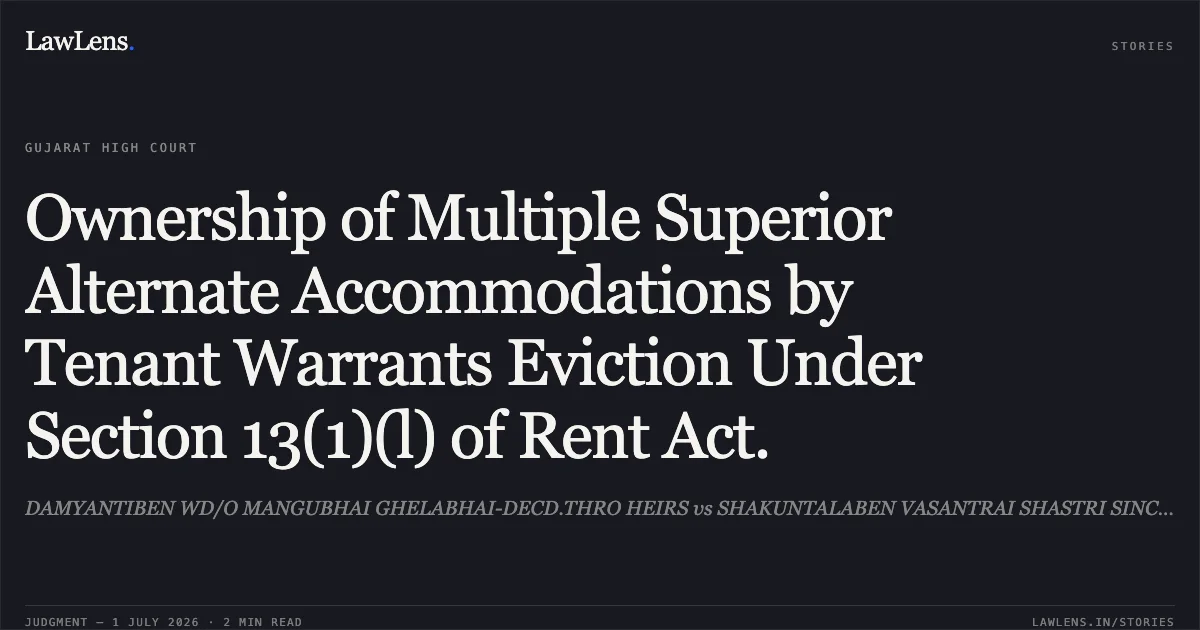
The High Court held that the tenant had acquired significantly larger and suitable alternate accommodation, satisfying the grounds for eviction under Section 13(1)(l).
Finding no procedural illegality or gross error in the lower courts' judgments, the Court dismissed the Revision Application and vacated all interim reliefs. Rule discharged.
Source reference: p. 10-11Acts & Sections Cited
2 provisions across 1 statute referred to in this judgment. Linked provisions open on LawLens.
Bombay Rents, Hotel and Lodging House Rates Control Act, 19472
Original Court PDF
DAMYANTIBEN WD/O MANGUBHAI GHELABHAI-DECD.THRO HEIRSvsSHAKUNTALABEN VASANTRAI SHASTRI SINCE DECD. THRO' HEIR
Click to open original judgment
Original judgment, available to read, download and summarize on LawLens.in