01Facts
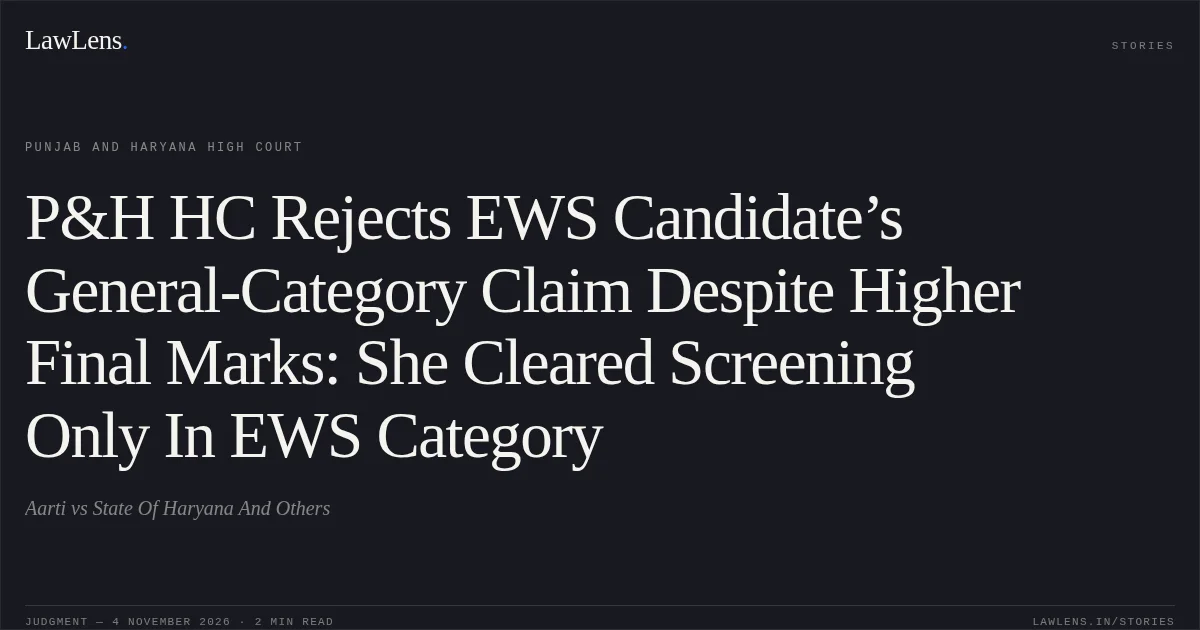
The petitioner applied for Assistant Professor (College Cadre)—History under the EWS category.
The three-stage selection comprised a screening test, a Subject Knowledge Test and an interview; only the latter two stages determined final merit.
The petitioner was shortlisted for the later stages as an EWS candidate, not against the General/Unreserved (UR) posts, and secured 51.84 final marks.
¶ 2–7, 15She challenged the result after a lower-scoring candidate was recommended against a UR post, seeking consideration against that category.
¶ 2–7, 15The High Court dismissed the petition.
¶ 18–1902Issues
i.Whether a reserved-category candidate who entered the later stages of a selection process by availing the category-specific standard at the screening stage may claim a UR post based on higher marks in the subsequent stages
¶ 7ii.Whether the screening test’s role as a gateway to later stages remains relevant to UR-category migration when its marks are excluded from final merit
¶ 4, 11, 1403Law Applied
Article 226 of the Constitution provides the basis for the petitioner’s writ challenge.
¶ 1Under Saurav Yadav v. State of Uttar Pradesh, (2021) 4 SCC 542, reserved-category candidates may be selected against open-category posts on merit, provided they have not availed a disqualifying special benefit.
¶ 8Rajasthan High Court v. Rajat Yadav, 2025 INSC 1503, recognizes that a reserved-category candidate who qualifies the screening stage on the same standard as general candidates competes for the unreserved category.
¶ 9Conversely, Union of India v. G. Kiran, 2026 INSC 15, holds that a candidate who requires a relaxed standard at a threshold examination to proceed cannot later claim selection on the general standard merely by outperforming candidates in later stages.
¶ 10This Court applied that approach in Kartik Saini v. State of Haryana, CWP No. 38944 of 2025, and Kiran Bala v. State of Haryana, CWP No. 7873 of 2026, treating a screening test as a substantive gateway even where its marks do not count toward final merit.
¶ 11–12Chaya v. State of Maharashtra, 2026 INSC 277, concerned relaxation in a separate eligibility qualification rather than a stage of the recruitment process and was distinguished.
¶ 13–1404Reasoning
The screening test was the first stage of this selection and determined which candidates could proceed to the Subject Knowledge Test; only candidates within the prescribed shortlist could advance.
¶ 14The petitioner was not among those shortlisted or retained against UR posts at that stage, but entered the later stages as an EWS candidate.
¶ 15Her higher final marks and lack of relaxation in age, experience or other eligibility conditions did not alter that fact: she had obtained access to the later stages through the EWS standard.
The nine non-General-category candidates recommended against UR posts had, unlike the petitioner, been retained against UR posts at the screening stage.
¶ 16The Court therefore held that the screening-stage benefit prevented her from claiming a UR post on the basis of later-stage marks alone.
¶ 14–1705Holding
The Court held that the Commission had correctly considered the petitioner only against the EWS category.
¶ 17–19It found no basis to disturb the result dated 16 February 2026 and dismissed the writ petition; pending miscellaneous applications were also disposed of.
¶ 17–19Original Court PDF
AartivsState Of Haryana And Others
Click to open original judgment
Original judgment, available to read, download and summarize on LawLens.in