01Facts
In a complaint under Section 138 of the Negotiable Instruments Act, 1881, the trial Court summoned Binder Singh.
p. 2 · ¶ 2After summons and warrants were returned unserved or unexecuted, the Court issued a proclamation on 18 February 2026 and, by order dated 7 October 2026, declared him a proclaimed person.
pp. 2–5, 9–10 · ¶ 2, 9–10, 16The High Court record showed that the proclamation was reported as effected on 15 April 2026, but the serving constable did not appear then; the trial Court later recorded his statement on 7 October 2026 before declaring the petitioner a proclaimed person.
pp. 2–5, 9–10 · ¶ 2, 9–10, 16The petitioner challenged that order, arguing that he had not been served and that the proclamation procedure was unlawful.
p. 2 · ¶ 302Issues
i.1. Whether the trial Court complied with the requirements of Section 82 Cr.P.C. before declaring the petitioner a proclaimed person
pp. 5–9 · ¶ 11–15ii.2. Whether the declaration was sustainable where the serving constable did not appear when the proclamation was returned as effected, and his statement was recorded only later
pp. 9–10 · ¶ 16–1703Law Applied
Section 82 Cr.P.C. permits a court, after issuing a warrant and having reason to believe that the person has absconded or is concealing himself to avoid its execution, to issue a proclamation requiring appearance at a specified place and time not less than 30 days from publication; publication must comply with the statutory modes in Section 82(2).
pp. 5–6 · ¶ 12In Sonu v. State of Haryana, 2021(1) RCR (Criminal) 319, the Court summarised that the statutory conditions for proclamation—including prior issuance of a warrant, judicial satisfaction regarding absconding or concealment, the prescribed notice period and publication procedure, and the Court’s written record of due publication—must be complied with; non-compliance with mandatory requirements invalidates the proclamation and subsequent proceedings.
pp. 6–9 · ¶ 13The Court also emphasised that the required satisfaction must be recorded because of the serious consequences for an accused.
p. 9 · ¶ 15Provisions in the judgment · 24 · Linked ones open on LawLens
Bharatiya Nagarik Suraksha Sanhita, 2023 Section 528Section 335
Negotiable Instruments Act, 1881 Section 138
Code of Criminal Procedure, 1973 Section 82Section 299
04Reasoning
The trial Court had recorded its satisfaction when issuing the proclamation, and the proclamation was reported as effected on 15 March 2026; the petitioner did not appear by the specified date.
pp. 9–10 · ¶ 16–17However, when the proclamation was returned as effected on 15 April 2026, the serving constable was absent.
p. 10 · ¶ 17The trial Court adjourned the matter and recorded the constable’s statement only on 7 October 2026, when it declared the petitioner a proclaimed person.
p. 10 · ¶ 17The High Court held that the trial Court erred by proceeding in this manner and that the impugned order was therefore unsustainable.
p. 10 · ¶ 1705Holding
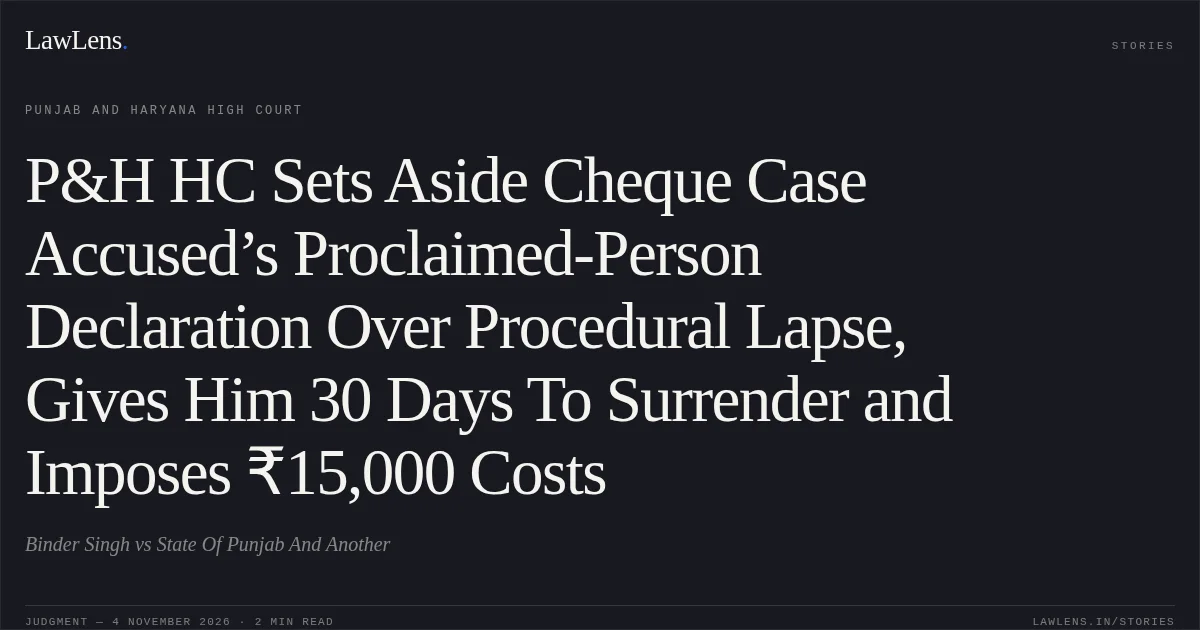
The High Court set aside the order declaring Binder Singh a proclaimed person.
pp. 10–11 · ¶ 17–19In view of his conduct, it imposed costs of ₹15,000, payable to the District Legal Services Authority, Sri Muktsar Sahib.
pp. 10–11 · ¶ 17–19The petitioner was directed to surrender within 30 days and, if he applied for bail, the trial Court was to decide the application expeditiously in accordance with law.
pp. 10–11 · ¶ 17–19If he failed to appear within that period, the petition would be deemed dismissed.
pp. 10–11 · ¶ 17–19Original Court PDF
Binder SinghvsState Of Punjab And Another
Click to open original judgment
Original judgment, available to read, download and summarize on LawLens.in