01Facts
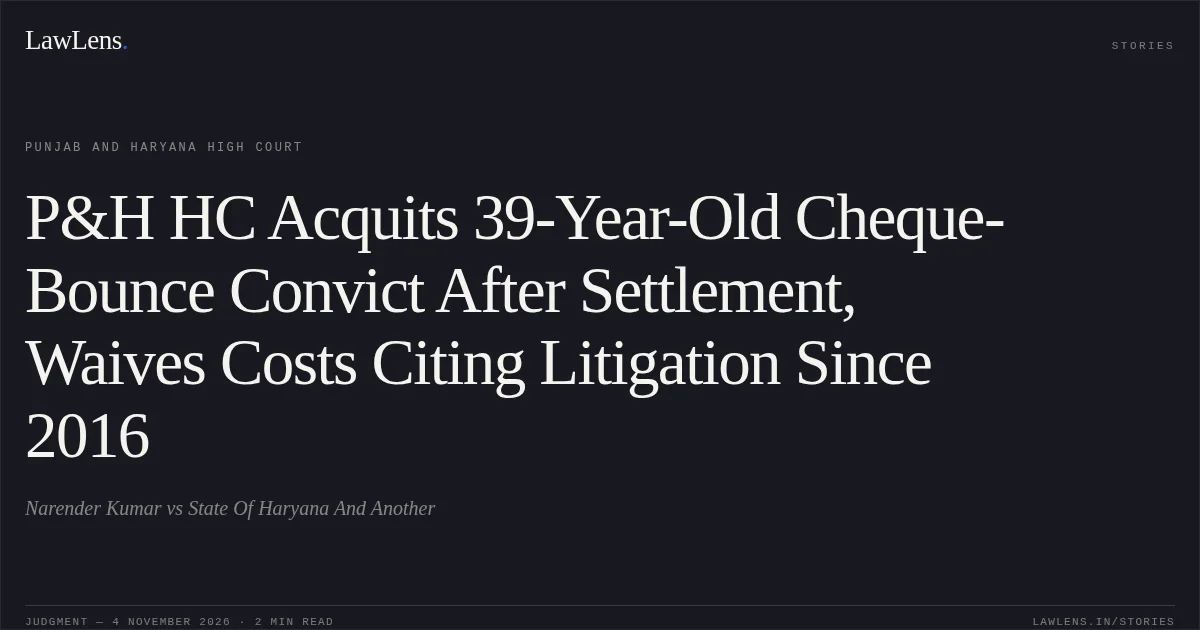
The petitioner was convicted under Section 138 of the Negotiable Instruments Act, 1881, by the Judicial Magistrate First Class, Sirsa, on 25.07.2022.
pp. 1–3The Additional Sessions Judge, Sirsa, dismissed his appeal on 10.03.2025, and this Court later dismissed his revision on merits on 25.05.2026.
pp. 1–3The petitioner then sought to set aside the conviction and appellate orders under Section 528 of the Bharatiya Nagarik Suraksha Sanhita, 2023 (BNSS), relying on a compromise dated 05.08.2026.
pp. 1–3The complainant confirmed the compromise and had no objection to compounding and acquittal; a report from the Judicial Magistrate First Class confirmed that the parties had settled
pp. 1–302Issues
i.Whether an offence under Section 138 of the Negotiable Instruments Act may be compounded, and the conviction set aside, after the accused’s appeal and revision have been decided
pp. 1–3, 6–9ii.Whether the Court should impose costs for compounding at the High Court stage or waive them in the circumstances of this case
pp. 4–803Law Applied
Section 147 of the Negotiable Instruments Act permits compounding of offences under that Act; read with Section 359 BNSS (formerly Section 320 CrPC) and the High Court’s inherent power under Section 528 BNSS, it allows compounding even after conviction and at a late stage of proceedings.
pp. 3–9Damodar S. Prabhu v. Sayed Babalal H. (2010) 5 SCC 663 established a graded-cost framework for delayed compounding and recognised that costs may be reduced for recorded reasons; Sanjabij Tari v. Kishore S. Borcar, 2025 INSC 1158, revised the costs applicable at different stages, including 7.5% of the cheque amount for compounding before a High Court in revision or appeal.
pp. 3–9M/s New Win Export v. A. Subramaniam, 2024 INSC 535, reaffirmed that courts should encourage compounding under the Act, with the compensatory aspect taking priority over the punitive aspect.
pp. 3–9The High Court may exercise Section 528 BNSS to quash a conviction following a genuine settlement where doing so does not harm public interest or the interests of justice; waiver of costs is exceptional and requires reasoned justification
pp. 3–9Provisions in the judgment · 5 · Linked ones open on LawLens
Bharatiya Nagarik Suraksha Sanhita, 2023 Section 528Section 359
Negotiable Instruments Act, 1881 Section 138Section 147
Code of Criminal Procedure, 1973 Section 320
04Reasoning
The Court found the compromise genuine: the complainant confirmed it, both parties’ statements had been recorded, and the Magistrate’s report verified the settlement.
pp. 3, 6–10Because the dispute had been amicably resolved, the Court held that further proceedings would serve no useful purpose and that Section 138 offences could be compounded even after the conviction and dismissal of the appeal.
pp. 3, 6–10Although the applicable guidelines ordinarily contemplated costs at the High Court stage, the Court waived them, citing the petitioner’s exposure to criminal litigation since about 2016 and his age of 39, which it considered sufficient in the circumstances
pp. 3, 6–1005Holding
The Court allowed the petition, set aside the Magistrate’s judgment and sentence dated 25.07.2022 and the Additional Sessions Judge’s judgment dated 10.03.2025, and acquitted the petitioner.
p. 10The parties remain bound by the compromise dated 05.08.2026; an aggrieved party may seek recall of the order for sufficient cause in the event of non-compliance.
p. 10No costs were imposed, and pending applications were disposed of
p. 10Original Court PDF
Narender KumarvsState Of Haryana And Another
Click to open original judgment
Original judgment, available to read, download and summarize on LawLens.in