01Facts
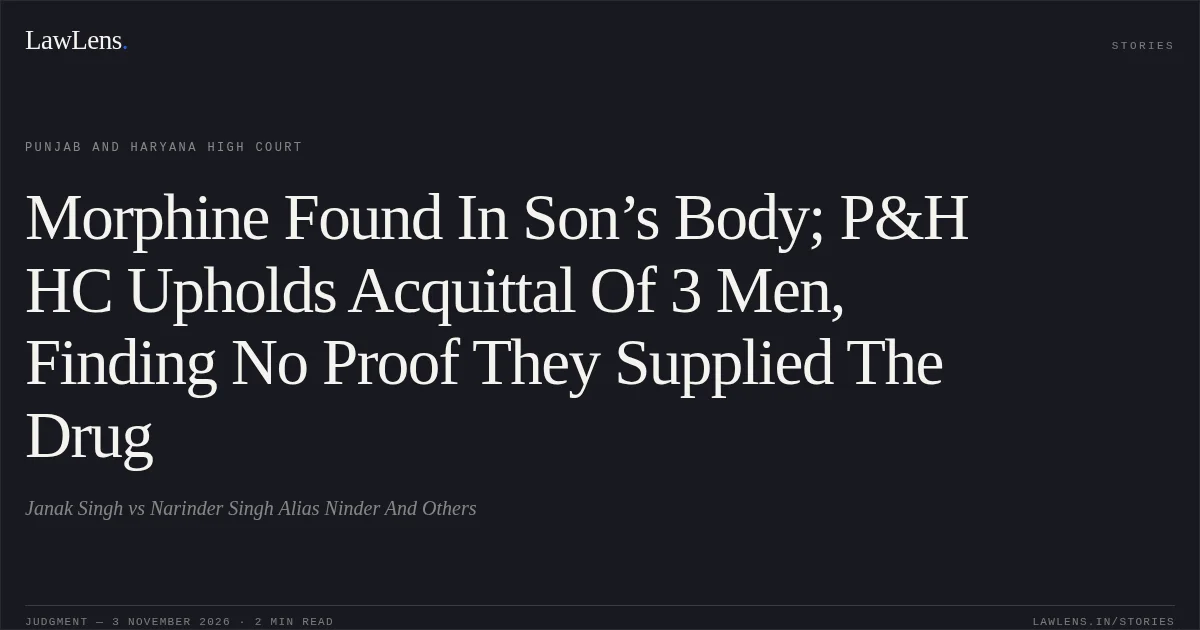
Sarpreet Singh was found unconscious near a village tomb on the morning of 3 April 2022 and was declared dead after being taken to hospital.
¶ 1–14His father, Janak Singh, alleged that respondents had administered a poisonous or intoxicating substance to him.
¶ 1–14The prosecution relied principally on evidence that Sarpreet had been seen with the respondents at the village bus stand, along with medical evidence showing morphine in his body.
¶ 1–14The trial court acquitted the respondents of charges under Sections 304 and 120-B IPC, finding the prosecution had not established their connection to the death.
¶ 20–21Janak Singh appealed against the acquittal.
¶ 20–2102Issues
i.Whether the evidence that the deceased was last seen with the respondents, considered with the medical and other evidence, proved their guilt beyond reasonable doubt
¶ 21–23, 27ii.Whether the trial court’s acquittal disclosed a basis for appellate interference
¶ 28–3003Law Applied
The respondents were charged under Sections 304 and 120-B of the Indian Penal Code.
¶ 1, 6The Court applied the rule that last-seen evidence, standing alone, may raise suspicion but is insufficient to establish guilt; it must be assessed with the entire evidentiary chain (Sahadevan v. State of Tamil Nadu, (2012) 6 SCC 403).
¶ 22–23In a circumstantial-evidence case, the circumstances must be fully established, consistent only with guilt, conclusive, exclude other reasonable hypotheses, and form a complete chain (Sharad Birdhichand Sarda v. State of Maharashtra, (1984) 4 SCC 116; Karakkattu Muhammed Basheer v. State of Kerala, (2024) 10 SCC 813).
¶ 25–26On appeal against acquittal, the appellate court may review the evidence, but the acquittal reinforces the presumption of innocence; where two reasonable views are possible, the acquittal should not be disturbed.
¶ 28Provisions in the judgment · 6 · Linked ones open on LawLens
Indian Penal Code, 1860 Section 304
Code of Criminal Procedure, 1973 Section 161Section 173Section 207Section 175Section 313
04Reasoning
The medical evidence supported the conclusion that Sarpreet had consumed an intoxicating substance and died following an overdose, but it did not establish that the respondents supplied or administered it.
¶ 24–27The prosecution produced no cogent evidence linking them to the substance or showing that it had been given forcibly.
¶ 24–27The evidence that Sarpreet was last seen with the respondents did not complete the circumstantial chain, and the medical evidence did not resolve the missing link between their presence and his death.
¶ 24–27The trial court’s conclusion that guilt had not been proved was therefore a reasonable view of the evidence.
¶ 24–2705Holding
The Court held that the prosecution had not proved the respondents’ guilt beyond reasonable doubt and found no illegality, perversity, or misappreciation of evidence warranting interference with the acquittal.
¶ 27–30The appeal was dismissed, and the trial court’s judgment dated 2 July 2025 was affirmed.
¶ 27–30Original Court PDF
Janak SinghvsNarinder Singh Alias Ninder And Others
Click to open original judgment
Original judgment, available to read, download and summarize on LawLens.in